
Pulp Fiction, 1925 · page 111 of 212
Adventure Magazine Cover, March 20, 1925 — page 111: what you’re looking at
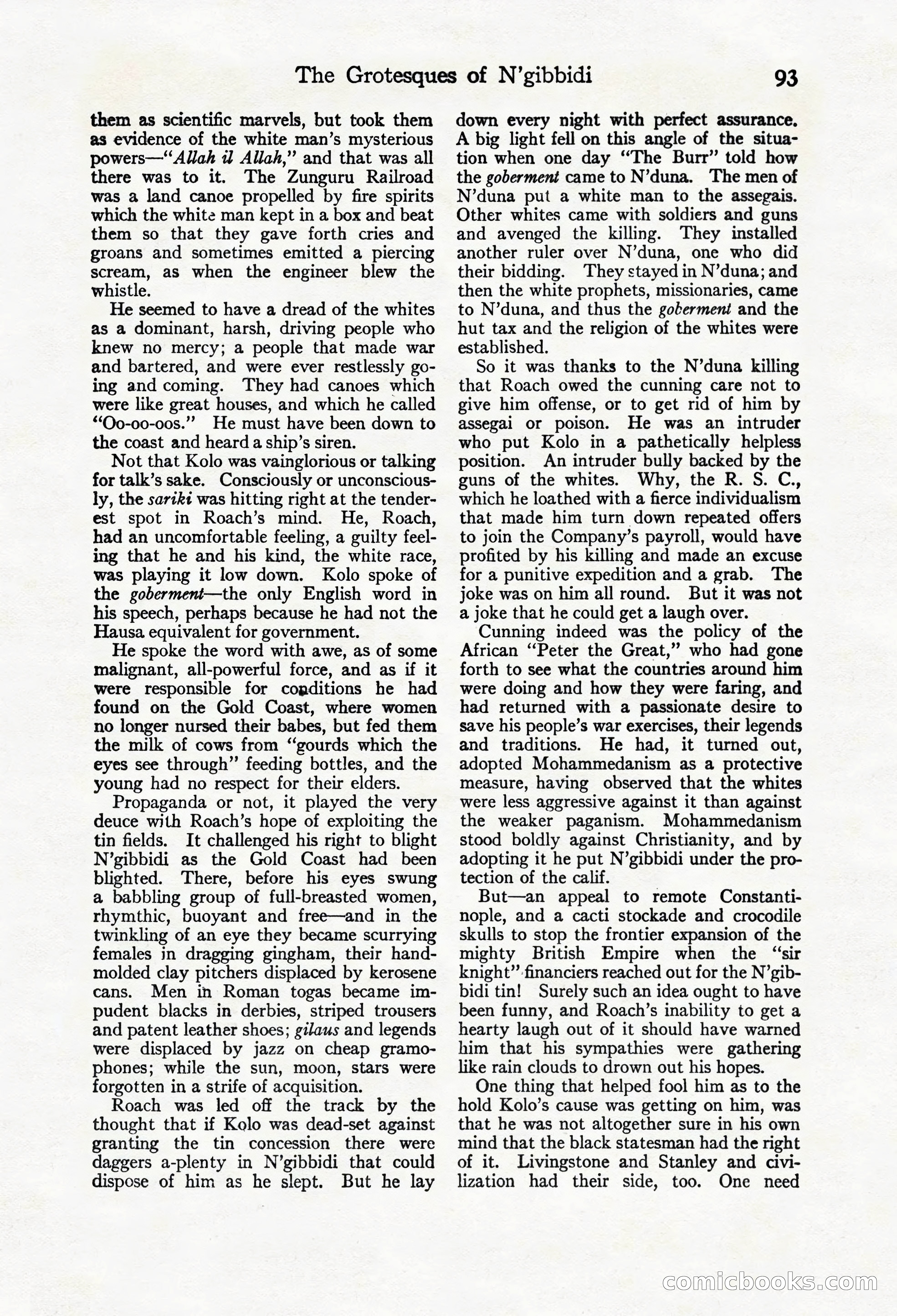
A restored page from Pulp Fiction, 1925. Page through the whole issue in the reader above.
📄 Transcribed text from this page (OCR, searchable)
Machine-transcribed from the original scan — historical spelling and the odd misread are preserved.
The Grotesques of N’gibbidi them as scientific marvels, but took them as evidence of the white man’s mysterious powers—“‘Allah tl Allah,” and that was all there was to it. The Zunguru Railroad was a land canoe propelled by fire spirits which the white man kept in a box and beat them so that they gave forth cries and groans and sometimes emitted a piercing scream, as when the engineer blew the whistle. He seemed to have a dread of the whites as a dominant, harsh, driving people who knew no mercy; a people that made war and bartered, and were ever restlessly go- ing and coming. They had canoes which were like great houses, and which he called ‘“Oo-00-00s.”” He must have been down to the coast and heard a ship’s siren. Not that Kolo was vainglorious or talking for talk’s sake. Consciously or unconscious- ly, the sarikt was hitting right at the tender- est spot in Roach’s mind. He, Roach, had an uncomfortable feeling, a guilty feel- ing that he and his kind, the white race, was playing it low down. Kolo spoke of the goberment—the only English word in his speech, perhaps because he had not the Hausa equivalent for government. He spoke the word with awe, as of some malignant, all-powerful force, and as if it were responsible for coagditions he had found on the Gold Coast, where women no longer nursed their babes, but fed them the milk of cows from “gourds which the eyes see through” feeding bottles, and the young had no respect for their elders. Propaganda or not, it played the very deuce with Roach’s hope of exploiting the tin fields. It challenged his right to blight N’gibbidi as the Gold Coast had been blighted. There, before his eyes swung a babbling group of full-breasted women, rhymthic, buoyant and free—and in the twinkling of an eye they became scurrying females in dragging gingham, their hand- molded clay pitchers displaced by kerosene cans. Men in Roman togas became im- pudent blacks in derbies, striped trousers and patent leather shoes; gzlaus and legends were displaced by jazz on cheap gramo- phones; while the sun, moon, stars were forgotten in a strife of acquisition. Roach was led off the track by the thought that if Kolo was dead-set against granting the tin concession there were daggers a-plenty in N’gibbidi that could dispose of him as he slept. But he lay 93 down every night with perfect assurance, A big light fell on this angle of the situa- tion when one day “The Burr” told how the goberment came to N’duna. The men of N’duna put a white man to the assegais. Other whites came with soldiers and guns and avenged the killing. They installed another ruler over N’duna, one who did their bidding. They stayed in N’duna; and then the white prophets, missionaries, came to N’duna, and thus the goberment and the hut tax and the religion of the whites were established. So it was thanks to the N’duna killing that Roach owed the cunning care not to give him offense, or to get rid of him by assegai or poison. He was an intruder who put Kolo in a pathetically helpless position. An intruder bully backed by the guns of the whites. Why, the R. S. C., which he loathed with a fierce individualism that made him turn down repeated offers to join the Company’s payroll, would have profited by his killing and made an excuse for a punitive expedition and a grab. The joke was on him all round. But it was not a joke that he could get a laugh over. Cunning indeed was the policy of the African ‘‘Peter the Great,’’ who had gone forth to see what the countries around him were doing and how they were faring, and had returned with a passionate desire to save his people’s war exercises, their legends and traditions. He had, it turned out, adopted Mohammedanism as a protective measure, having observed that the whites were less aggressive against it than against the weaker paganism. Mohammedanism stood boldly against Christianity, and by adopting it he put N’gibbidi under the pro- tection of the calif. But—an appeal to remote Constanti- nople, and a cacti stockade and crocodile skulls to stop the frontier expansion of the mighty British Empire when the “sir knight’’ financiers reached out for the N’gib- bidi tin! Surely such an idea ought to have been funny, and Roach’s inability to get a hearty laugh out of it should have warned him that his sympathies were gathering like rain clouds to drown out his hopes. One thing that helped fool him as to the hold Kolo’s cause was getting on him, was that he was not altogether sure in his own mind that the black statesman had the right of it. Livingstone and Stanley and civi- lization had their side, too. One need COMmMiiclooe (©