
Pulp Fiction, 1924 · page 88 of 216
Adventure Magazine, December 10, 1924 — page 88: what you’re looking at
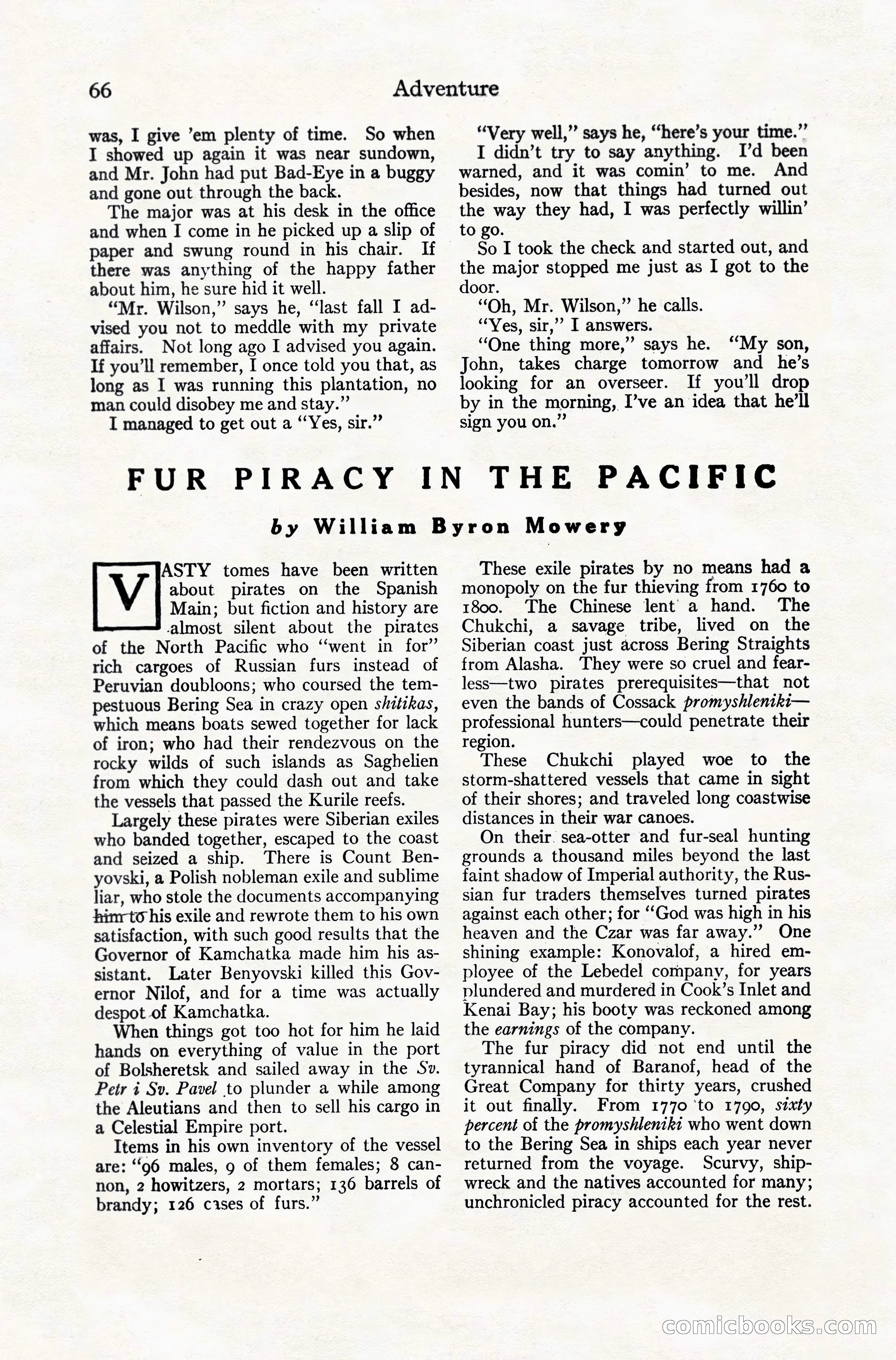
A restored page from Pulp Fiction, 1924. Page through the whole issue in the reader above.
📄 Transcribed text from this page (OCR, searchable)
Machine-transcribed from the original scan — historical spelling and the odd misread are preserved.
66 was, I give ’em plenty of time. So when I showed up again it was near sundown, and Mr. John had put Bad-Eye in a buggy and gone out through the back. The major was at his desk in the office and when I come in he picked up a slip of paper and swung round in his chair. If | there was anything of the happy father about him, he sure hid it well. “Mr. Wilson,” says he, “‘last fall I ad- vised you not to meddle with my private affairs. Not long ago I advised you again. If you’ll remember, I once told you that, as long as I was running this plantation, no man could disobey me and stay.”’ I managed to get out a “Yes, sir.”’ Adventure “Very well,” says he, “here’s your time.’’ I didn’t try to say anything. I’d been warned, and it was comin’ to me. And besides, now that things had turned out the way they had, I was perfectly willin’ to go. So I took the check and started out, and the major stopped me just as I got to the door. “Oh, Mr. Wilson,” he calls. “Yes, sir,” I answers. “One thing more,” says he. “My son, John, takes charge tomorrow and he’s looking for an overseer. If you'll drop by in the morning, I’ve an idea that he’ll sign you on.” FUR PIRACY IN THE PACIFIC by William Byron Mowery ASTY tomes have been written V about pirates on the Spanish Main; but fiction and history are almost silent about the pirates of the North Pacific who ‘‘went in for” rich cargoes of Russian furs instead of Peruvian doubloons; who coursed the tem- pestuous Bering Sea in crazy open shttikas, which means boats sewed together for lack of iron; who had their rendezvous on the rocky wilds of such islands as Saghelien from which they could dash out and take the vessels that passed the Kurile reefs. Largely these pirates were Siberian exiles who banded together, escaped to the coast and seized a ship. There is Count Ben- yovski, a Polish nobleman exile and sublime liar, who stole the documents accompanying hinrto his exile and rewrote them to his own satisfaction, with such good results that the Governor of Kamchatka made him his as- sistant. Later Benyovski killed this Gov- ernor Nilof, and for a time was actually despot of Kamchatka. When things got too hot for him he laid hands on everything of value in the port of Bolsheretsk and sailed away in the Sv. Petr i Sv. Pavel to plunder a while among the Aleutians and then to sell his cargo in a Celestial Empire port. Items in his own inventory of the vessel are: ‘96 males, 9 of them females; 8 can- non, 2 howitzers, 2 mortars; 136 barrels of brandy; 126 cases of furs.” These exile pirates by no means had a monopoly on the fur thieving from 1760 to 1800. The Chinese lent a hand. The Chukchi, a savage tribe, lived on the Siberian coast just across Bering Straights from Alasha. They were so cruel and fear- less—two pirates prerequisites—that not even the bands of Cossack promyshleniki— professional hunters—could penetrate their region. These Chukchi played woe to the storm-shattered vessels that came in sight of their shores; and traveled long coastwise distances in their war canoes. On their. sea-otter and fur-seal hunting grounds a thousand miles beyond the last faint shadow of Imperial authority, the Rus- sian fur traders themselves turned pirates against each other; for “God was high in his heaven and the Czar was far away.” One shining example: Konovalof, a hired em- ployee of the Lebedel company, for years plundered and murdered in Cook’s Inlet and Kenai Bay; his booty was reckoned among the earnings of the company. The fur piracy did not end until the tyrannical hand of Baranof, head of the Great Company for thirty years, crushed it out finally. From 1770 ‘to 1790, sixty percent of the promyshleniki who went down to the Bering Sea in ships each year never returned from the voyage. Scurvy, ship- wreck and the natives accounted for many; unchronicled piracy accounted for the rest. CoMmicbhoolkk Wh) CO 5}