
Pulp Fiction, 1924 · page 213 of 216
Adventure Magazine, December 10, 1924 — page 213: what you’re looking at
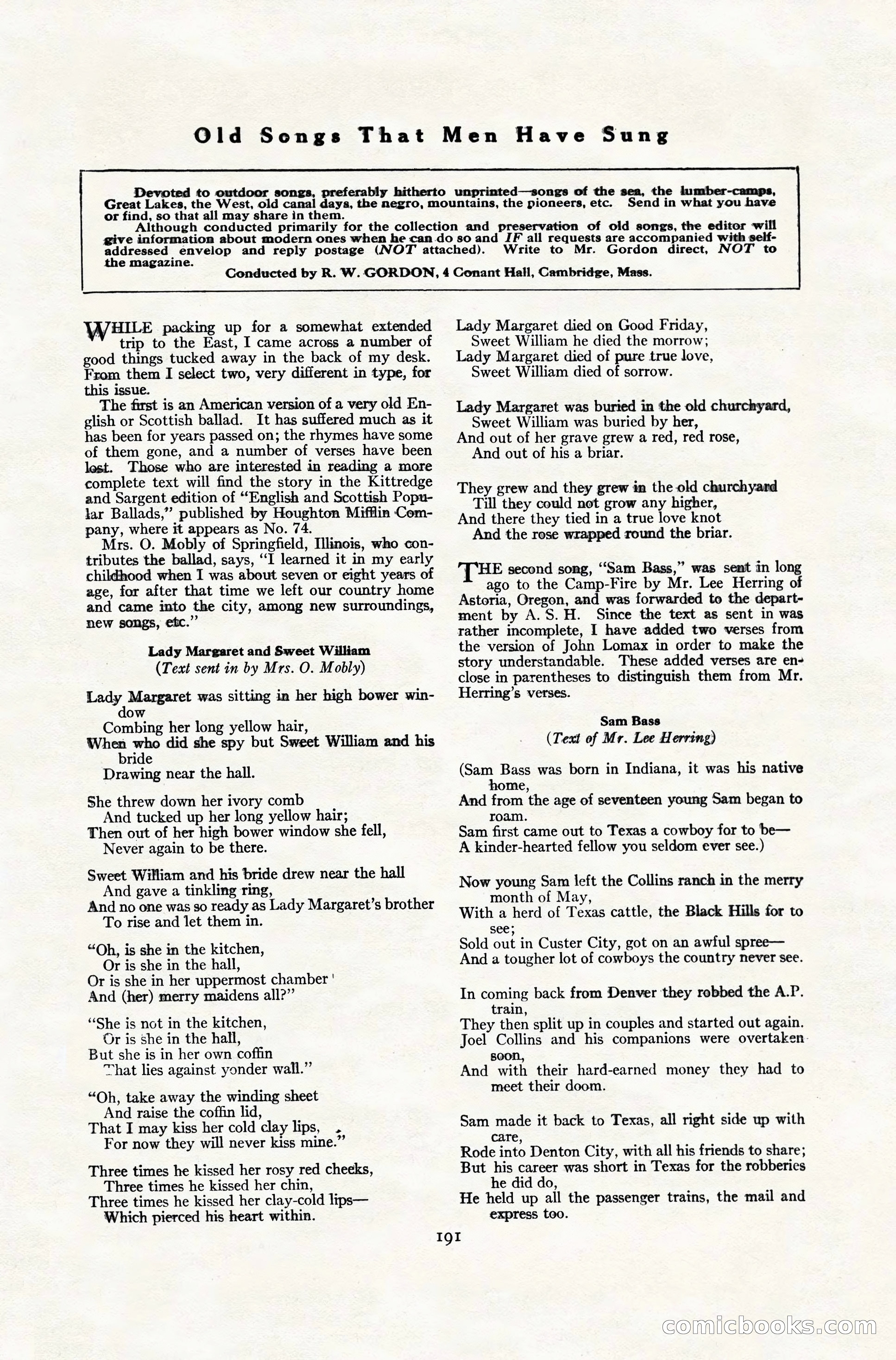
A restored page from Pulp Fiction, 1924. Page through the whole issue in the reader above.
📄 Transcribed text from this page (OCR, searchable)
Machine-transcribed from the original scan — historical spelling and the odd misread are preserved.
Old Songs That Men Have Sung Devoted to outdoor songs, preferably hitherto unprinted—songs of the sea, the iumber-camps, Send in what you have Great Lakes, the West, old canal days, the negro, mountains, the pioneers, etc. or find, so that all may share in them. Although conducted primarily for the collection and preservation of old songs, the editor will give information about modern ones when he can do so and IF all requests are accompanied with self- addressed envelop and reply postage (NOT attached). the magazine. Write to Mr. Gordon direct, NOT to Conducted by R. W. GORDON, 4 Conant Hall, Cambridge, Mass. A/HILE packing up for a somewhat extended trip to the East, I came across a number of good things tucked away in the back of my desk. From them I select two, very different in type, for this issue. The first is an American version of a very old En- glish or Scottish ballad. It has suffered much as it has been for years passed on; the rhymes have some of them gone, and a number of verses have been lest. Those who are interested in reading a more complete text will find the story in the Kittredge and Sargent edition of “English and Scottish Popu- lar Ballads,” published by Houghton Mifflin Com- pany, where it appears as No. 74. Mrs. O. Mobly of Springfield, Illinois, who con- tributes the ballad, says, ‘I learned it in my early childhood when I was about seven or eight years of age, for after that time we left our country home and came into the city, among new surroundings, new songs, etc.” Lady Margaret and Sweet William (Text sent in by Mrs. O. Mobly) Lady Margaret was sitting in her high bower win- dow Combing her long yellow hair, When who did she spy but Sweet William and his bride Drawing near the hall. She threw down her ivory comb And tucked up her long yellow hair; Then out of her high bower window she fell, Never again to be there. Sweet William and his bride drew near the hall And gave a tinkling ring, And no one was so ready as Lady Margaret’s brother To rise and let them in. “Oh, is she in the kitchen, Or is she in the hall, Or is she in her uppermost chamber ' And (her) merry maidens all?” “She is not in the kitchen, Or is she in the hall, But she is in her own coffin ™hat lies against yonder wall.” “Oh, take away the winding sheet And raise the coffin lid, That I may kiss her cold clay lips, . For now they will never kiss mine.” Three times he kissed her rosy red cheeks, Three times he kissed her chin, Three times he kissed her clay-cold lips— Which pierced his heart within. Lady Margaret died on Good Friday, Sweet William he died the morrow; Lady Margaret died of pure true love, Sweet William died of sorrow. Lady Margaret was buried in the old churchyard, Sweet William was buried by her, And out of her grave grew a red, red rose, And out of his a briar. They grew and they grew in the old churchyard Till they could not grow any higher, And there they tied in a true love knot And the rose wrapped round the briar. THE second song, “Sam Bass,” was sent in long ago to the Camp-Fire by Mr. Lee Herring of Astoria, Oregon, and was forwarded to the depart- ment by A.S.H. Since the text as sent in was rather incomplete, I have added two verses from the version of John Lomax in order to make the story understandable. These added verses are en- close in parentheses to distinguish them from Mr. Herring’s verses. Sam Bass (Text of Mr. Lee Herring) (Sam Bass was born in Indiana, it was his native home, And from the age of seventeen young Sam began to roam. Sam first came out to Texas a cowboy for to be— A kinder-hearted fellow you seldom ever see.) Now young Sam left the Collins ranch in the merry month of May, With a herd of Texas cattle, the Black Hills for to see; Sold out in Custer City, got on an awful spree— And a tougher lot of cowboys the country never see. In coming back from Denver they robbed the A.P. train, They then split up in couples and started out again. Joel Collins and his companions were overtaken. soon, And with their hard-earned money they had to meet their doom. Sam made it back to Texas, all right side up with care, Rode into Denton City, with all his friends to share; But his career was short in Texas for the robberies he did do, He held up all the passenger trains, the mail and express too. IQI CoOMmicloo 5}