
Pulp Fiction, 1924 · page 211 of 216
Adventure Magazine, December 10, 1924 — page 211: what you’re looking at
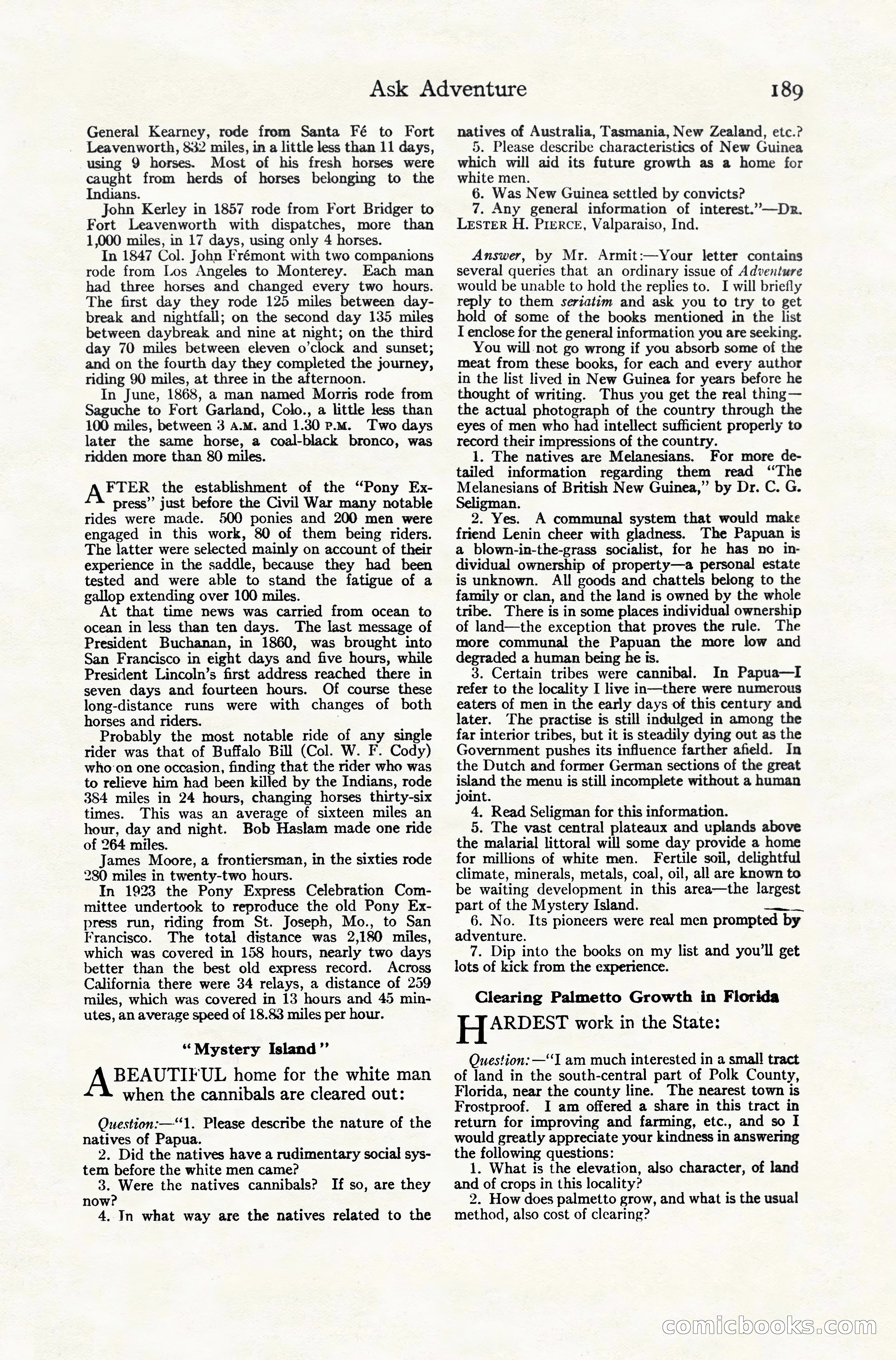
A restored page from Pulp Fiction, 1924. Page through the whole issue in the reader above.
📄 Transcribed text from this page (OCR, searchable)
Machine-transcribed from the original scan — historical spelling and the odd misread are preserved.
Ask Adventure General Kearney, rode from Santa Fé to Fort Leavenworth, 832 miles, in a little less than 11 days, using 9 horses. Most of his fresh horses were caught from herds of horses belonging to the Indians. John Kerley in 1857 rode from Fort Bridger to Fort Leavenworth with dispatches, more than 1,000 miles, in 17 days, using only 4 horses. In 1847 Col. John Frémont with two companions rode from Los Angeles to Monterey. Each man had three horses and changed every two hours. The first day they rode 125 miles between day- break and nightfall; on the second day 135 miles between daybreak and nine at night; on the third day 70 miles between eleven o’clock and sunset; and on the fourth day they completed the journey, riding 90 miles, at three in the afternoon. In June, 1868, a man named Morris rode from Saguche to Fort Garland, Colo., a little less than 100 miles, between 3 A.M. and 1.30 p.m. Two days later the same horse, a coal-black bronco, was ridden more than 80 miles. AFTER the establishment of the “Pony Ex- press” just before the Civil War many notable rides were made. 500 ponies and 200 men were engaged in this work, 80 of them being riders. The latter were selected mainly on account of their experience in the saddle, because they had been tested and were able to stand the fatigue of a gallop extending over 100 miles. At that time news was carried from ocean to ocean in less than ten days. The last message of President Buchanan, in 1860, was brought into San Francisco in eight days and five hours, while President Lincoln’s first address reached there in seven days and fourteen hours. Of course these long-distance runs were with changes of both horses and riders. 7 Probably the most notable ride of any single rider was that of Buffalo Bill (Col. W. F. Cody) who ‘on one occasion, finding that the nder who was to relieve him had been killed by the Indians, rode 384 miles in 24 hours, changing horses thirty-six times. This was an average of sixteen miles an hour, day and night. Bob Haslam made one ride of 264 miles. James Moore, a frontiersman, in the sixties rode 280 miles in twenty-two hours. In 1923 the Pony Express Celebration Com- mittee undertook to reproduce the old Pony Ex- press run, riding from St. Joseph, Mo., to San Francisco. The total distance was 2,180 miles, which was covered in 158 hours, nearly two days better than the best old express record. Across California there were 34 relays, a distance of 259 miles, which was covered in 13 hours and 45 min- utes, an average speed of 18.83 miles per hour. “Mystery Island’’ BEAUTIFUL home for the white man when the cannibals are cleared out: Question: —“‘1. Please describe the nature of the natives of Papua. 2. Did the natives have a rudimentary social sys- tem before the white men came? 3. Were the natives cannibals? If so, are they now? 4. In what way are the natives related to the 189 natives of Australia, Tasmania, New Zealand, etc.? 5. Please describe characteristics of New Guinea which will aid its future growth as a home for white men. 6. Was New Guinea settled by convicts? 7. Any general information of interest.””—Dr. LrsTER H. Pierce, Valparaiso, Ind. Answer, by Mr. Armit:—Your letter contains several queries that an ordinary issue of Adventure would be unable to hold the replies to. I will briefly reply to them seriatim and ask you to try to get hold of some of the books mentioned in the list T enclose for the general information you are seeking. You will not go wrong if you absorb some of the meat from these books, for each and every author in the list lived in New Guinea for years before he thought of writing. Thus you get the real thing— the actual photograph of the country through the eyes of men who had intellect sufficient properly to record their impressions of the country. 1. The natives are Melanesians. For more de- tailed information regarding them read “The Melanesians of British New Guinea,” by Dr. C. G. Seligman. 2. Yes. A communal system that would make friend Lenin cheer with gladness. The Papuan is a blown-in-the-grass socialist, for he has no in- dividual ownership of property—a personal estate is unknown. All goods and chattels belong to the family or clan, and the land is owned by the whole tribe. There is in some places individual ownership of land—the exception that proves the rule. The more communal the Papuan the more low and degraded a human being he is. 3. Certain tribes were cannibal. In Papua—I refer to the locality I live in—there were numerous eaters of men in the early days of this century and later. The practise is still indulged in among the far interior tribes, but it is steadily dying out as the Government pushes its influence farther afield. In the Dutch and former German sections of the great island the menu is still incomplete without a human joint. 4. Read Seligman for this information. 5. The vast central plateaux and uplands above the malarial littoral will some day provide a home for millions of white men. Fertile soil, delightful climate, minerals, metals, coal, oil, all are known to be waiting development in this area—the largest part of the Mystery Island. So 6. No. Its pioneers were real men prompted by adventure. 7. Dip into the books on my list and you'll get lots of kick from the experience. Clearing Palmetto Growth in Florida jg eee work in the State: Question: —“I am much interested in a small tract of land in the south-central part of Polk County, Florida, near the county line. The nearest town is Frostproof. I am offered a share in this tract in return for improving and farming, etc., and so I would greatly appreciate your kindness in answering the following questions: 1. What is the elevation, also character, of land and of crops in this locality? 2. How does palmetto grow, and what is the usual method, also cost of clearing? CoOMmiclhoo 5}