
Pulp Fiction, 1924 · page 209 of 216
Adventure Magazine, December 10, 1924 — page 209: what you’re looking at
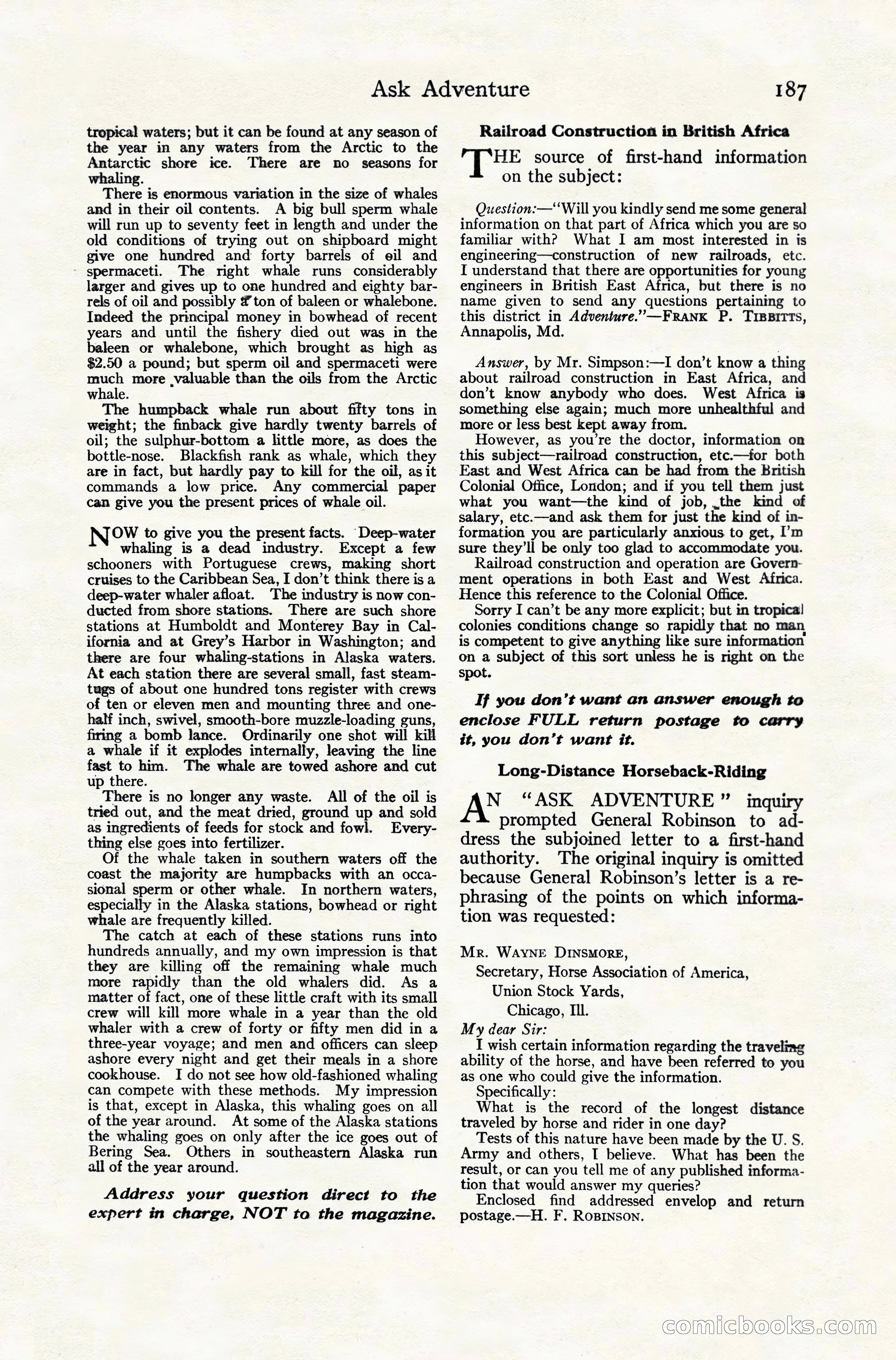
A restored page from Pulp Fiction, 1924. Page through the whole issue in the reader above.
📄 Transcribed text from this page (OCR, searchable)
Machine-transcribed from the original scan — historical spelling and the odd misread are preserved.
Ask Adventure tropical waters; but it can be found at any season of the year in any waters from the Arctic to the Antarctic shore ice. There are no seasons for whaling. There is enormous variation in the size of whales and in their oil contents. A big bull sperm whale will run up to seventy feet in length and under the old conditions of trying out on shipboard might give one hundred and forty barrels of eil and - gpermaceti. The right whale runs considerably larger and gives up to one hundred and eighty bar- rels of oil and possibly # ton of baleen or whalebone. Indeed the principal money in bowhead of recent years and until the fishery died out was in the baleen or whalebone, which brought as high as $2.50 a pound; but sperm oil and spermaceti were much more valuable than the oils from the Arctic whale. The humpback whale run about fifty tons in weight; the finback give hardly twenty barrels of oil; the sulphur-bottom a little more, as does the bottle-nose. Blackfish rank as whale, which they are in fact, but hardly pay to kill for the oil, as it commands a low price. Any commercial paper can give you the present prices of whale oil. Now to give you the present facts. Deep-water whaling is a dead industry. Except a few schooners with Portuguese crews, making short cruises to the Caribbean Sea, I don’t think there is a deep-water whaler afloat. The industry is now con- ducted from shore stations. There are such shore stations at Humboldt and Monterey Bay in Cal- ifornia and at Grey’s Harbor in Washington; and there are four whaling-stations in Alaska waters. At each station there are several small, fast steam- tugs of about one hundred tons register with crews of ten or eleven men and mounting three and one- half inch, swivel, smooth-bore muzzle-loading guns, firing a bomb lance. Ordinarily one shot will kill a whale if it explodes internally, leaving the line fast to him. The whale are towed ashore and cut up there. There is no longer any waste. All of the oil is tried out, and the meat dried, ground up and sold as ingredients of feeds for stock and fowl. Every- thing else goes into fertilizer. Of the whale taken in southern waters off the coast the majority are humpbacks with an occa- sional sperm or other whale. In northern waters, especially in the Alaska stations, bowhead or right whale are frequently killed. The catch at each of these stations runs into hundreds annually, and my own impression is that they are killing off the remaining whale much more rapidly than the old whalers did. As a matter of fact, one of these little craft with its small crew will kill more whale in a year than the old whaler with a crew of forty or fifty men did in a three-year voyage; and men and officers can sleep ashore every night and get their meals in a shore cookhouse. I do not see how old-fashioned whaling can compete with these methods. My impression is that, except in Alaska, this whaling goes on all of the year around. At some of the Alaska stations the whaling goes on only after the ice goes out of Bering Sea. Others in southeastern Alaska run all of the year around. Address your question direct to the expert in charge, NOT to the magazine. 187 Railroad Construction in British Africa HE source of first-hand information on the subject: Question: —‘‘Will you kindly send me some general information on that part of Africa which you are so familiar with? What I am most interested in is engineering—construction of new railroads, etc. I understand that there are opportunities for young engineers in British East Africa, but t is no name given to send any questions pertaining to this district in Adventure.”—FRANK P. TIBBITTS, Annapolis, Md. Answer, by Mr. Simpson:—I don’t know a thing about railroad construction in East Africa, and don’t know anybody who does. West Africa is something else again; much more unhealthful and more or less best kept away from. However, as you’re the doctor, information on this subject—railroad construction, etc.—for both East and West Africa can be had from the British Colonial Office, London; and if you tell them just what you want—the kind of job, .the kind of salary, etc.—and ask them for just the kind of in- formation you are particularly anxious to get, I’m sure they'll be only too glad to accommodate you. Railroad construction and operation are Govern- ment operations in both East and West Africa. Hence this reference to the Colonial Office. Sorry I can’t be any more explicit; but in tropica! colonies conditions change so rapidly that no man is competent to give anything like sure information on a subject of this sort unless he is right on the spot. If you don’t want an answer enough to enclose FULL return postage to carry it, you don’t want it. Long-Distance Horseback-Riding N “ASK ADVENTURE ” inquiry prompted General Robinson to ad- dress the subjoined letter to a first-hand authority. The original inquiry is omitted because General Robinson’s letter is a re- phrasing of the points on which informa- tion was requested: Mr. WAYNE DINSMORE, Secretary, Horse Association of America, Union Stock Yards, Chicago, IIl. My dear Sir: I wish certain information regarding the traveling ability of the horse, and have been referred to you as one who could give the information. Specifically : What is the record of the longest distance traveled by horse and rider in one day? Tests of this nature have been made by the U. S. Army and others, I believe. What has been the result, or can you tell me of any published informa- tion that would answer my queries? Enclosed find addressed envelop and return postage.—H. F. RoBInson. CoOMmiGcdoo 5}