
Pulp Fiction, 1924 · page 206 of 216
Adventure Magazine, December 10, 1924 — page 206: what you’re looking at
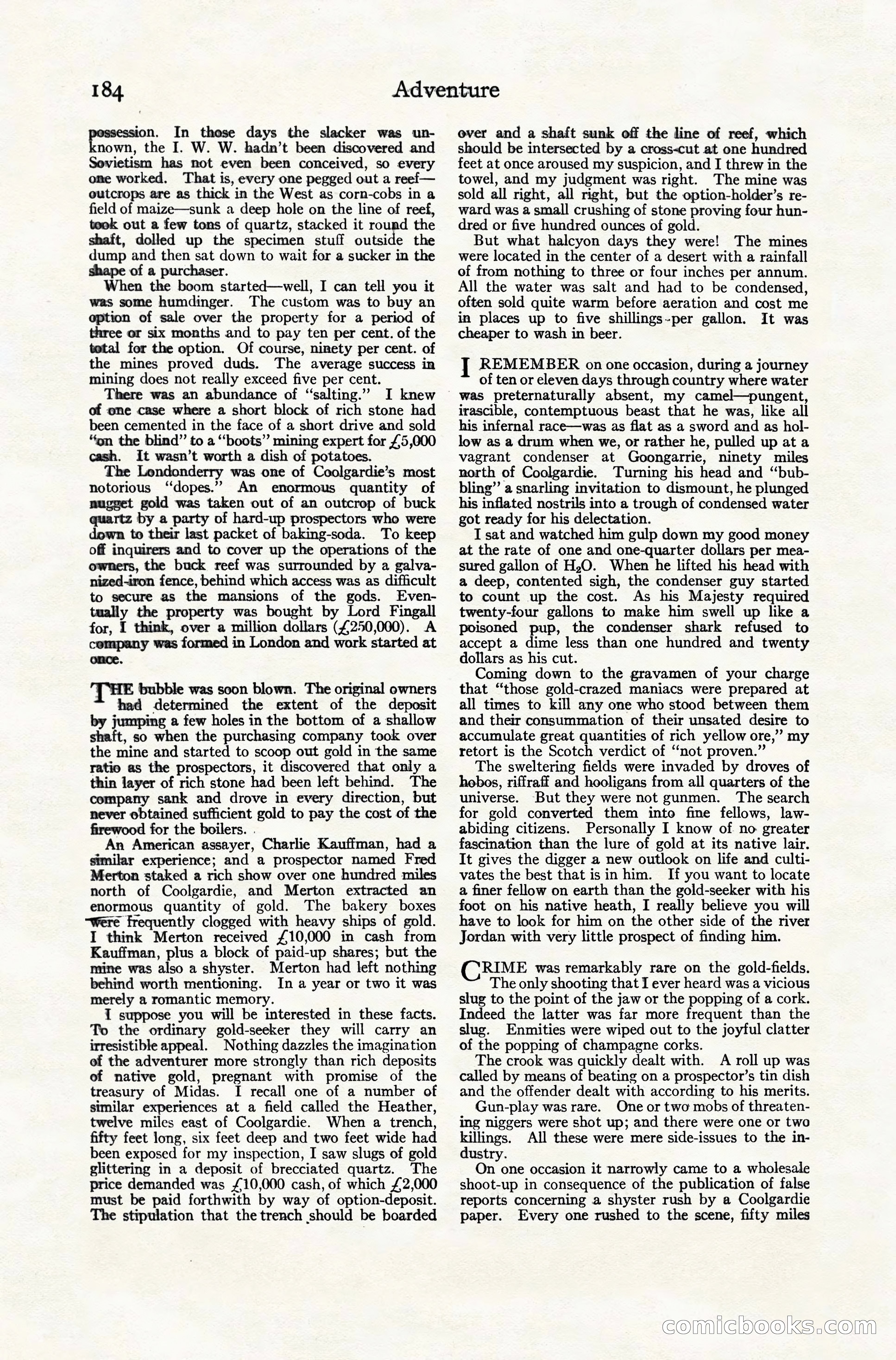
A restored page from Pulp Fiction, 1924. Page through the whole issue in the reader above.
📄 Transcribed text from this page (OCR, searchable)
Machine-transcribed from the original scan — historical spelling and the odd misread are preserved.
184 ession. In those days the slacker was un- nown, the I. W. W. hadn’t been discovered and Sovietism has not even been conceived, so every one worked. That is, every one pegged out a reef— outcrops are as thick in the West as corn-cobs in a field of maize—sunk a deep hole on the line of reef, took out a few tons of quartz, stacked it round the shaft, dolled up the specimen stuff outside the dump and then sat down to wait for a sucker in the shape of a purchaser. When the boom started—well, I can tell you it was some humdinger. The custom was to buy an option of sale over the property for a period of three or six months and to pay ten per cent. of the total for the option. Of course, ninety per cent. of the mines proved duds. The average success in mining does not really exceed five per cent. There was an abundance of “salting.”’ I knew of one case where a short block of rich stone had been cemented in the face of a short drive and sold “on the blind” to a “‘boots” mining expert for £5,000 cash. it wasn’t worth a dish of potatoes. The Lendonderry was one of Coolgardie’s most notorious ‘“dopes.” An enormous quantity of nugget gold was taken out of an outcrop of buck quartz by a party of hard-up prospectors who were down to their last packet of baking-soda. To keep off inquirers and to cover up the operations of the owners, the buck reef was surrounded by a galva- nized-iron fence, behind which access was as difficult to secure as the mansions of the gods. Even- tually the property was bought by Lord Fingall for, I think, over a million dollars (£250,000). A cempany was formed in London and work started at once. | bubble was soon blown. The original owners had determined the extent of the deposit by jumping a few holes in the bottom of a shallow shaft, so when the purchasing company took over the mine and started to scoop out gold in the same ratio as the prospectors, it discovered that only a thin layer of rich stone had been left behind. The company sank and drove in every direction, but never obtained sufficient gold to pay the cost of the firewood for the boilers. . An American assayer, Charlie Kauffman, had a similar experience; and a prospector named Fred Merton staked a rich show over one hundred miles north of Coolgardie, and Merton extracted an enormous quantity of gold. The bakery boxes “Were frequently clogged with heavy ships of gold. I think Merton received £10,000 in cash from Kauffman, plus a block of paid-up shares; but the mine was also a shyster. Merton had left nothing behind worth mentioning. In a year or two it was merely a romantic memory. 1 suppose you will be interested in these facts. To the ordinary gold-seeker they will carry an irresistible appeal. Nothing dazzles the imagination of the adventurer more strongly than rich deposits of native gold, pregnant with promise of the treasury of Midas. I recall one of a number of similar experiences at a field called the Heather, twelve miles east of Coolgardie. When a trench, fifty feet long, six feet deep and two feet wide had been exposed for my inspection, I saw slugs of gold glittering in a deposit of brecciated quartz. The price demanded was £10,000 cash, of which £2,000 must be paid forthwith by way of option-deposit. The stipulation that the trench should be boarded Adventure over and a shaft sunk off the line of reef, which should be intersected by a cross-cut at one hundred feet at once aroused my suspicion, and I threw in the towel, and my judgment was right. The mine was sold all right, all right, but the option-holder’s re- ward was a small crushing of stone proving four hun- dred or five hundred ounces of gold. But what halcyon days they were! The mines were located in the center of a desert with a rainfall of from nothing to three or four inches per annum. All the water was salt and had to be condensed, often sold quite warm before aeration and cost me in places up to five shillings-per gallon. It was cheaper to wash in beer. REMEMBER on one occasion, during a journey of ten or eleven days through country where water ' was preternaturally absent, my camel—pungent, irascible, contemptuous beast that he was, like all his infernal race—was as flat as a sword and as hol- low as a drum when we, or rather he, pulled up at a vagrant condenser at Goongarrie, ninety miles north of Coolgardie. Turning his head and “bub- bling” a snarling invitation to dismount, he plunged his inflated nostrils into a trough of condensed water got ready for his delectation. I sat and watched him gulp down my good money at the rate of one and one-quarter dollars per mea- sured gallon of H,O. When he lifted his head with a deep, contented sigh, the condenser guy started to count up the cost. As his Majesty required twenty-four gallons to make him swell up like a poisoned pup, the condenser shark refused to accept a dime less than one hundred and twenty dollars as his cut. Coming down to the gravamen of your charge that “those gold-crazed maniacs were prepared at all times to kill any one who stood between them and their consummation of their unsated desire to accumulate great quantities of rich yellow ore,” my retort is the Scotch verdict of “not proven.” The sweltering fields were invaded by droves of hobos, riffraff and hooligans from all quarters of the universe. But they were not gunmen. The search for gold converted them into fine fellows, law- abiding citizens. Personally I know of. no greater fascination than the lure of gold at its native lair. It gives the digger a new outlook on life and culti- vates the best that isin him. If you want to locate a finer fellow on earth than the gold-seeker with his foot on his native heath, I really believe you will have to look for him on the other side of the river Jordan with very little prospect of finding him. RIME was remarkably rare on the gold-fields. The only shooting that I ever heard was a vicious slug to the point of the jaw or the popping of a cork. Indeed the latter was far more frequent than the slug. Enmities were wiped out to the joyful clatter of the popping of champagne corks. The crook was quickly dealt with. A roll up was called by means of beating on a prospector’s tin dish and the offender dealt with according to his merits. Gun-play was rare. One or two mobs of threaten- ing niggers were shot up; and there were one or two killings. All these were mere side-issues to the in- dustry. On one occasion it narrowly came to a wholesale shoot-up in consequence of the publication of false reports concerning a shyster rush by a Coolgardie paper. Every one rushed to the scene, fifty miles COMmMiclhoo =