
Pulp Fiction, 1924 · page 174 of 216
Adventure Magazine, December 10, 1924 — page 174: what you’re looking at
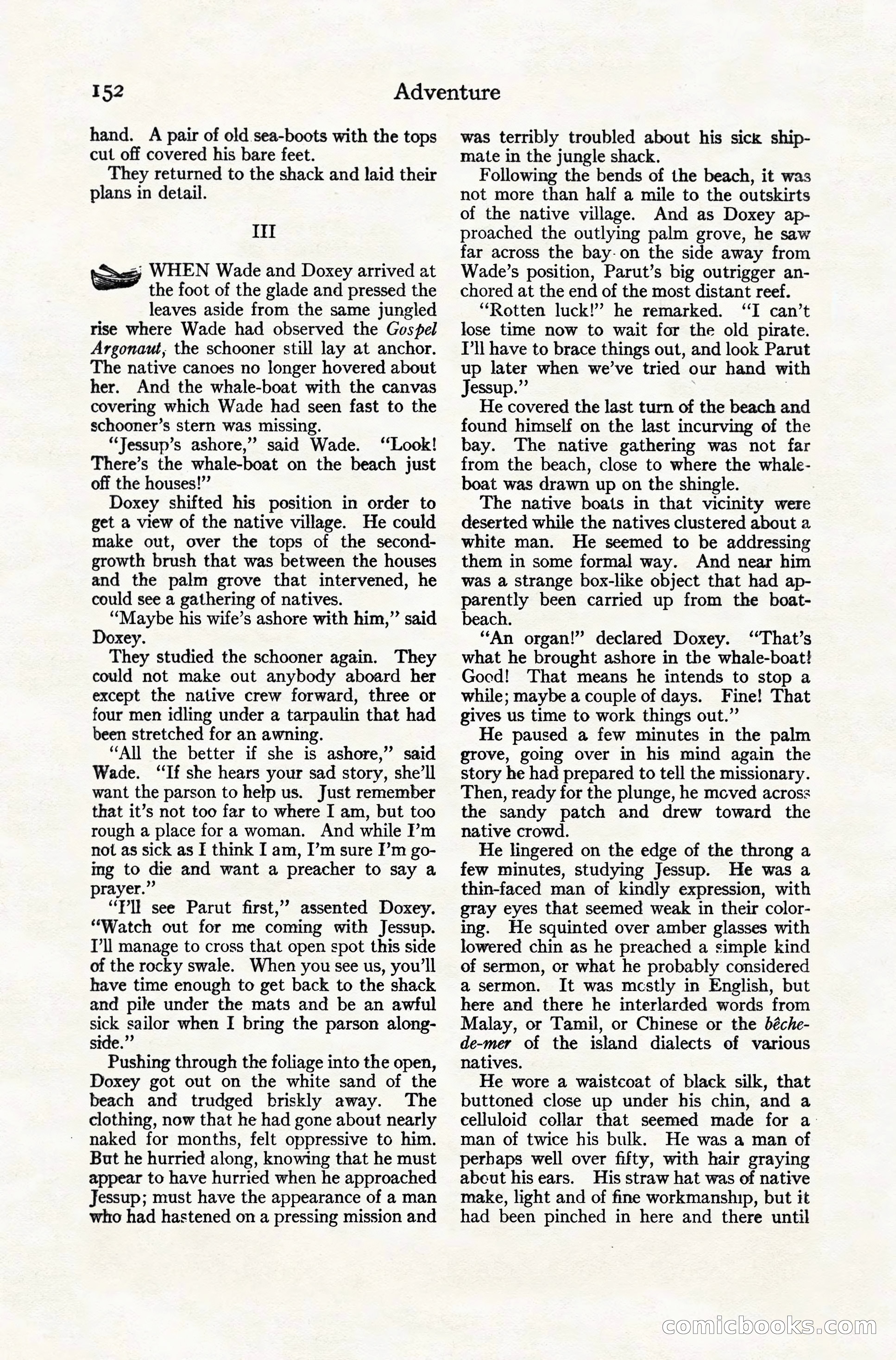
A restored page from Pulp Fiction, 1924. Page through the whole issue in the reader above.
📄 Transcribed text from this page (OCR, searchable)
Machine-transcribed from the original scan — historical spelling and the odd misread are preserved.
152 hand. A pair of old sea-boots with the tops cut off covered his bare feet. They returned to the shack and laid their plans in detail. It Ss WHEN Wade and Doxey arrived at the foot of the glade and pressed the leaves aside from the same jungled rise where Wade had observed the Gospel Argonaut, the schooner still lay at anchor. The native canoes no longer hovered about her. And the whale-boat with the canvas covering which Wade had seen fast to the schooner’s stern was missing. “Jessup’s ashore,” said Wade. ‘Look! There’s the whale-boat on the beach just off the houses!” Doxey shifted his position in order to get a view of the native village. He could make out, over the tops of the second- growth brush that was between the houses and the palm grove that intervened, he could see a gathering of natives. “Maybe his wife’s ashore with him,” said Doxey. They studied the schooner again. They could not make out anybody aboard her except the native crew forward, three or four men idling under a tarpaulin that had been stretched for an awning. “All the better if she is ashore,” said Wade. “If she hears your sad story, she’ll want the parson to help us. Just remember that it’s not too far to where I am, but too rough a place fora woman. And while ’m not as sick as I think I am, I’m sure I’m go- ing to die and want a preacher to say a prayer.” “Pll see Parut first,” assented Doxey. “Watch out for me coming with Jessup. T’ll manage to cross that open spot this side of the rocky swale. When you see us, you'll have time enough to get back to the shack and pile under the mats and be an awful sick sailor when I bring the parson along- side.”’ Pushing through the foliage into the open, Doxey got out on the white sand of the beach and trudged briskly away. The clothing, now that he had gone about nearly naked for months, felt oppressive to him. But he hurried along, knowing that he must appear to have hurried when he approached Jessup; must have the appearance of a man who had hastened on a pressing mission and Adventure was terribly troubled about his sick ship- mate in the jungle shack. Following the bends of the beach, it was not more than half a mile to the outskirts of the native village. And as Doxey ap- proached the outlying palm grove, he saw far across the bay-on the side away from Wade’s position, Parut’s big outrigger an- chored at the end of the most distant reef. “Rotten luck!” he remarked. “I can’t lose time now to wait for the old pirate. Til have to brace things out, and look Parut up later when we’ve tried our hand with Jessup.” ? He covered the last turn of the beach and found himself on the last incurving of the bay. The native gathering was not far from the beach, close to where the whale- boat was drawn up on the shingle. The native boats in that vicinity were deserted while the natives clustered about a white man. He seemed to be addressing them in some formal way. And near him was a strange box-like object that had ap- parently been carried up from the boat- beach. “An organ!” declared Doxey. ‘That’s what he brought ashore in the whale-boat! Gocd! That means he intends to stop a while; maybe a couple of days. Fine! That gives us time to work things out.” He paused a few minutes in the palm grove, going over in his mind again the story he had prepared to tell the missionary. Then, ready for the plunge, he moved across the sandy patch and drew toward the native crowd. He lingered on the edge of the throng a few minutes, studying Jessup. He was a thin-faced man of kindly expression, with gray eyes that seemed weak in their color- ing. He squinted over amber glasses with lowered chin as he preached a simple kind of sermon, or what he probably considered a sermon. It was mcstly in English, but here and there he interlarded words from Malay, or Tamil, or Chinese or the béche- de-mer of the island dialects of various natives. He wore a waistcoat of black silk, that buttoned close up under his chin, and a celluloid collar that seemed made for a- man of twice his bulk. He was a man of perhaps well over fifty, with hair graying abeut his ears. His straw hat was of native make, light and of fine workmanship, but it had been pinched in here and there until COMmichook A) CO 5}