
Pulp Fiction, 1924 · page 165 of 216
Adventure Magazine, December 10, 1924 — page 165: what you’re looking at
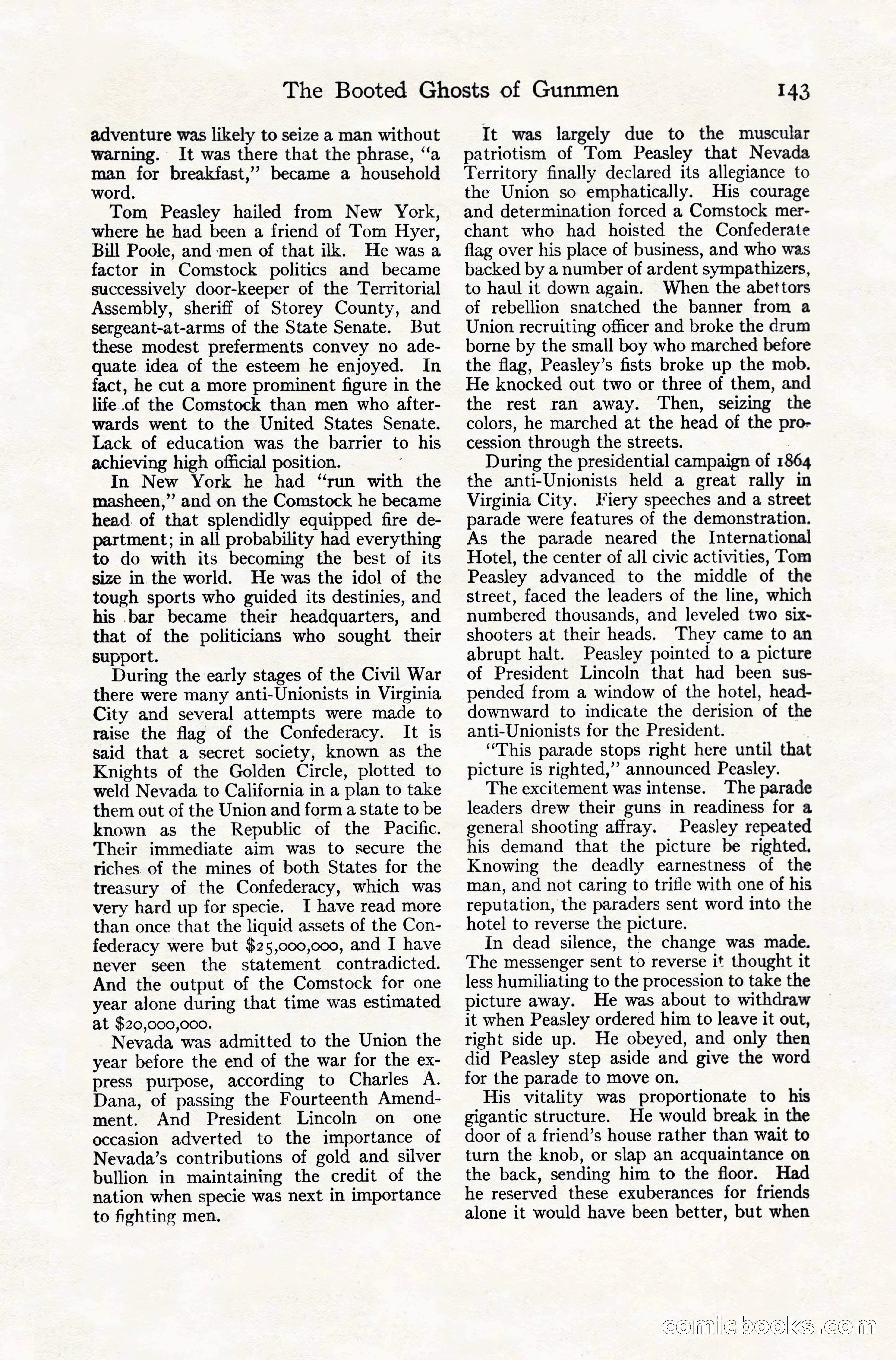
A restored page from Pulp Fiction, 1924. Page through the whole issue in the reader above.
📄 Transcribed text from this page (OCR, searchable)
Machine-transcribed from the original scan — historical spelling and the odd misread are preserved.
The Booted Ghosts of Gunmen adventure was likely to seize a man without warning. It was there that the phrase, “a man for breakfast,’”’ became a household word. Tom Peasley hailed from New York, where he had been a friend of Tom Hyer, Bill Poole, and men of that ilk. He was a factor in Comstock politics and became successively door-keeper of the Territorial Assembly, sheriff of Storey County, and sergeant-at-arms of the State Senate. But these modest preferments convey no ade- quate idea of the esteem he enjoyed. In fact, he cut a more prominent figure in the life of the Comstock than men who after- wards went to the United States Senate. Lack of education was the barrier to his achieving high official position. In New York he had “run with the masheen,”’ and on the Comstock he became head. of that splendidly equipped fire de- partment; in all probability had everything to do with its becoming the best of its size in the world. He was the idol of the tough sports who guided its destinies, and his bar became their headquarters, and that of the politicians who sought their support. During the early stages of the Civil War there were many anti-Unionists in Virginia City and several attempts were made to raise the flag of the Confederacy. It is said that a secret society, known as the Knights of the Golden Circle, plotted to weld Nevada to California in a plan to take them out of the Union and form a state to be known as the Republic of the Pacific. Their immediate aim was to secure the riches of the mines of both States for the treasury of the Confederacy, which was very hard up for specie. I have read more than once that the liquid assets of the Con- federacy were but $25,000,000, and I have never seen the statement contradicted. And the output of the Comstock for one year alone during that time was estimated at $20,000,000. Nevada was admitted to the Union the year before the end of the war for the ex- press purpose, according to Charles A. Dana, of passing the Fourteenth Amend- ment. And President Lincoln on _ one occasion adverted to the importance of Nevada’s contributions of gold and silver bullion in maintaining the credit of the nation when specie was next in importance to fighting men. 143 It was largely due to the muscular patriotism of Tom Peasley that Nevada Territory finally declared its allegiance to the Union so emphatically. His courage and determination forced a Comstock mer- chant who had hoisted the Confederate flag over his place of business, and who was backed by a number of ardent sympathizers, to haul it down again. When the abettors of rebellion snatched the banner from a Union recruiting officer and broke the drum borne by the small boy who marched before the flag, Peasley’s fists broke up the mob. He knocked out two or three of them, and the rest ran away. Then, seizing the colors, he marched at the head of the pro- cession through the streets. : During the presidential campaign of 1864 the anti-Unionists held a great rally in Virginia City. Fiery speeches and a street parade were features of the demonstration. As the parade neared the International Hotel, the center of all civic activities, Tom Peasley advanced to the middle of the street, faced the leaders of the line, which numbered thousands, and leveled two six- shooters at their heads. They came to an abrupt halt. Peasley pointed to a picture of President Lincoln that had been sus- pended from a window of the hotel, head- downward to indicate the derision of the anti-Unionists for the President. “This parade stops right here until that picture is righted,”’ announced Peasley. The excitement was intense. The parade leaders drew their guns in readiness for a general shooting affray. Peasley repeated his demand that the picture be righted, Knowing the deadly earnestness of the man, and not caring to trifle with one of his reputation, the paraders sent word into the hotel to reverse the picture. In dead silence, the change was made. The messenger sent to reverse it thought it less humiliating to the procession to take the picture away. He was about to withdraw it when Peasley ordered him to leave it out, right side up. He obeyed, and only then did Peasley step aside and give the word for the parade to move on. His vitality was proportionate to his gigantic structure. He would break in the door of a friend’s house rather than wait to turn the knob, or slap an acquaintance on the back, sending him to the floor. Had he reserved these exuberances for friends alone it would have been better, but when CoMmicboolk Wh) © 5}