
Pulp Fiction, 1924 · page 163 of 216
Adventure Magazine, December 10, 1924 — page 163: what you’re looking at
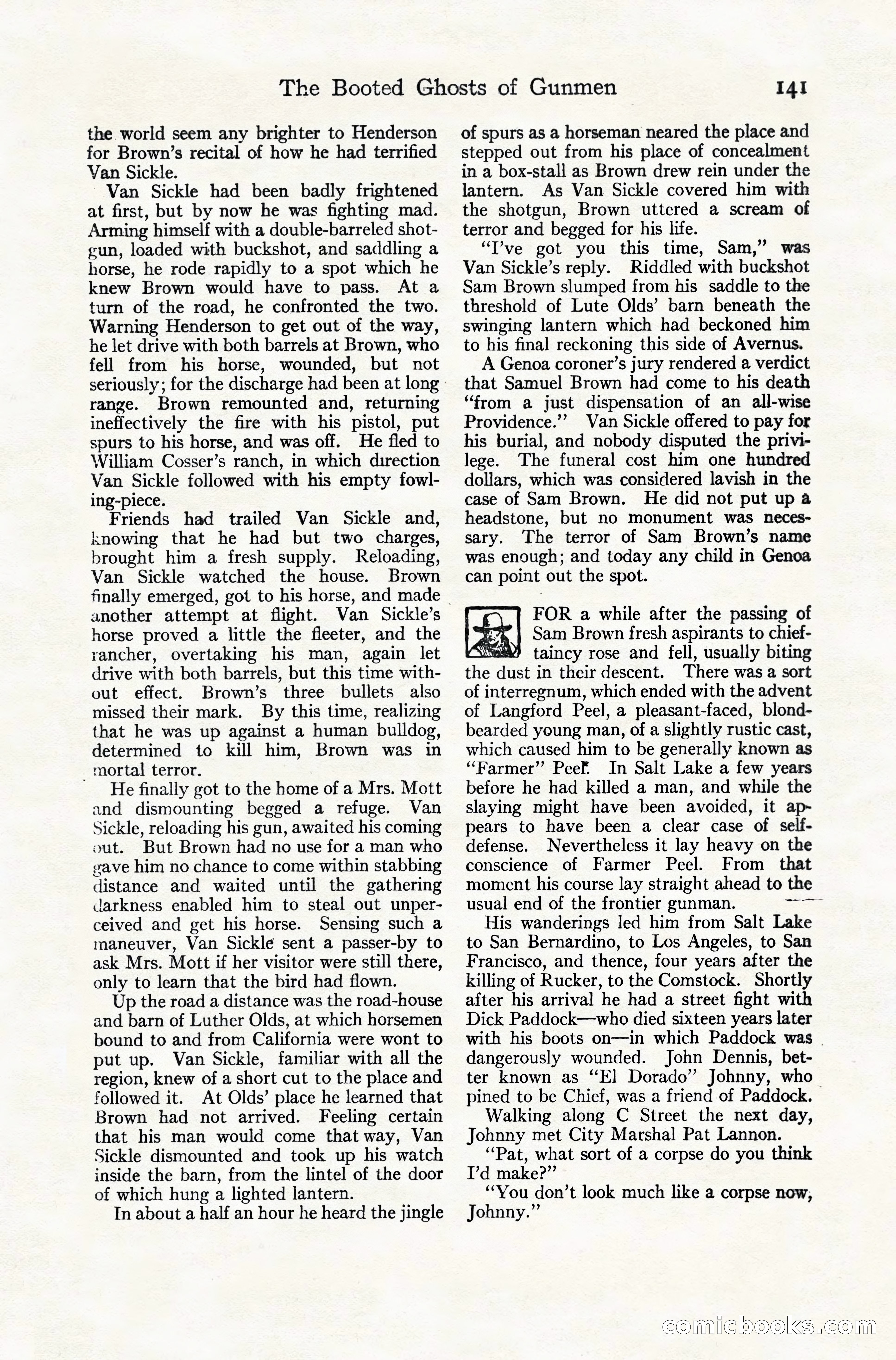
A restored page from Pulp Fiction, 1924. Page through the whole issue in the reader above.
📄 Transcribed text from this page (OCR, searchable)
Machine-transcribed from the original scan — historical spelling and the odd misread are preserved.
The Booted Ghosts of Gunmen the world seem any brighter to Henderson for Brown’s recital of how he had terrified Van Sickle. Van Sickle had been badly frightened at first, but by now he was fighting mad. Arming himself with a double-barreled shot- gun, loaded with buckshot, and saddling a horse, he rode rapidly to a spot which he knew Brown would have to pass. At a turn of the road, he confronted the two. Warning Henderson to get out of the way, he let drive with both barrels at Brown, who fell from his horse, wounded, but not seriously; for the discharge had been at long» range. Brown remounted and, returning ineffectively the fire with his pistol, put spurs to his horse, and was off. He fled to William Cosser’s ranch, in which direction Van Sickle followed with his empty fowl- ing-piece. Friends had trailed Van Sickle and, knowing that he had but two charges, brought him a fresh supply. Reloading, Van Sickle watched the house. Brown finally emerged, got to his horse, and made another attempt at flight. horse proved a little the fleeter, and the rancher, overtaking his man, again let drive with both barrels, but this time with- out effect. Brown’s three bullets also missed their mark. By this time, realizing that he was up against a human bulldog, determined to kill him, Brown was in _ mortal terror. He finally got to the home of a Mrs. Mott and dismounting begged a refuge. Van Sickle, reloading his gun, awaited his coming out. But Brown had no use for a man who gave him no chance to come within stabbing distance and waited until the gathering darkness enabled him to steal out unper- ceived and get his horse. Sensing such a maneuver, Van Sickle sent a passer-by to ask Mrs. Mott if her visitor were still there, only to learn that the bird had flown. Up the road a distance was the road-house and barn of Luther Olds, at which horsemen bound to and from California were wont to put up. Van Sickle, familiar with all the region, knew of a short cut to the place and followed it. At Olds’ place he learned that Brown had not arrived. Feeling certain that his man would come that way, Van Sickle dismounted and took up his watch inside the barn, from the lintel of the door of which hung a lighted lantern. In about a half an hour he heard the jingle Van Sickle’s 14! of spurs as a horseman neared the place and stepped out from his place of concealment in a box-stall as Brown drew rein under the lantern. As Van Sickle covered him with the shotgun, Brown uttered a scream of terror and begged for his life. “lve got you this time, Sam,” was Van Sickle’s reply. Riddled with buckshot Sam Brown slumped from his saddle to the threshold of Lute Olds’ barn beneath the swinging lantern which had beckoned him to his final reckoning this side of Avernus. A Genoa coroner’s jury rendered a verdict that Samuel Brown had come to his death “from a just dispensation of an all-wise Providence.’’ Van Sickle offered to pay for his burial, and nobody disputed the privi- lege. The funeral cost him one hundred dollars, which was considered lavish in the case of Sam Brown. He did not put up a headstone, but no monument was neces- sary. The terror of Sam Brown’s name was enough; and today any child in Genoa can point out the spot. FOR a while after the passing of *% | Sam Brown fresh aspirants to chief- Swit? taincy rose and fell, usually biting the dust in their descent. There was a sort of interregnum, which ended with the advent of Langford Peel, a pleasant-faced, blond- bearded young man, of a slightly rustic cast, which caused him to be generally known as “Farmer” Peef. In Salt Lake a few years before he had killed a man, and while the slaying might have been avoided, it ap- pears to have been a clear case of self- defense. Nevertheless it lay heavy on the conscience of Farmer Peel. From_ that moment his course lay straight ahead to the usual end of the frontier gunman. His wanderings led him from Salt Lake to San Bernardino, to Los Angeles, to San Francisco, and thence, four years after the killing of Rucker, to the Comstock. Shortly after his arrival he had a street fight with Dick Paddock—who died sixteen years later ~—--—~ = with his boots on—in which Paddock was | dangerously wounded. John Dennis, bet- ter known as “E] Dorado” Johnny, who pined to be Chief, was a friend of Paddock. Walking along C Street the next day, Johnny met City Marshal Pat Lannon. “Pat, what sort of a corpse do you think I’d make?” “You don’t look much like a corpse now, Johnny.” cComiclbook C© 5}