
Pulp Fiction, 1924 · page 159 of 216
Adventure Magazine, December 10, 1924 — page 159: what you’re looking at
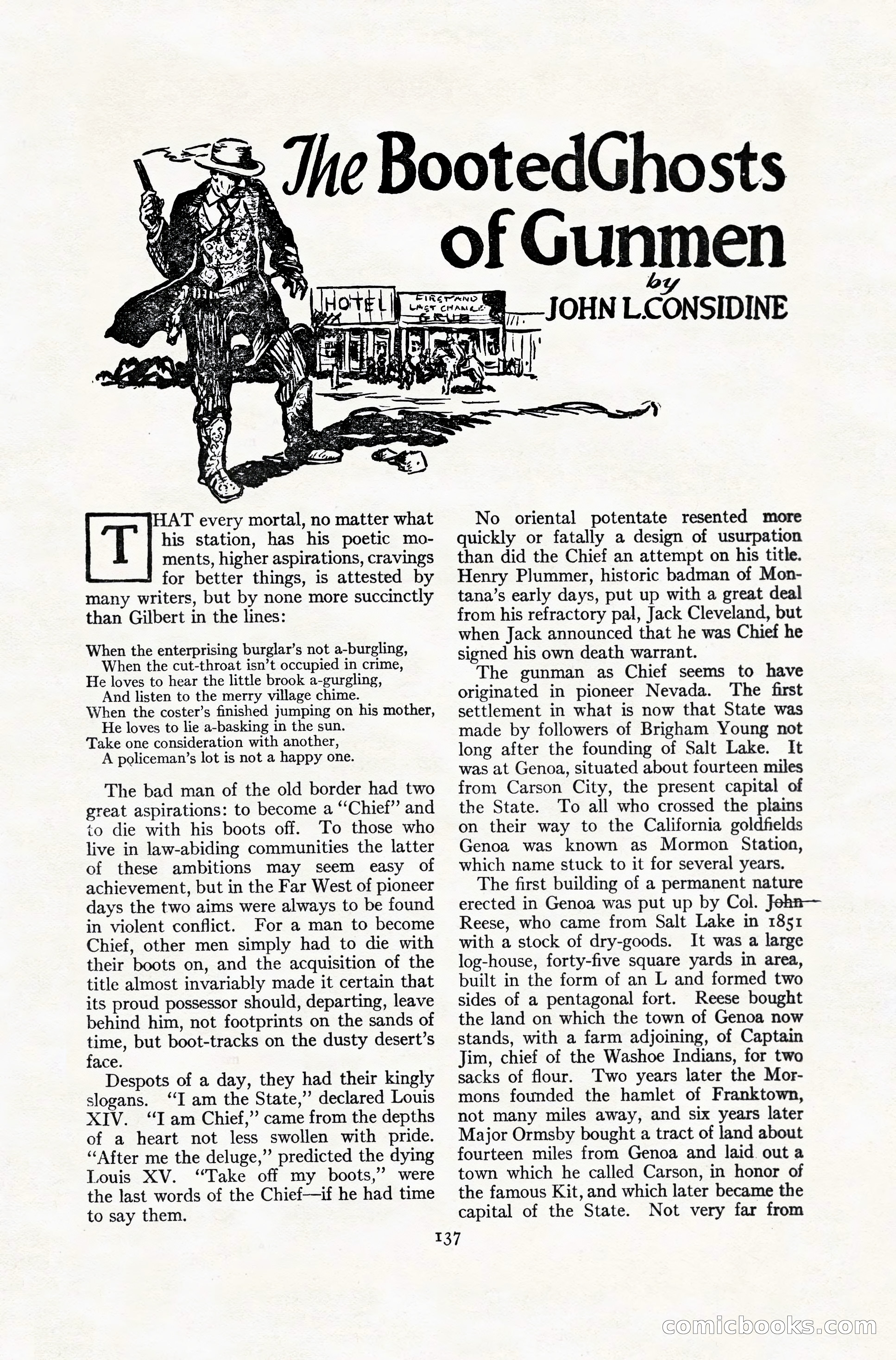
A restored page from Pulp Fiction, 1924. Page through the whole issue in the reader above.
📄 Transcribed text from this page (OCR, searchable)
Machine-transcribed from the original scan — historical spelling and the odd misread are preserved.
HAT every mortal, no matter what <i his station, has his poetic mo- ments, higher aspirations, cravings 3 for better things, is attested by many writers, but by none more succinctly than Gilbert in the lines: When the enterprising burglar’s not a-burgling, When the cut-throat isn’t occupied in crime, He loves to hear the little brook a-gurgling, And listen to the merry village chime. When the coster’s finished jumping on his mother, He loves to lie a-basking in the sun. Take one consideration with another, A policeman’s lot is not a happy one. The bad man of the old border had two great aspirations: to become a “Chief”’ and to die with his boots off. To those who live in law-abiding communities the latter of these ambitions may seem easy of achievement, but in the Far West of pioneer days the two aims were always to be found in violent conflict. For a man to become Chief, other men simply had to die with their boots on, and the acquisition of the title almost invariably made it certain that its proud possessor should, departing, leave behind him, not footprints on the sands of time, but boot-tracks on the dusty desert’s face. Despots of a day, they had their kingly slogans. “I am the State,” declared Louis XIV. “I am Chief,’ came from the depths of a heart not less swollen with pride. “After me the deluge,” predicted the dying Louis XV. ‘Take off my boots,’ were the last words of the Chief—if he had time to say them. e BootedGhosts of Gunmen SANT =. . by Ls 7 JOHN LCCONSIDINE No oriental potentate resented more quickly or fatally a design of usurpation than did the Chief an attempt on his title. Henry Plummer, historic badman of Mon- tana’s early days, put up with a great deal from his refractory pal, Jack Cleveland, but when Jack announced that he was Chief he signed his own death warrant. The gunman as Chief seems to have originated in pioneer Nevada. The first settlement in what is now that State was made by followers of Brigham Young not long after the founding of Salt Lake. It was at Genoa, situated about fourteen miles from Carson City, the present capital of the State. To all who crossed the plains on their way to the California goldfields Genoa was known as Mormon Station, which name stuck to it for several years. The first building of a permanent nature erected in Genoa was put up by Col. Jehn— Reese, who came from Salt Lake in 1851 with a stock of dry-goods. It was a large log-house, forty-five square yards in area, built in the form of an L and formed two sides of a pentagonal fort. Reese bought the land on which the town of Genoa now stands, with a farm adjoining, of Captain Jim, chief of the Washoe Indians, for two sacks of flour. Two years later the Mor- mons founded the hamlet of Franktown, not many miles away, and six years later Major Ormsby bought a tract of land about fourteen miles from Genoa and laid out a town which he called Carson, in honor of the famous Kit, and which later became the capital of the State. Not very far from 137 CO cloookxS C© 5}