
Pulp Fiction, 1924 · page 133 of 216
Adventure Magazine, December 10, 1924 — page 133: what you’re looking at
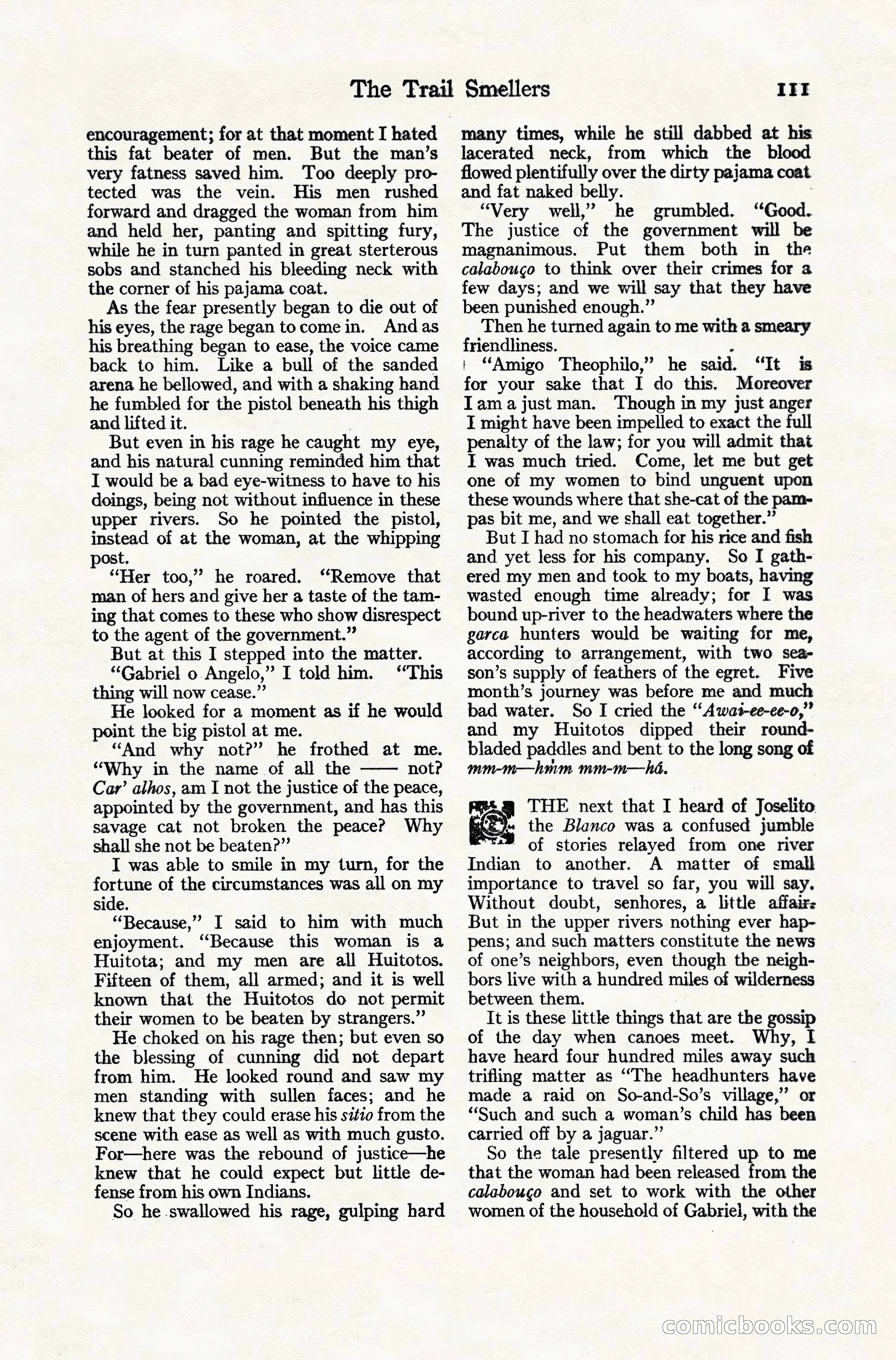
A restored page from Pulp Fiction, 1924. Page through the whole issue in the reader above.
📄 Transcribed text from this page (OCR, searchable)
Machine-transcribed from the original scan — historical spelling and the odd misread are preserved.
The Trail Smellers encouragement; for at that moment I hated this fat beater of men. But the man’s very fatness saved him. Too deeply pro- tected was the vein. His men rushed forward and dragged the woman from him and held her, panting and spitting fury, while he in turn panted in great sterterous sobs and stanched his bleeding neck with the corner of his pajama coat. As the fear presently began to die out of his eyes, the rage began tocomein. Andas his breathing began to ease, the voice came back to him. Like a bull of the sanded arena he bellowed, and with a shaking hand he fumbled for the pistol beneath his thigh and lifted it. , But even in his rage he caught my eye, and his natural cunning reminded him that I would be a bad eye-witness to have to his doings, being not without influence in these upper rivers. So he pointed the pistol, instead of at the woman, at the whipping ost. ‘“Her too,” he roared. ‘“‘Remove that man of hers and give her a taste of the tam- ing that comes to these who show disrespect to the agent of the government.” But at this I stepped into the matter. “Gabriel o Angelo,” I told him. ‘This thing will now cease.” He looked for a moment as if he would point the big pistol at me. “And why not?” he frothed at me. “Why in the name of all the —— not? Car’ alhos, am I not the justice of the peace, appointed by the government, and has this savage cat not broken the peace? Why shall she not be beaten?”’ I was able to smile in my turn, for the fortune of the circumstances was all on my side. ‘““Because,” I said to him with much enjoyment. “Because this woman is a Huitota; and my men are all Huitotos. Fifteen of them, all armed; and it is well known that the Huitotos do not permit their women to be beaten by strangers.”’ He choked on his rage then; but even so the blessing of cunning did not depart from him. He looked round and saw my men standing with sullen faces; and he knew that they could erase his sitio from the scene with ease as well as with much gusto. For—here was the rebound of justice—he knew that he could expect but little de- fense from his own Indians. So he swallowed his rage, gulping hard Itt many times, while he still dabbed at his lacerated neck, from which the blood flowed plentifully over the dirty paiama coat and fat naked belly. : “Very well,” he grumbled. “Good. The justice of the government will be magnanimous. Put them both in the calabougo to think over their crimes for a few days; and we will say that they have been punished enough.” Then he turned again to me with a smeary friendliness. ; | “Amigo Theophilo,” he said. “It is for your sake that I do this. Moreover Iama just man. Though in my just anger I might have been impelled to exact the full penalty of the law; for you will admit that I was much tried. Come, let me but get one of my women to bind unguent upon these wounds where that she-cat of the pam- pas bit me, and we shall eat together.” But I had no stomach for his rice and fish and yet less for his company. So I gath- ered my men and took to my boats, having wasted enough time already; for I was bound up-river to the headwaters where the garca hunters would be waiting for me, according to arrangement, with two sea- son’s supply of feathers of the egret. Five month’s journey was before me and much bad water. So I cried the “Awai-ee-ce-o,” and my MHuitotos dipped their round- bladed paddles and bent to the long song of mm-m—hmm mm-m—hé. rsa THE next that I heard of Joselito eae the Blanco was a confused jumble +* of stories relayed from one river Indian to another. A matter of small importance to travel so far, you will say. Without doubt, senhores, a little affair: But in the upper rivers nothing ever hap- pens; and such matters constitute the news of one’s neighbors, even though the neigh- bors live with a hundred miles of wilderness between. them. | It is these little things that are the gossip of the day when canoes meet. Why, I have heard four hundred miles away such trifling matter as “The headhunters have made a raid on So-and-So’s village,” or “Such and such a woman’s child has been carried off by a jaguar.” So the tale presently filtered up to me that the woman had been released from the calabougo and set to work with the other women of the household of Gabriel, with the Comiclhoool Wh) CO =