
Pulp Fiction, 1924 · page 130 of 216
Adventure Magazine, December 10, 1924 — page 130: what you’re looking at
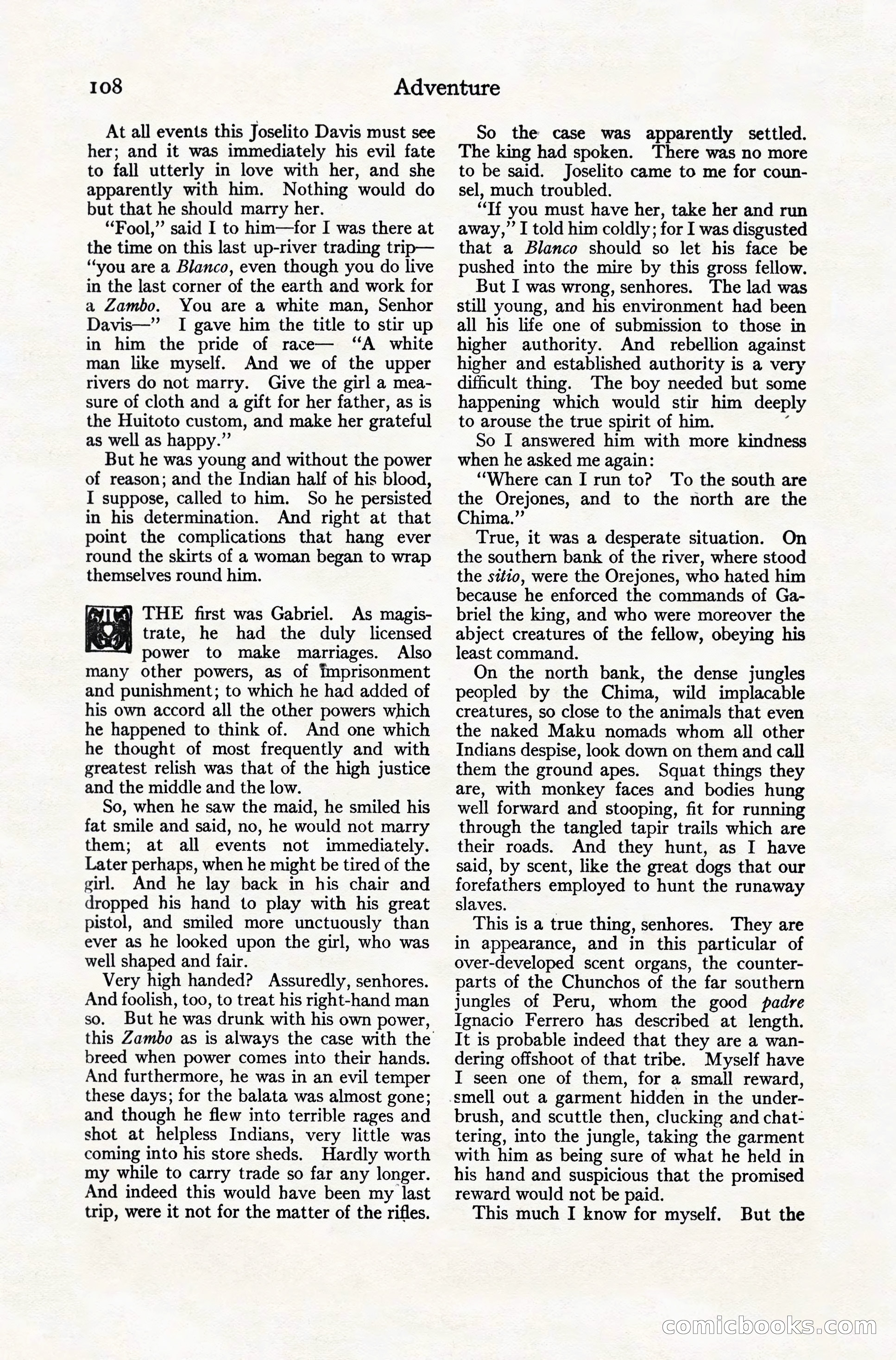
A restored page from Pulp Fiction, 1924. Page through the whole issue in the reader above.
📄 Transcribed text from this page (OCR, searchable)
Machine-transcribed from the original scan — historical spelling and the odd misread are preserved.
108 At all events this Joselito Davis must see her; and it was immediately his evil fate to fall utterly in love with her, and she apparently with him. Nothing would do but that he should marry her. “Fool,” said I to him—for I was there at the time on this last up-river trading trip— “you are a Blanco, even though you do live in the last corner of the earth and work for a Zambo. You are a white man, Senhor Davis—” I gave him the title to stir up in him the pride of race— “A white man like myself. And we of the upper rivers do not marry. Give the girl a mea- sure of cloth and a gift for her father, as is the Huitoto custom, and make her grateful as well as happy.” But he was young and without the power of reason; and the Indian half of his blood, I suppose, called to him. So he persisted in his determination. And right at that point the complications that hang ever round the skirts of a woman began to wrap themselves round him. “) THE first was Gabriel. As magis- fm trate, he had the duly licensed ' power to make marriages. Also many other powers, as of imprisonment and punishment; to which he had added of his own accord all the other powers which he happened to think of. And one which he thought of most frequently and with greatest relish was that of the high justice and the middle and the low. So, when he saw the maid, he smiled his fat smile and said, no, he would not marry them; at all events not immediately. Later perhaps, when he might be tired of the girl, And he lay back in his chair and dropped his hand to play with his great pistol, and smiled more unctuously than ever as he looked upon the girl, who was well shaped and fair. Very high handed? Assuredly, senhores. And foolish, too, to treat his right-hand man so. But he was drunk with his own power, this Zambo as is always the case with the breed when power comes into their hands. And furthermore, he was in an evil temper these days; for the balata was almost gone; and though he flew into terrible rages and shot at helpless Indians, very little was coming into his store sheds. Hardly worth my while to carry trade so far any longer. And indeed this would have been my last trip, were it not for the matter of the rifles. Adventure So the case was apparently settled. The king had spoken. There was no more to be said. Joselito came to me for coun- sel, much troubled. “Tf you must have her, take her and run away,’ I told him coldly; for I was disgusted that a Blanco should so let his face be pushed into the mire by this gross fellow. But I was wrong, senhores. The lad was still young, and his environment had been all his life one of submission to those in higher authority. And rebellion against higher and established authority is a very difficult thing. The boy needed but some happening which would stir him deeply to arouse the true spirit of him. : So I answered him with more kindness when he asked me again: “Where can I run to? To the south are the Orejones, and to the north are the Chima.” True, it was a desperate situation. On the southern bank of the river, where stood the sztio, were the Orejones, who hated him because he enforced the commands of Ga- briel the king, and who were moreover the abject creatures of the fellow, obeying his least command. On the north bank, the dense jungles peopled by the Chima, wild implacable creatures, so close to the animals that even the naked Maku nomads whom all other Indians despise, look down on them and call them the ground apes. Squat things they are, with monkey faces and bodies hung well forward and stooping, fit for running through the tangled tapir trails which are their roads. And they hunt, as I have said, by scent, like the great dogs that our forefathers employed to hunt the runaway slaves. : This is a true thing, senhores. They are in appearance, and in this particular of over-developed scent organs, the counter- parts of the Chunchos of the far southern jungles of Peru, whom the good padre Ignacio Ferrero has described at length. It is probable indeed that they are a wan- dering offshoot of that tribe. Myself have I seen one of them, for a small reward, smell out a garment hidden in the under- brush, and scuttle then, clucking and chat- tering, into the jungle, taking the garment with him as being sure of what he held in his hand and suspicious that the promised reward would not be paid. This much I know for myself. But the CoMmicboolk A) CO =