
Pulp Fiction, 1924 · page 113 of 216
Adventure Magazine, December 10, 1924 — page 113: what you’re looking at
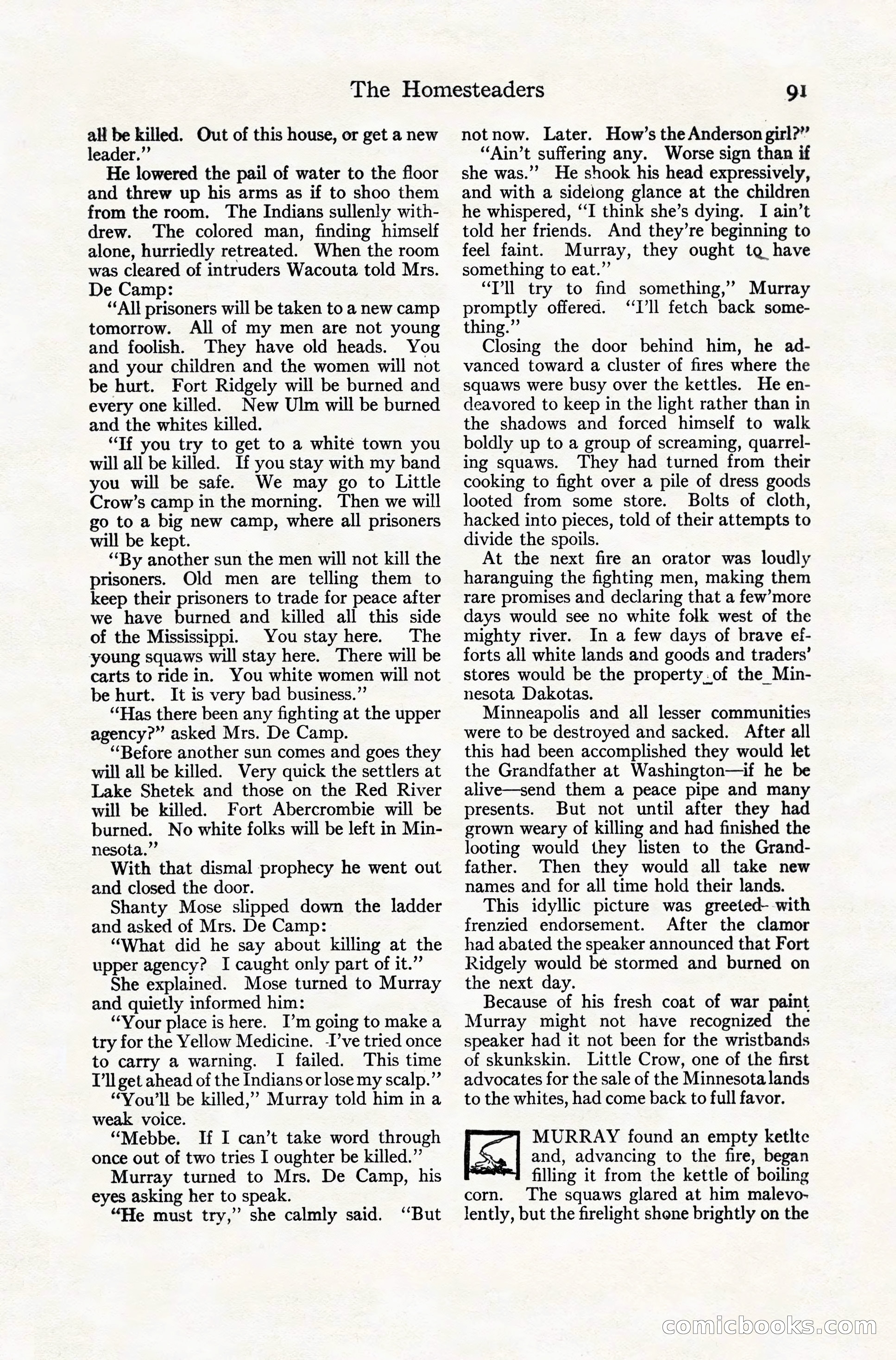
A restored page from Pulp Fiction, 1924. Page through the whole issue in the reader above.
📄 Transcribed text from this page (OCR, searchable)
Machine-transcribed from the original scan — historical spelling and the odd misread are preserved.
The Homesteaders all be killed. Out of this house, or get a new leader.” He lowered the pail of water to the floor and threw up his arms as if to shoo them from the room. The Indians sullenly with- drew. The colored man, finding himself alone, hurriedly retreated. When the room was cleared of intruders Wacouta told Mrs. De Camp: ‘‘All prisoners will be taken to a new camp tomorrow. All of my men are not young and foolish. They have old heads. You and your children and the women will not be hurt. Fort Ridgely will be burned and every one killed. New Ulm will be burned and the whites killed. “Tf you try to get to a white town you will all be killed. If you stay with my band you will be safe. We may go to Little Crow’s camp in the morning. Then we will go to a big new camp, where all prisoners will be kept. “By another sun the men will not kill the prisoners. Old men are telling them to keep their prisoners to trade for peace after we have burned and killed all this side of the Mississippi. You stay here. The young squaws will stay here. There will be carts to ride in. You white women will not be hurt. It is very bad business.”’ ‘“‘Has there been any fighting at the upper agency?” asked Mrs. De Camp. ‘“‘Before another sun comes and goes they will all be killed. Very quick the settlers at Lake Shetek and those on the Red River will be killed. Fort Abercrombie will be burned. No white folks will be left in Min- nesota.”’ With that dismal prophecy he went out and closed the door. Shanty Mose slipped down the ladder and asked of Mrs. De Camp: ‘What did he say about killing at the upper agency? I caught only part of it.” She explained. Mose turned to Murray and quietly informed him: “Your place is here. I’m going to make a try for the Yellow Medicine. -I’ve tried once to carry a warning. I failed. This time T’ll get ahead of the Indians or lose my scalp.” “You'll be killed,’ Murray told him in a weak voice. “Mebbe. If I can’t take word through once out of two tries I oughter be killed.” Murray turned to Mrs. De Camp, his eyes asking her to speak. “He must try,” she calmly said. ‘But QI not now. Later. How’s the Anderson girl?” “Ain’t suffering any. Worse sign than if she was.” He shook his head expressively, and with a sidelong glance at the children he whispered, “‘I think she’s dying. I ain’t told her friends. And they’re beginning to feel faint. Murray, they ought tq have something to eat.” “T’ll try to find something,” Murray promptly offered. “I'll fetch back some- thing.” Closing the door behind him, he ad- vanced toward a cluster of fires where the squaws were busy over the kettles. He en- deavored to keep in the light rather than in the shadows and forced himself to walk boldly up to a group of screaming, quarrel- ing squaws. They had turned from their cooking to fight over a pile of dress goods looted from some store. Bolts of cloth, hacked into pieces, told of their attempts to divide the spoils. At the next fire an orator was loudly haranguing the fighting men, making them rare promises and declaring that a few’more days would see no white folk west of the mighty river. In a few days of brave ef- forts all white lands and goods and traders’ stores would be the property:of the Min- nesota Dakotas. Minneapolis and all lesser communities were to be destroyed and sacked. After all this had been accomplished they would let the Grandfather at Washington—if he be alive—send them a peace pipe and many presents. But not until after they had grown weary of killing and had finished the looting would they listen to the Grand- father. Then they would all take new names and for all time hold their lands. This idyllic picture was greeted- with frenzied endorsement. After the clamor had abated the speaker announced that Fort Ridgely would be stormed and burned on the next day. Because of his fresh coat of war paint Murray might not have recognized the speaker had it not been for the wristbands of skunkskin. Little Crow, one of the first advocates for the sale of the Minnesota lands to the whites, had come back to full favor. i filling it from the kettle of boiling corn. The squaws glared at him malevo- lently, but the firelight shone brightly on the MURRAY found an empty ketlte and, advancing to the fire, began cComiclbook Wh) © 5}