
Pulp Fiction, 1924 · page 106 of 216
Adventure Magazine, December 10, 1924 — page 106: what you’re looking at
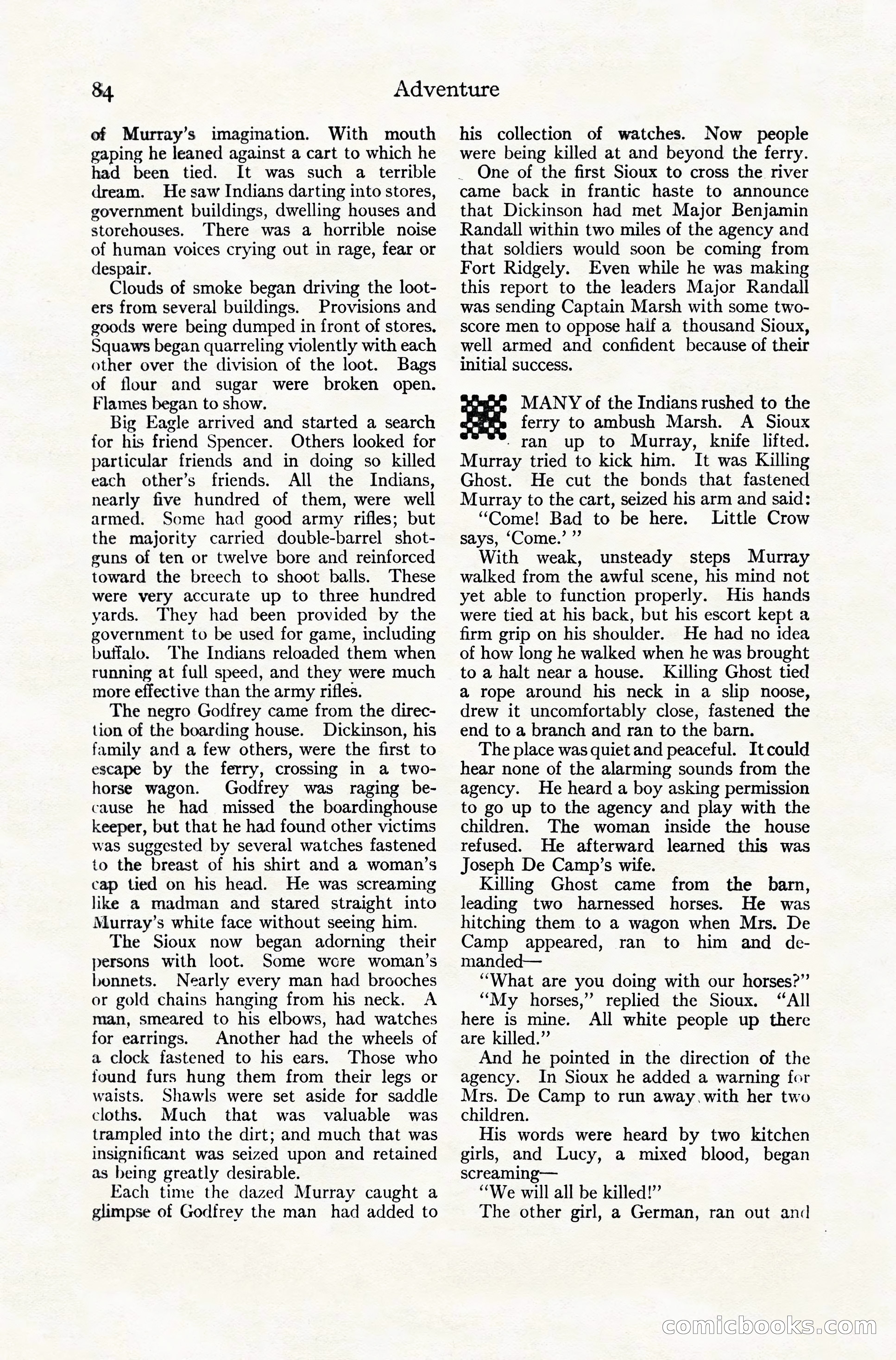
A restored page from Pulp Fiction, 1924. Page through the whole issue in the reader above.
📄 Transcribed text from this page (OCR, searchable)
Machine-transcribed from the original scan — historical spelling and the odd misread are preserved.
84 of Murray’s imagmation. With mouth gaping he leaned against a cart to which he had been tied. It was such a terrible dream. He saw Indians darting into stores, government buildings, dwelling houses and storehouses. There was a horrible noise of human voices crying out in rage, fear or despair. Clouds of smoke began driving the loot- ers from several buildings. Provisions and goods were being dumped in front of stores. Squaws began quarreling violently with each other over the division of the loot. Bags of flour and sugar were broken open. Flames began to show. Big Eagle arrived and started a search for his friend Spencer. Others looked for particular friends and in doing so killed each other’s friends. All the Indians, nearly five hundred of them, were well armed. Some had good army rifles; but the majority carried double-barrel shot- guns of ten or twelve bore and reinforced toward the breech to shoot balls. These were very accurate up to three hundred yards. They had been provided by the government to be used for game, including buffalo. The Indians reloaded them when running at full speed, and they were much more effective than the army rifles. The negro Godfrey came from the direc- tion of the boarding house. Dickinson, his family and a few others, were the first to escape by the ferry, crossing in a two- horse wagon. Godfrey was raging be- cause he had missed the boardinghouse keeper, but that he had found other victims was suggested by several watches fastened to the breast of his shirt and a woman’s cap tied on his head. He was screaming like a madman and stared straight into Murray’s white face without seeing him. The Sioux now began adorning their persons with loot. Some wcre woman’s bonnets. Nearly every man had brooches or gold chains hanging from his neck. A man, smeared to his elbows, had watches for earrings. Another had the wheels of a clock fastened to his ears. Those who found furs hung them from their legs or waists. Shawls were set aside for saddle cloths. Much that was valuable was trampled into the dirt; and much that was insignificant was seized upon and retained as being greatly desirable. Each time the dazed Murray caught a glimpse of Godfrey the man had added to Adventure his collection of watches. Now people were being killed at and beyond the ferry. - QOne of the first Sioux to cross the river came back in frantic haste to announce that Dickinson had met Major Benjamin Randall within two miles of the agency and that soldiers would soon be coming from Fort Ridgely. Even while he was making this report to the leaders Major Randall was sending Captain Marsh with some two- score men to oppose half a thousand Sioux, well armed and confident because of their initial success. MANY of the Indians rushed to the ferry to ambush Marsh. A Sioux - ran up to Murray, knife lifted. Murray tried to kick him. It was Killing Ghost. He cut the bonds that fastened Murray to the cart, seized his arm and said: “Come! Bad to be here. Little Crow says, ‘Come.’ ”’ With weak, unsteady steps Murray walked from the awful scene, his mind not yet able to function properly. His hands were tied at his back, but his escort kept a firm grip on his shoulder. He had no idea of how long he walked when he was brought to a halt near a house. Killing Ghost tied a rope around his neck in a slip noose, drew it uncomfortably close, fastened the end to a branch and ran to the barn. The place was quiet and peaceful. It could hear none of the alarming sounds from the agency. He heard a boy asking permission to go up to the agency and play with the children. The woman inside the house refused. He afterward learned this was Joseph De Camp’s wife. Killing Ghost came from the barn, leading two harnessed horses. He was hitching them to a wagon when Mrs. De Camp appeared, ran to him and de- manded— ‘What are you doing with our horses?”’ “My horses,” replied the Sioux. “All here is mine. All white people up there are killed.” | And he pointed in the direction of the agency. In Sioux he added a warning for Mrs. De Camp to run away. with her two children. His words were heard by two kitchen girls, and Lucy, a mixed blood, began screaming— “We will all be killed!” The other girl, a German, ran out and CoMmichook Wh) © =