
Pulp Fiction, 1924 · page 97 of 194
Adventure Magazine Cover, November 10, 1924 — page 97: what you’re looking at
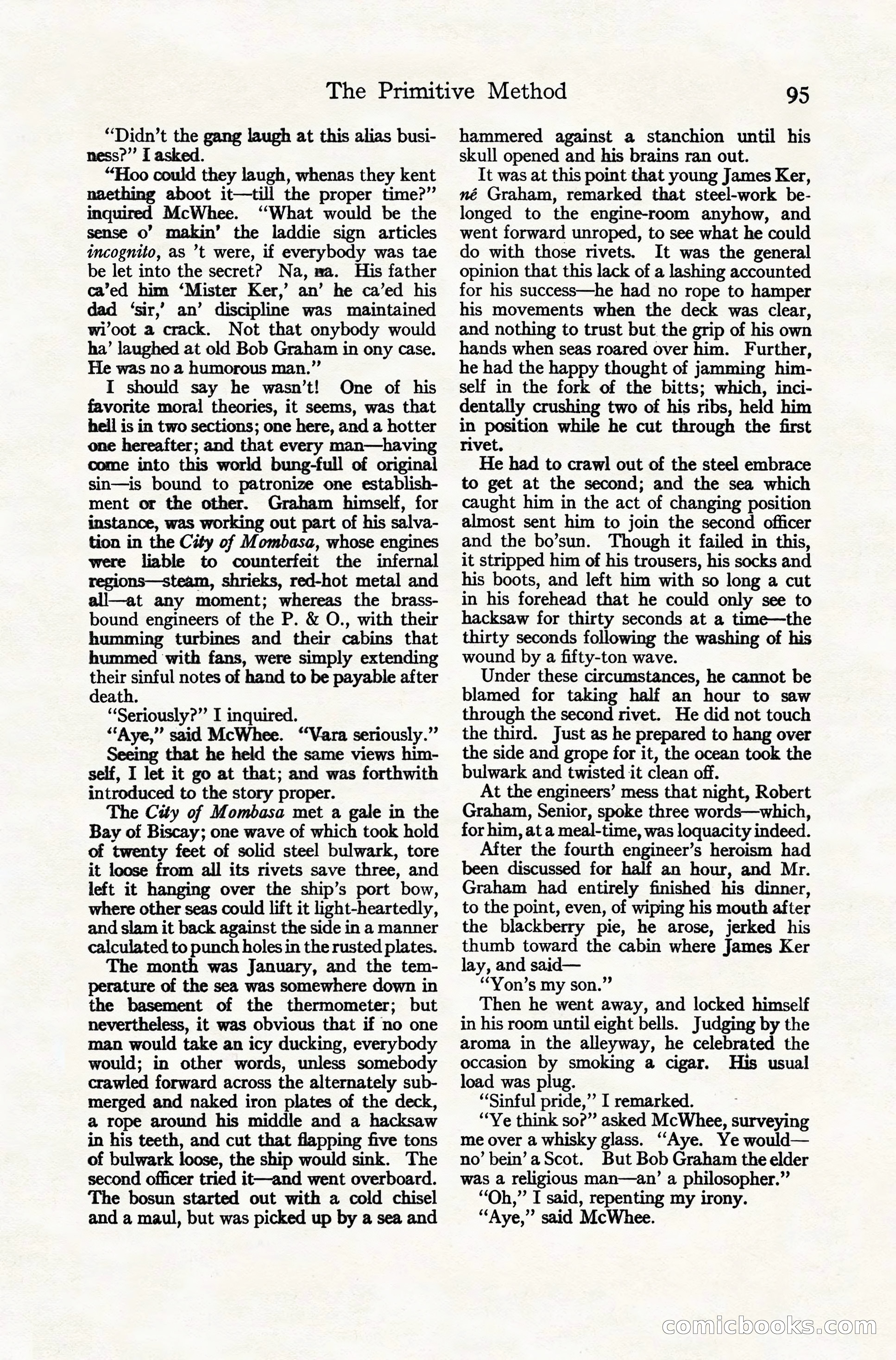
A restored page from Pulp Fiction, 1924. Page through the whole issue in the reader above.
📄 Transcribed text from this page (OCR, searchable)
Machine-transcribed from the original scan — historical spelling and the odd misread are preserved.
The Primitive Method “Didn’t the gang laugh at this alias busi- ness?”’ I asked. “Hoo could they laugh, whenas they kent naething aboot it—till the proper time?” inquired McWhee. ‘‘What would be the sense o’ makin’ the laddie sign articles incognito, as ’t were, if everybody was tae be let into the secret? Na, wa. His father ca’ed him ‘Mister Ker,’ an’ he ca’ed his dad ‘sir,’ an’ discipline was maintained wi’oot a crack. Not that onybody would ha’ laughed at old Bob Graham in ony case. He was no a humorous man.” I should say he wasn’t! One of his favorite moral theories, it seems, was that hell is in two sections; one here, and a hotter one hereafter; and that every man—having come into this world bung-full of original sin—is bound to patronize one establish- ment or the other. Graham himself, for instance, was working out part of his salva- tion in the Cty of Mombasa, whose engines were liable to counterfeit the infernal regions—steam, shrieks, red-hot metal and all—at any moment; whereas the brass- bound engineers of the P. & O., with their humming turbines and their cabins that hummed with fans, were simply extending their sinful notes of hand to be payable after death. “Seriously?” I inquired. “‘Aye,” said McWhee. “Vara seriously.” Seeing that he held the same views him- self, I let it go at that; and was forthwith introduced to the story proper. The City of Mombasa met a gale in the Bay of Biscay; one wave of which took hold of twenty feet of solid steel bulwark, tore it loose from all its rivets save three, and left it hanging over the ship’s port bow, where other seas could lift it light-heartedly, and slam it back against the side in a manner calculated to punch holes in the rusted plates. The month was January, and the tem- perature of the sea was somewhere down in the basement of the thermometer; but nevertheless, it was obvious that if no one man would take an icy ducking, everybody would; in other words, unless somebody crawled forward across the alternately sub- merged and naked iron plates of the deck, a rope around his middle and a hacksaw in his teeth, and cut that flapping five tons of bulwark loose, the ship would sink. The second officer tried it—and went overboard. The bosun started out with a cold chisel and a maul, but was picked up by a sea and 95 hammered against a stanchion until his skull opened and his brains ran out. It was at this point that young James Ker, né Graham, remarked that steel-work be- longed to the engineroom anyhow, and went forward unroped, to see what he could do with those rivets. It was the general opinion that this lack of a lashing accounted for his success—he had no rope to hamper his movements when the deck was clear, and nothing to trust but the grip of his own hands when seas roared over him. Further, he had the happy thought of jamming him- self in the fork of the bitts; which, inci- dentally crushing two of his ribs, held him in position while he cut through the first rivet. He had to crawl out of the steel embrace to get at the second; and the sea which caught him in the act of changing position almost sent him to join the second officer and the bo’sun. Though it failed in this, it stripped him of his trousers, his socks and his boots, and left him with so long a cut in his forehead that he could only see to hacksaw for thirty seconds at a time—the thirty seconds following the washing of his wound by a fifty-ton wave. Under these circumstances, he cannot be blamed for taking half an hour to saw through the second rivet. He did not touch the third. Just as he prepared to hang over the side and grope for it, the ocean took the bulwark and twisted it clean off. At the engineers’ mess that night, Robert Graham, Senior, spoke three words—which, for him, at a meal-time, was loquacity indeed. After the fourth engineer’s heroism had been discussed for half an hour, and Mr. Graham had entirely finished his dinner, to the point, even, of wiping his mouth after the blackberry pie, he arose, jerked his thumb toward the cabin where James Ker lay, and said— ‘“‘Yon’s my son.” Then he went away, and locked himself in his room until eight bells. Judging by the aroma in the alleyway, he celebrated the occasion by smoking a cigar. His usual load was plug. “Sinful pride,” I remarked. “Ye think sor” asked McWhee, surveying me over a whisky glass. “Aye. Ye would— no’ bein’a Scot. But Bob Graham the elder was a religious man—an’ a philosopher.” “Oh,” I said, repenting my irony. “Aye,” said McWhee. Comicbook (©