
Pulp Fiction, 1924 · page 66 of 194
Adventure Magazine Cover, November 10, 1924 — page 66: what you’re looking at
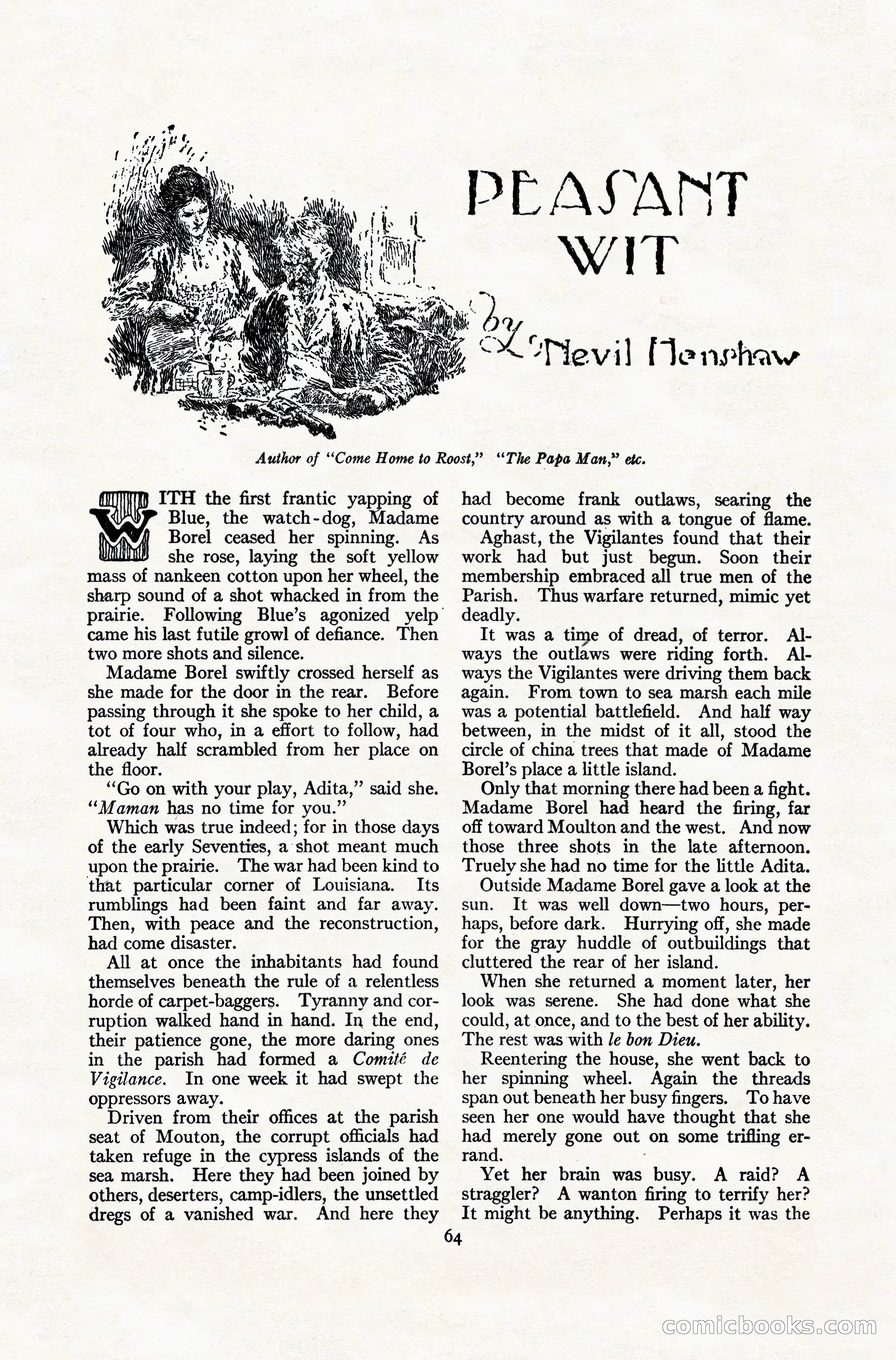
A restored page from Pulp Fiction, 1924. Page through the whole issue in the reader above.
📄 Transcribed text from this page (OCR, searchable)
Machine-transcribed from the original scan — historical spelling and the odd misread are preserved.
! or" th, na, oe ix Ao A WT vi . "Nevill Menrhaw Author of ‘Come Home to Roost,” ‘The Papa Man,” etc. oe ITH the first frantic yapping of WS Blue, the watch-dog, Madame ind Borel ceased her spinning. As she rose, laying the soft yellow mass of nankeen cotton upon her wheel, the sharp sound of a shot whacked in from the prairie. came his last futile growl of defiance. Then two more shots and silence. Madame Borel swiftly crossed herself as she made for the door in the rear. Before passing through it she spoke to her child, a tot of four who, in a effort to follow, had already half scrambled from her place on the floor. “Go on with your play, Adita,” said she. ‘Maman has no time for you.” Which was true indeed; for in those days of the early Seventies, a shot meant much upon the prairie. The war had been kind to that particular corner of Louisiana. Its rumblings had been faint and far away. Then, with peace and the reconstruction, had come disaster. All at once the inhabitants had found themselves beneath the rule of a relentless horde of carpet-baggers. Tyranny and cor- ruption walked hand in hand. In the end, their patience gone, the more daring ones in the parish had formed a Comité de Vigilance. In one week it had swept the oppressors away. Driven from their offices at the parish seat of Mouton, the corrupt officials had taken refuge in the cypress islands of the sea marsh. Here they had been joined by others, deserters, camp-idlers, the unsettled dregs of a vanished war. And here they Following Blue’s agonized yelp had become frank outlaws, searing the country around as with a tongue of flame. Aghast, the Vigilantes found that their work had but just begun. Soon their membership embraced all true men of the Parish. Thus warfare returned, mimic yet deadly. It was a time of dread, of terror. Al- ways the outlaws were riding forth. Al- ways the Vigilantes were driving them back again. From town to sea marsh each mile was a potential battlefield. And half way between, in the midst of it all, stood the circle of china trees that made of Madame Borel’s place a little island. Only that morning there had been a fight. Madame Borel had heard the firing, far off toward Moulton and the west. And now those three shots in the late afternoon. Truely she had no time for the little Adita. Outside Madame Borel gave a look at the sun. It was well down—two hours, per- haps, before dark. Hurrying off, she made for the gray huddle of outbuildings that cluttered the rear of her island. When she returned a moment later, her look was serene. She had done what she could, at once, and to the best of her ability. The rest was with le bon Dieu. Reentering the house, she went back to her spinning wheel. Again the threads span out beneath her busy fingers. ‘To have seen her one would have thought that she had merely gone out on some trifling er- rand. ; Yet her brain was busy. A raid? A straggler? A wanton firing to terrify her? It might be anything. Perhaps it was the 64 CoOMmiclhoo (© 5}