
Pulp Fiction, 1924 · page 59 of 194
Adventure Magazine Cover, November 10, 1924 — page 59: what you’re looking at
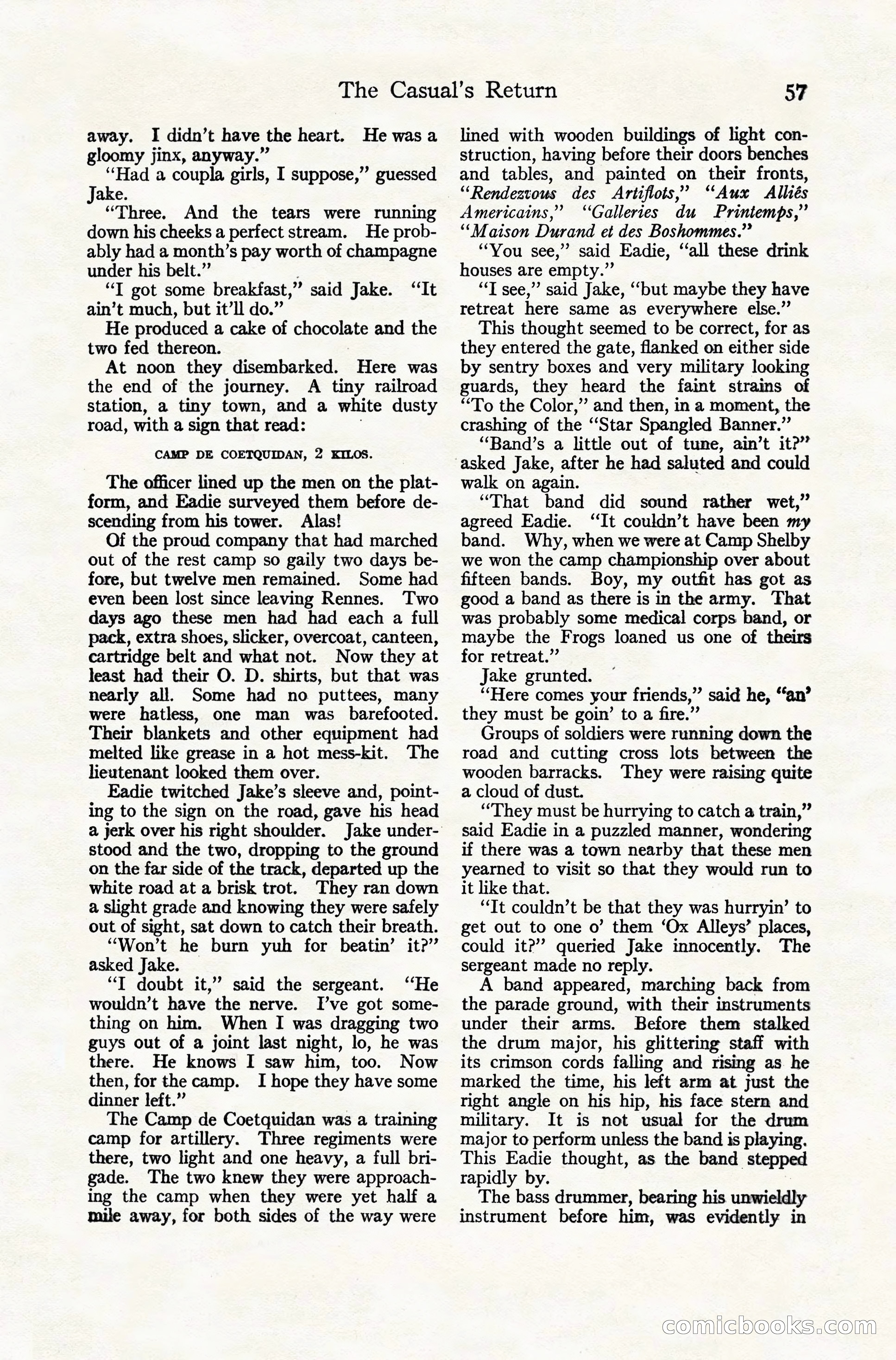
A restored page from Pulp Fiction, 1924. Page through the whole issue in the reader above.
📄 Transcribed text from this page (OCR, searchable)
Machine-transcribed from the original scan — historical spelling and the odd misread are preserved.
The Casual’s Return away. I didn’t have the heart. He was a gloomy jinx, anyway.” “Had a coupla girls, I suppose,” guessed Jake. “Three. And the tears were running down his cheeks a perfect stream. He prob- ably had a month’s pay worth of champagne under his belt.” “T got some breakfast, ” said Jake. ain’t much, but it’ll do.” He produced a cake of chocolate and the two fed thereon. At noon they disembarked. Here was the end of the journey. A tiny railroad station, a tiny town, and a white dusty road, with a sign that read: CAMP DE COETQUIDAN, 2 KILOS. The officer lined up the men on the plat- form, and Eadie surveyed them before de- scending from his tower. Alas! Of the proud company that had marched out of the rest camp so gaily two days be- fore, but twelve men remained. Some had even been lost since leaving Rennes. Two days ago these men had had each a full pack, extra shoes, slicker, overcoat, canteen, cartridge belt and what not. Now they at least had their O. D. shirts, but that was nearly all. Some had no puttees, many were hatless, one man was barefooted. Their blankets and other equipment had melted like grease in a hot mess-kit. The lieutenant looked them over. Eadie twitched Jake’s sleeve and, point- ing to the sign on the road, gave his head a jerk over his right shoulder. stood and the two, dropping to the ground on the far side of the track, departed up the white road at a brisk trot. They ran down a slight grade and knowing they were safely out of sight, sat down to catch their breath. ‘“Won’t he burn yuh for beatin’ it?” asked Jake. “T doubt it,” said the sergeant. “He wouldn’t have the nerve. I’ve got some- thing on him. When I was dragging two guys out of a joint last night, lo, he was there. He knows I saw him, too. Now then, for the camp. I hope they have some dinner left.” The Camp de Coetquidan was a training camp for artillery. Three regiments were there, two light and one heavy, a full bri- gade. The two knew they were approach- ing the camp when they were yet half a mile away, for both sides of the way were aby fe Jake under- 57 lined with wooden buildings of light con- struction, having before their doors benches and tables, and painted on their fronts, ““Rendeztous des Artiflots,’ “Aux Alliés Americains,’ “Galleries du Printemps,” ‘““Maison Durand et des Boshommes.” “You see,” said Eadie, “all these drink houses are empty.” “T see,”’ said Jake, ‘‘but maybe they have retreat here same as everywhere else.” This thought seemed to be correct, for as they entered the gate, flanked on either side by sentry boxes and very military looking guards, they heard the faint strains of ‘““To the Color,” and then, in a moment, the crashing of the ‘‘Star Spangled Banner.” ‘“‘Band’s a little out of tune, ain’t it?” asked Jake, after he had saluted and could walk on again. “That band did sound rather wet,” agreed Eadie. ‘It couldn’t have been my band. Why, when we were at Camp Shelby we won the camp championship over about fifteen bands. Boy, my outfit has got as good a band as there is in the army. That was probably some medical corps band, or maybe the Frogs loaned us one of theirs for retreat.” Jake grunted. ‘“‘Here comes your friends,” said he, “an? they must be goin’ to a fire.” Groups of soldiers were running down the road and cutting cross lots between the wooden barracks. They were raising quite a cloud of dust. “They must be hurrying to catch a train,” said Eadie in a puzzled manner, wondering if there was a town nearby that these men yearned to visit so that they would run to it like that. “Tt couldn’t be that they was hurryin’ to get out to one o’ them ‘Ox Alleys’ places, could it?’ queried Jake innocently. The sergeant made no reply. A band appeared, marching back from the parade ground, with their instruments under their arms. Before them stalked the drum major, his glittering staff with its crimson cords falling and rising as he marked the time, his left arm at just the right angle on his hip, his face stern and military. It is not usual for the drum major to perform unless the band is playing. This Eadie thought, as the band stepped rapidly by. The bass drummer, bearing his unwieldly instrument before him, was evidently in Comicbook (© =