
Pulp Fiction, 1924 · page 19 of 194
Adventure Magazine Cover, November 10, 1924 — page 19: what you’re looking at
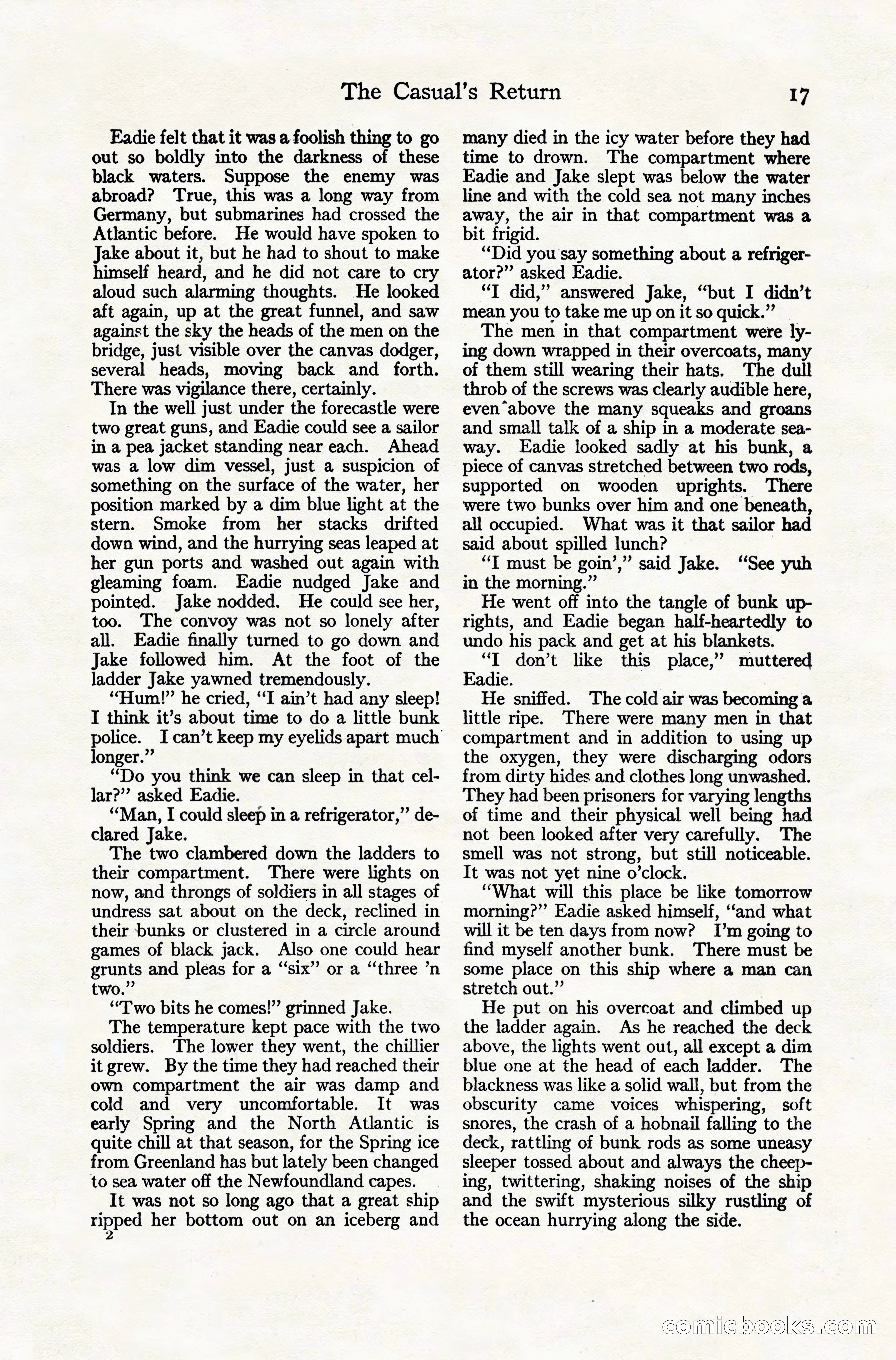
A restored page from Pulp Fiction, 1924. Page through the whole issue in the reader above.
📄 Transcribed text from this page (OCR, searchable)
Machine-transcribed from the original scan — historical spelling and the odd misread are preserved.
The Casual’s Return Eadie felt that it was a foolish thing to go out so boldly into the darkness of these black waters. Suppose the enemy was abroad? ‘True, this was a long way from Germany, but submarines had crossed the Atlantic before. He would have spoken to Jake about it, but he had to shout to make himself heard, and he did not care to cry aloud such alarming thoughts. He looked aft again, up at the great funnel, and saw against the sky the heads of the men on the bridge, just visible over the canvas dodger, several heads, moving back and forth. There was vigilance there, certainly. In the well just under the forecastle were two great guns, and Eadie could see a sailor in a pea jacket standing near each. Ahead was a low dim vessel, just a suspicion of something on the surface of the water, her position marked by a dim blue light at the stern. Smoke from her stacks drifted down wind, and the hurrying seas leaped at her gun ports and washed out again with gleaming foam. Eadie nudged Jake and pointed. Jake nodded. He could see her, too. The convoy was not so lonely after all. Eadie finally turned to go down and Jake followed him. At the foot of the ladder Jake yawned tremendously. “Hum!” he cried, ‘I ain’t had any sleep! I think it’s about time to do a little bunk police. longer.” “Do you think we can sleep in that cel- lar?’”’ asked Eadie. “Man, I could sleep in a refrigerator,” de- clared Jake. The two clambered down the ladders to their compartment. There were lights on now, and throngs of soldiers in all stages of undress sat about on the deck, reclined in their bunks or clustered in a circle around games of black jack. Also one could hear grunts and pleas for a “‘six” or a “three ’n two.” ‘“‘Two bits he comes!” grinned Jake. The temperature kept pace with the two soldiers. ‘The lower they went, the chillier it grew. By the time they had reached their own compartment the air was damp and cold and very uncomfortable. It was early Spring and the North Atlantic is quite chill at that season, for the Spring ice from Greenland has but lately been changed to sea water off the Newfoundland capes. It was not so long ago that a great ship ripped her bottom out on an iceberg and I can’t keep my eyelids apart much 17 many died in the icy water before they had time to drown. The compartment where Eadie and Jake slept was below the water line and with the cold sea not many inches away, the air in that compartment was a bit frigid. “Did you say something about a refriger- ator?” asked Eadie. “I did,’ answered Jake, “but I didn’t mean you to take me up on it so quick.”’ The men in that compartment were ly- ing down wrapped in their overcoats, many of them still wearing their hats. The dull throb of the screws was clearly audible here, even above the many squeaks and groans and small talk of a ship in a moderate sea- way. Eadie looked sadly at his bunk, a piece of canvas stretched between two rods, supported on wooden uprights. There were two bunks over him and one beneath, all occupied. What was it that sailor had said about spilled lunch? | “Tt must be goin’,” said Jake. ‘See yuh in the morning.” He went off into the tangle of bunk up- rights, and Eadie began half-heartedly to undo his pack and get at his blankets. “IT don’t like this place,’’ muttered Eadie. He sniffed. The cold air was becoming a little npe. There were many men in that compartment and in addition to using up the oxygen, they were discharging odors from dirty hides and clothes long unwashed. They had been prisoners for varying lengths of time and their physical well being had not been looked after very carefully. The smell was not strong, but still noticeable. It was not yet nine o’clock. “What will this place be like tomorrow morning?” Eadie asked himself, ‘‘and what will it be ten days from now? I’m going to find myself another bunk. There must be some place on this ship where a man can stretch out.” He put on his overcoat and climbed up the ladder again. As he reached the deck above, the lights went out, all except a dim blue one at the head of each ladder. The blackness was like a solid wall, but from the obscurity came voices whispering, soft snores, the crash of a hobnail falling to the deck, rattling of bunk rods as some uneasy sleeper tossed about and always the cheep- ing, twittering, shaking noises of the ship and the swift mysterious silky rustling of the ocean hurrying along the side. CoOMmicboook. ) (© 5}