
Pulp Fiction, 1924 · page 185 of 194
Adventure Magazine Cover, November 10, 1924 — page 185: what you’re looking at
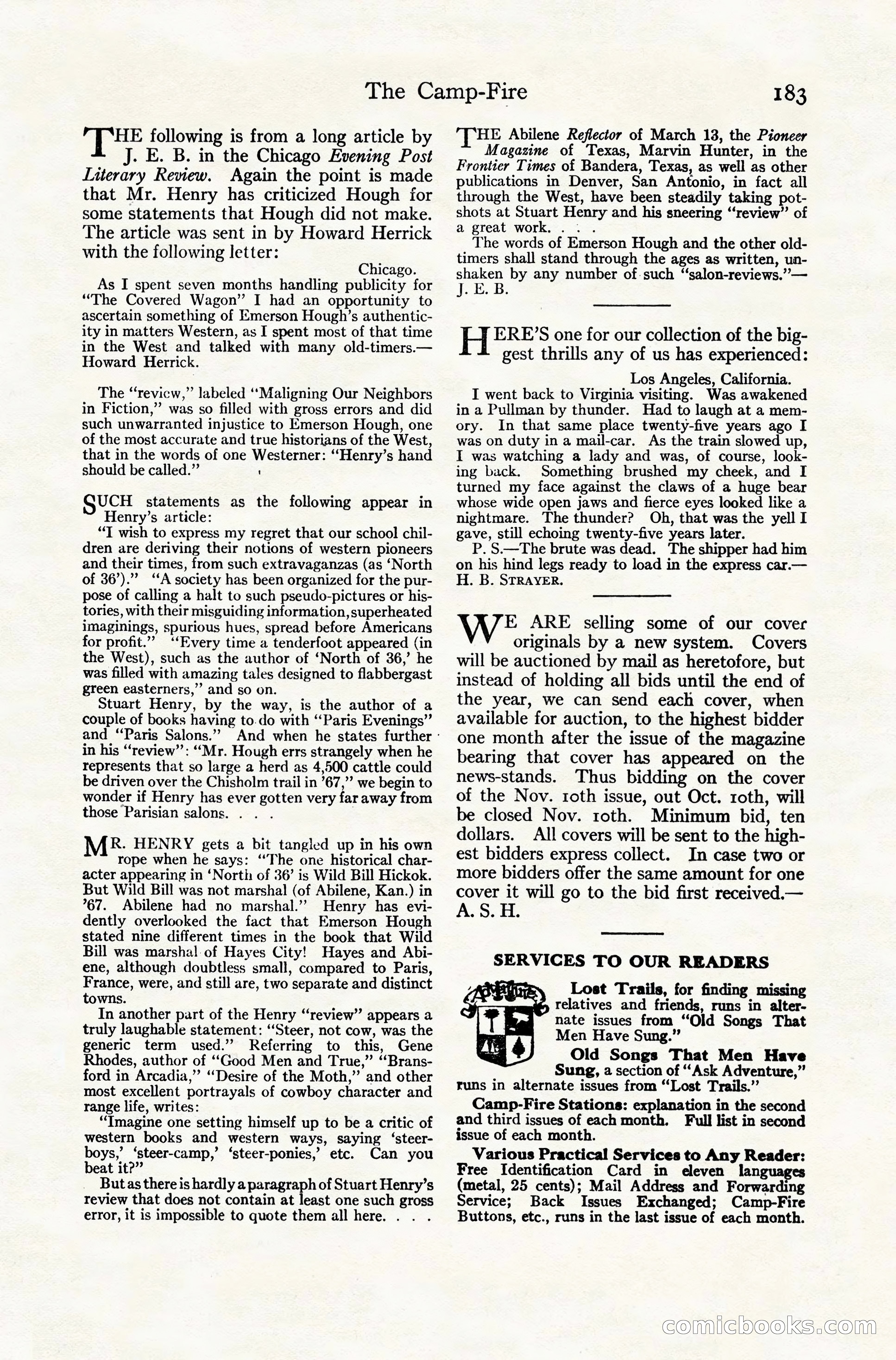
A restored page from Pulp Fiction, 1924. Page through the whole issue in the reader above.
📄 Transcribed text from this page (OCR, searchable)
Machine-transcribed from the original scan — historical spelling and the odd misread are preserved.
The Camp-Fire "Tt following is from a long article by J. E. B. in the Chicago Evening Post Literary Review. Again the point is made that Mr. Henry has criticized Hough for some statements that Hough did not make. The article was sent in by Howard Herrick with the following letter: Chicago. As I spent seven months handling publicity for “The Covered Wagon’ I had an opportunity to ascertain something of Emerson Hough’s authentic- ity in matters Western, as I spent most of that time in the West and talked with many old-timers.— Howard Herrick. The “revicw,” labeled ‘‘Maligning Our Neighbors in Fiction,” was so filled with gross errors and did such unwarranted injustice to Emerson Hough, one of the most accurate and true historians of the West, that in the words of one Westerner: ‘“‘Henry’s hand should be called.” ' SUCH statements as the following appear in Henry’s article: “T wish to express my regret that our school chil- dren are deriving their notions of western pioneers and their times, from such extravaganzas (as ‘North of 36’).” ‘A society has been organized for the pur- pose of calling a halt to such pseudo-pictures or his- tories, with their misguiding information, superheated imaginings, spurious hues, spread before Americans for profit.” ‘‘Every time a tenderfoot appeared (in the West), such as the author of ‘North of 36,’ he was filled with amazing tales designed to flabbergast green easterners,’’ and so on. Stuart Henry, by the way, is the author of a couple of books having to.do with “Paris Evenings” and “Paris Salons.’ in his “review”: “Mr. Hough errs strangely when he represents that so large a herd as 4,500 cattle could driven over the Chisholm trail in ’67,”’ we begin to wonder if Henry has ever gotten very far away from those Parisian salons. . . . | ME. HENRY gets a bit tangled up in his own rope when he says: “The one historical char- acter appearing in ‘North of 36’ is Wild Bill Hickok. But Wild Bill was not marshal (of Abilene, Kan.) in 67. Abilene had no marshal.’”’ Henry has evi- dently overlooked the fact that Emerson Hough stated nine different times in the book that Wild Bill was marshal of Hayes City! Hayes and Abi- ene, although doubtless small, compared to Paris, France, were, and still are, two separate and distinct towns. In another part of the Henry “review” appears a truly laughable statement: ‘Steer, not cow, was the generic term used.” Referring to this, Gene Rhodes, author of ““Good Men and True,” ‘Brans- ford in Arcadia,” “Desire of the Moth,” and other most excellent portrayals of cowboy character and range life, writes: “Imagine one setting himself up to be a critic of western books and western ways, saying ‘steer- boys,’ ‘steer-camp,’ ‘steer-ponies,’ etc. Can you beat it?” But as there is hardly a paragraph of Stuart Henry’s review that does not contain at least one such gross error, it is impossible to quote them all here. . . . And when he states further - 183 HE Abilene Reflector of March 13, the Pioneer Magazine of Texas, Marvin Hunter, in the Frontier Times of Bandera, Texas, as well as other publications in Denver, San Antonio, in fact all through the West, have been steadily taking pot- shots at Stuart Henry and his sneering “review” of a great work... . The words of Emerson Hough and the other old- timers shall stand through the ages as written, un- shaken by any number of-such “salon-reviews.”— J. E. B. H ERE’S one for our collection of the big- gest thrills any of us has experienced: Los Angeles, California. I went back to Virginia visiting. Was awakened in a Pullman by thunder. Had to laugh at a mem- ory. In that same place twenty-five years ago I was on duty in a mail-car. As the train slowed up, I was watching a lady and was, of course, look- ing back. Something brushed my cheek, and I turned my face against the claws of a huge bear whose wide open jaws and fierce eyes looked like a nightmare. The thunder? Oh, that was the yell I gave, still echoing twenty-five years later. P. S.—The brute was dead. The shipper had him on his hind legs ready to load in the express car.— H. B. STRAYER. WE ARE selling some of our cover originals by a new system. Covers will be auctioned by mail as heretofore, but instead of holding all bids until the end of the year, we can send each cover, when available for auction, to the highest bidder one month after the issue of the magazine bearing that cover has appeared on the news-stands. Thus bidding on the cover of the Nov. roth issue, out Oct. roth, will be closed Nov. roth. Minimum bid, ten dollars. All covers will be sent to the high- est bidders express collect. In case two or more bidders offer the same amount for one cover it will go to the bid first received.— A. S. H. SERVICES TO OUR READERS Lost Trails, for finding missing relatives and friends, runs in alter- nate issues from “Old Songs That Men Have Sung.” Old Songs That Men Have Sung, 2 section of “Ask Adventure,” funs in alternate issues from “Lost Trails.” Camp-Fire Stations: explanation in the second and third issues of each month. Full list in second issue of each month. Various Practical Services to Any Reader: Free Identification Card in eleven languages (metal, 25 cents); Mail Address and Forwarding Service; Back Issues Exchanged; Camp-Fire Buttons, etc., runs in the last issue of each month. Comicloooks =