
Pulp Fiction, 1924 · page 164 of 194
Adventure Magazine Cover, November 10, 1924 — page 164: what you’re looking at
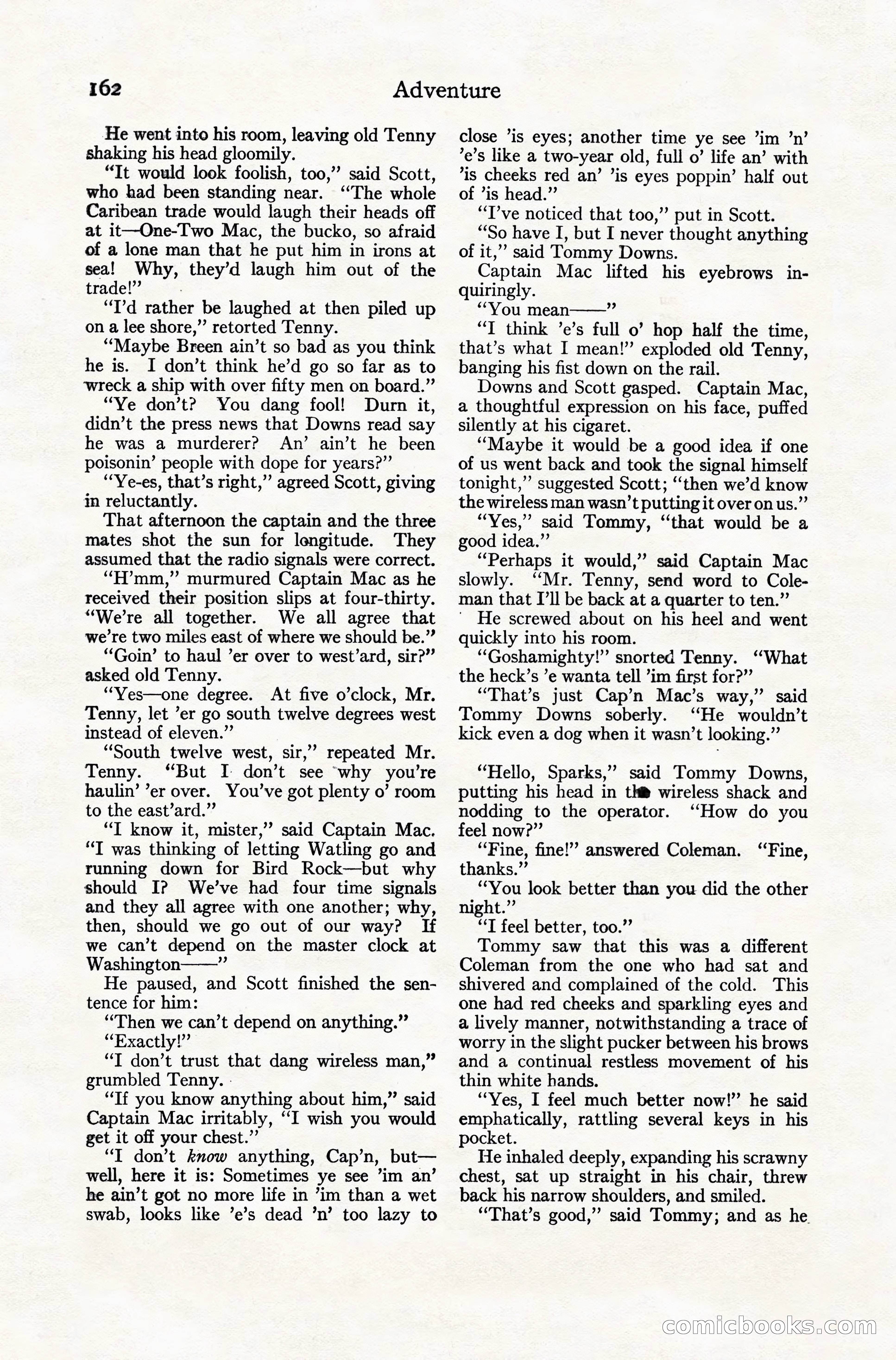
A restored page from Pulp Fiction, 1924. Page through the whole issue in the reader above.
📄 Transcribed text from this page (OCR, searchable)
Machine-transcribed from the original scan — historical spelling and the odd misread are preserved.
162 He went into his room, leaving old Tenny shaking his head gloomily. “It would look foolish, too,” said Scott, who had been standing near. ‘The whole Caribean trade would laugh their heads off at it—One-Two Mac, the bucko, so afraid of a lone man that he put him in irons at sea! Why, they’d laugh him out of the trade!” . “I'd rather be laughed at then piled up on a lee shore,” retorted Tenny. “Maybe Breen ain’t so bad as you think he is. I don’t think he’d go so far as to ‘wreck a ship with over fifty men on board.” “Ye don’t? You dang fool! Durn it, didn’t the press news that Downs read say he was a murderer? An’ ain’t he been poisonin’ people with dope for years?” ‘“Ye-es, that’s right,” agreed Scott, giving in reluctantly. That afternoon the captain and the three mates shot the sun for lengitude. They assumed that the radio signals were correct. ‘“H’mm,’’? murmured Captain Mac as he received their position slips at four-thirty. “We're all together. We all agree that we're two miles east of where we should be.” “Goin’ to haul ’er over to west’ard, sir?” asked old Tenny. ““Yes—one degree. At five o’clock, Mr. Tenny, let ’er go south twelve degrees west instead of eleven.” “South twelve west, sir,” repeated Mr. Tenny. “But I don’t see ‘why you’re haulin’ ’er over. You’ve got plenty o’ room to the east’ard.” “T know it, mister,” said Captain Mac. “T was thinking of letting Watling go and running down for Bird Rock—but why should I? We’ve had four time signals and they all agree with one another; why, then, should we go out of our way? If we can’t depend on the master clock at Washington——”’ He paused, and Scott finished the sen- tence for him: ‘“‘Then we can’t depend on anything.” “Exactly!” “T don’t trust that dang wireless man,” grumbled Tenny. - “Tf you know anything about him,” said Captain Mac irritably, ‘I wish you would get it off your chest.” “YT don’t know anything, Cap’n, but— well, here it is: Sometimes ye see ’im an’ he ain’t got no more life in ’im than a wet swab, looks like ’e’s dead ’n’ too lazy to Adventure close ’is eyes; another time ye see ’im ’n’ ’e’s like a two-year old, full o’ life an’ with 1s cheeks red an’ ’is eyes poppin’ half out of ’is head.” ‘T’ve noticed that too,’”’ put in Scott. “So have I, but I never thought anything of it,” said Tommy Downs. Captain Mac lifted his eyebrows in- quiringly. ““You mean——” “I think ’e’s full o’ hop half the time, that’s what I mean!” exploded old Tenny, banging his fist down on the rail. Downs and Scott gasped. Captain Mac, a thoughtful expression on his face, puffed silently at his cigaret. ‘Maybe it would be a good idea if one of us went back and took the signal himself tonight,”’ suggested Scott; ‘then we’d know the wireless man wasn’t putting it over on us.”’ “Yes,” said Tommy, ‘‘that would be a good idea.” ‘“‘Perhaps it would,” said Captain Mac slowly. “Mr. Tenny, send word to Cole- man that I’ll be back at a quarter to ten.”’ ' He screwed about on his heel and went quickly into his room. ““Goshamighty!”’ snorted Tenny. ‘What the heck’s ’e wanta tell ’im first for?” “That’s just Cap’n Mac’s way,” said Tommy Downs soberly. ‘He wouldn’t kick even a dog when it wasn’t looking.” “Hello, Sparks,’ said Tommy Downs, putting his head in th® wireless shack and nodding to the operator. ‘‘How do you feel now?” ‘Fine, fine!” answered Coleman. “Fine, thanks.” “You look better than you did the other night.” “‘T feel better, too.’’ Tommy saw that this was a different Coleman from the one who had sat and shivered and complained of the cold. This one had red cheeks and sparkling eyes and a lively manner, notwithstanding a trace of worry in the slight pucker between his brows and a continual restless movement of his thin white hands. “Yes, I feel much better now!’ he said emphatically, rattling several keys in his pocket. He inhaled deeply, expanding his scrawny chest, sat up straight in his chair, threw back his narrow shoulders, and smiled. “‘That’s good,”’ said Tommy; and as he CoMmicbook A) (© =