
Pulp Fiction, 1924 · page 158 of 194
Adventure Magazine Cover, November 10, 1924 — page 158: what you’re looking at
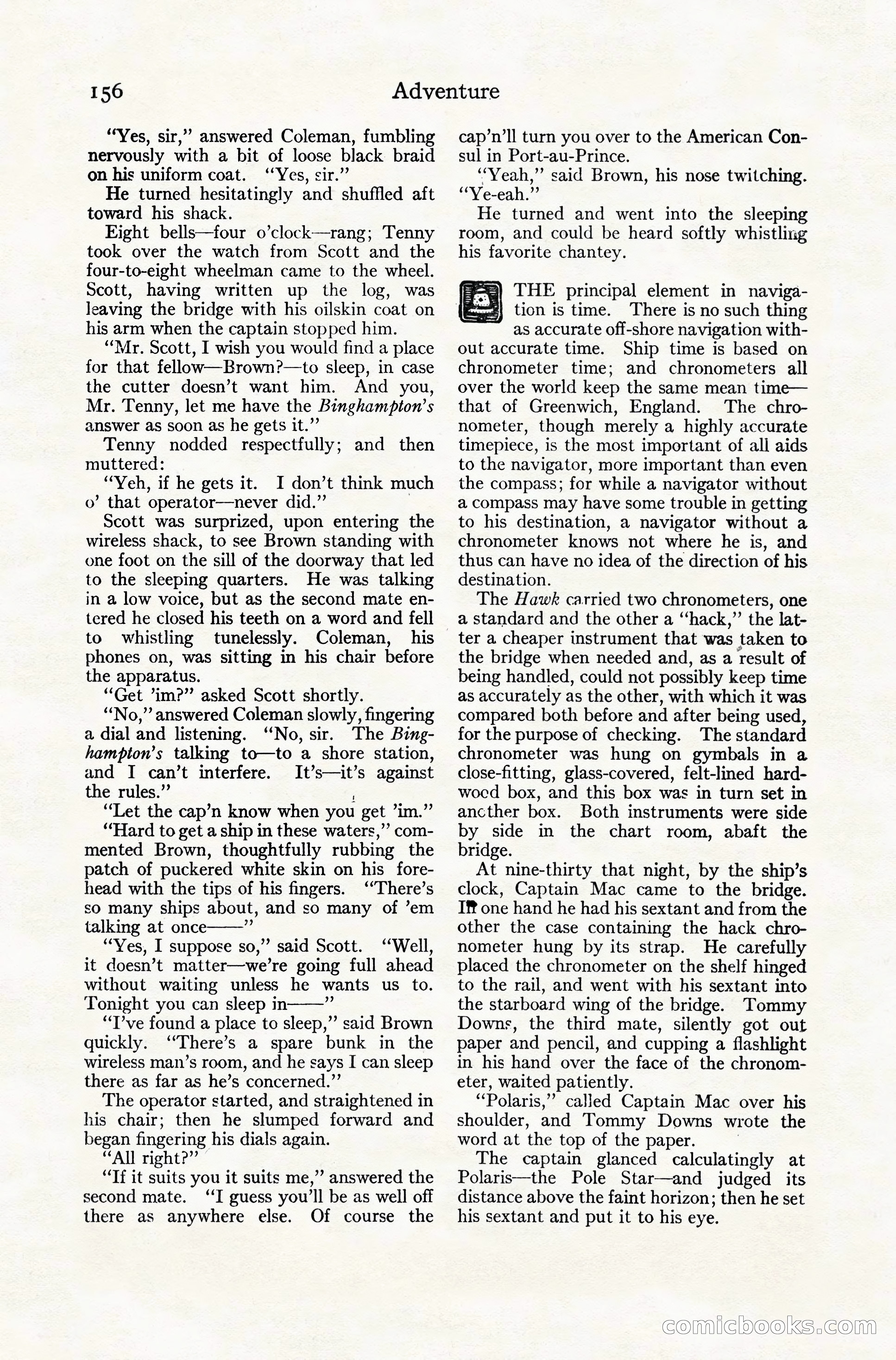
A restored page from Pulp Fiction, 1924. Page through the whole issue in the reader above.
📄 Transcribed text from this page (OCR, searchable)
Machine-transcribed from the original scan — historical spelling and the odd misread are preserved.
156 “Yes, sir,” answered Coleman, fumbling nervously with a bit of loose black braid on his uniform coat. ‘‘Yes, cir.” He turned hesitatingly and shuffled aft toward his shack. Eight bells—four o’clock—rang; Tenny took over the watch from Scott and the four-to-eight wheelman came to the wheel. Scott, having written up the log, was leaving the bridge with his oilskin coat on his arm when the captain stopped him. “Mr. Scott, I wish you would find a place for that fellow—Brown?—to sleep, in case the cutter doesn’t want him. And you, Mr. Tenny, let me have the Binghampton’s answer as soon as he gets it.” Tenny nodded respectfully; and then muttered: “Yeh, if he gets it. I don’t think much o’ that operator—never did.” | Scott was surprized, upon entering the wireless shack, to see Brown standing with one foot on the sill of the doorway that led to the sleeping quarters. He was talking in a low voice, but as the second mate en- tered he closed his teeth on a word and fell to whistling tunelessly. Coleman, his phones on, was sitting in his chair before the apparatus. “Get im?” asked Scott shortly. “No,” answered Coleman slowly, fingering a dial and listening. ‘‘No, sir. The Bing- hampton’s talking to—to a shore station, and I can’t interfere. It’s—it’s against the rules.”’ ; “Let the cap’n know when you get ’im.”’ “Hard to get a ship in these waters,”’ com- mented Brown, thoughtfully rubbing the patch of puckered white skin on his fore- head with the tips of his fingers. ‘““There’s so many ships about, and so many of ’em talking at once “Yes, I suppose so,” said Scott. ‘Well, it doesn’t matter—we’re going full ahead without waiting unless he wants us to. Tonight you can sleep in 2 “T’ve found a place to sleep,” said Brown quickly. ‘‘There’s a spare bunk in the wireless man’s room, and he says I can sleep there as far as he’s concerned.”’ The operator started, and straightened in his chair; then he slumped forward and began fingering his dials again. “All right?” — “Tf it suits you it suits me,”’ answered the second mate. “I guess you'll be as well off there as anywhere else. Of course the Adventure cap’n’ll turn you over to the American Con- sul in Port-au-Prince. ‘““Yeah,”’ said Brown, his nose twitching. “Ve-eah.”’ He turned and went into the sleeping room, and could be heard softly whistling his favorite chantey. THE principal element in naviga- tion is time. There is no such thing as accurate off-shore navigation with- out accurate time. Ship time is based on chronometer time; and chronometers all over the world keep the same mean time— that of Greenwich, England. The chro- nometer, though merely a highly accurate timepiece, is the most important of all aids to the navigator, more important than even the compass; for while a navigator without a compass may have some trouble in getting to his destination, a navigator without a chronometer knows not where he is, and thus can have no idea of the direction of his destination. The Hawk carried two chronometers, one a standard and the other a ‘“‘hack,”’ the lat- ter a cheaper instrument that was taken to the bridge when needed and, as a result of being handled, could not possibly keep time as accurately as the other, with which it was compared both before and after being used, for the purpose of checking. The standard chronometer was hung on gymbals in a close-fitting, glass-covered, felt-lined hard- wocd box, and this box was in turn set in ancther box. Both instruments were side by side in the chart room, abaft the bridge. At nine-thirty that night, by the ship’s clock, Captain Mac came to the bridge. Iff one hand he had his sextant and from the other the case containing the hack chro- nometer hung by its strap. He carefully placed the chronometer on the shelf hinged to the rail, and went with his sextant into the starboard wing of the bridge. Tommy Downs, the third mate, silently got out paper and pencil, and cupping a flashlight in his hand over the face of the chronom- eter, waited patiently. ‘Polaris,’ called Captain Mac over his shoulder, and Tommy Downs wrote the word at the top of the paper. The captain glanced calculatingly at Polaris—the Pole Star—and judged its distance above the faint horizon; then he set his sextant and put it to his eye. CoOMmicloo © 5}