
Pulp Fiction, 1924 · page 154 of 194
Adventure Magazine Cover, November 10, 1924 — page 154: what you’re looking at
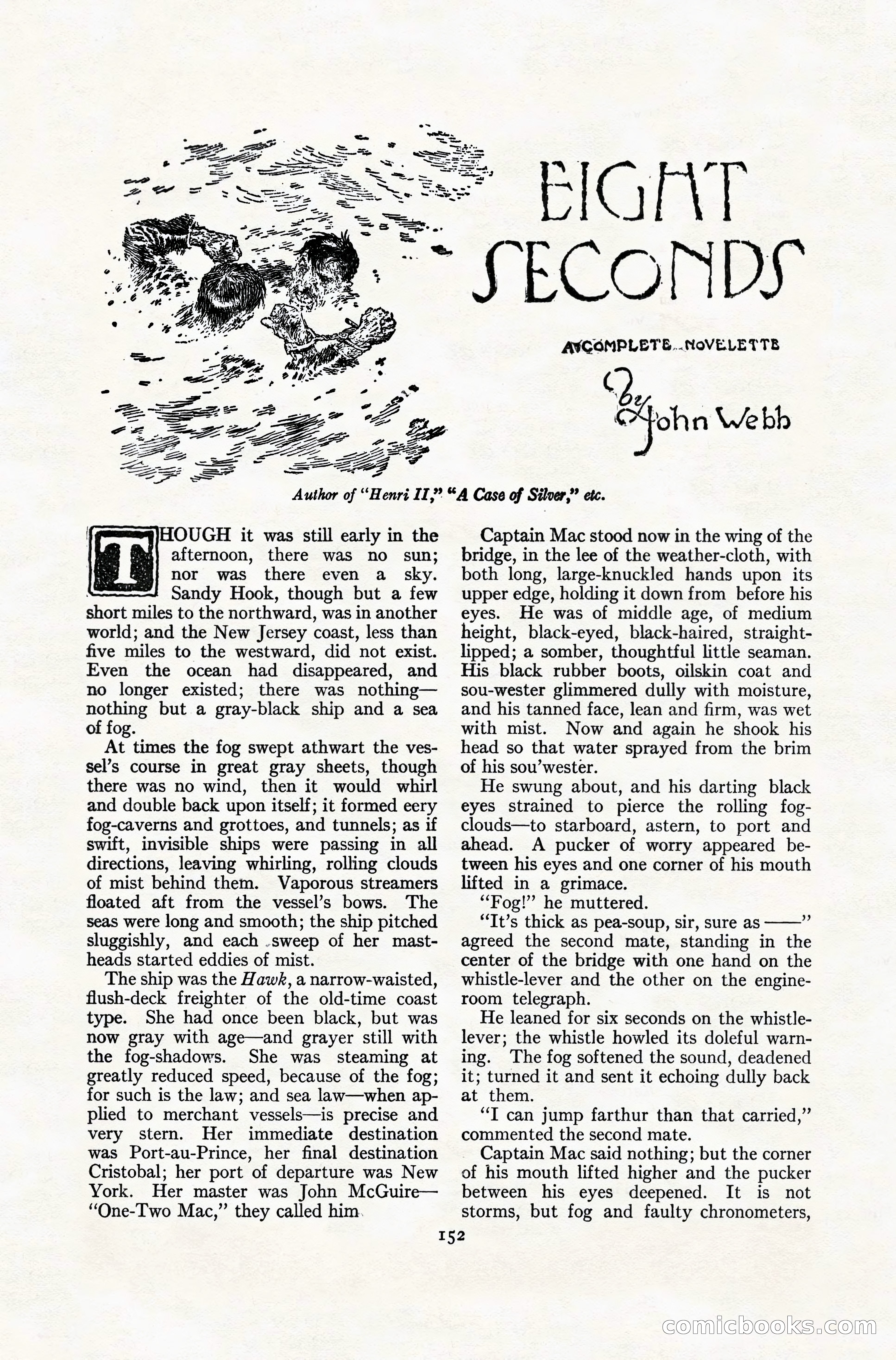
A restored page from Pulp Fiction, 1924. Page through the whole issue in the reader above.
📄 Transcribed text from this page (OCR, searchable)
Machine-transcribed from the original scan — historical spelling and the odd misread are preserved.
& dys ~ ERO DS, AYCOMPLETS..NOVELETTE Author of ‘Henri II,” “A Case of Silver,” etc. IHOUGH it was still early in the afternoon, there was no sun; nor was there even a_ sky. Sandy Hook, though but a few short miles to the northward, was in another world; and the New Jersey coast, less than five miles to the westward, did not exist. Even the ocean had disappeared, and no longer existed; there was nothing— nothing but a gray-black ship and a sea of fog. At times the fog swept athwart the ves- sel’s course in great gray sheets, though there was no wind, then it would whirl and double back upon itself; it formed eery fog-caverns and grottoes, and tunnels; as if swift, invisible ships were passing in all directions, leaving whirling, rolling clouds of mist behind them. Vaporous streamers floated aft from the vessel’s bows. The seas were long and smooth; the ship pitched sluggishly, and each .sweep of her mast- heads started eddies of mist. The ship was the Hawk, a narrow-waisted, flush-deck freighter of the old-time coast type. She had once been black, but was now gray with age—and grayer still with the fog-shadows. She was steaming at greatly reduced speed, because of the fog; for such is the law; and sea law—when ap- plied to merchant vessels—is precise and very stern. Her immediate destination was Port-au-Prince, her final destination Cristobal; her port of departure was New York. Her master was John McGuire— “Qne-Two Mac,” they called him. Captain Mac stood now in the wing of the bridge, in the lee of the weather-cloth, with both long, large-knuckled hands upon its upper edge, holding it down from before his eyes. He was of middle age, of medium height, black-eyed, black-haired, straight- lipped; a somber, thoughtful little seaman. His black rubber boots, oilskin coat and sou-wester glimmered dully with moisture, and his tanned face, lean and firm, was wet with mist. Now and again he shook his head so that water sprayed from the brim of his sou’wester. He swung about, and his darting black eyes strained to pierce the rolling fog- clouds—to starboard, astern, to port and ahead. A pucker of worry appeared be- tween his eyes and one corner of his mouth lifted in a grimace. “Fog!” he muttered. “It’s thick as pea-soup, sir, sure as ——”’ agreed the second mate, standing in the center of the bridge with one hand on the whistle-lever and the other on the engine- room telegraph. He leaned for six seconds on the whistle- lever; the whistle howled its doleful warn- ing. The fog softened the sound, deadened it; turned it and sent it echoing dully back at them. “T can jump farthur than that carried,” commented the second mate. Captain Mac said nothing; but the corner of his mouth lifted higher and the pucker between his eyes deepened. It is not storms, but fog and faulty chronometers, 152 Go LNOO C© 5}