
Pulp Fiction, 1924 · page 149 of 194
Adventure Magazine Cover, November 10, 1924 — page 149: what you’re looking at
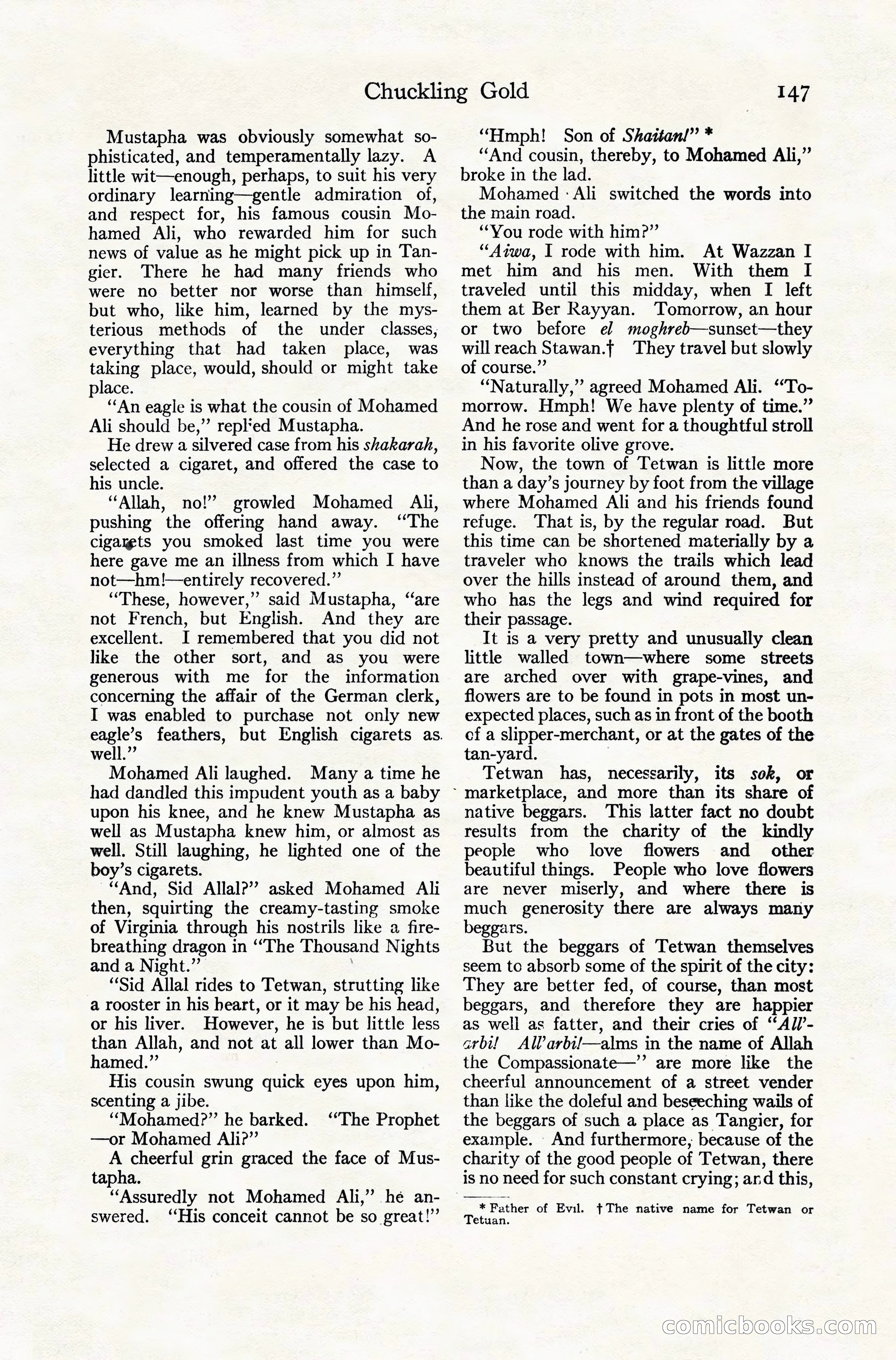
A restored page from Pulp Fiction, 1924. Page through the whole issue in the reader above.
📄 Transcribed text from this page (OCR, searchable)
Machine-transcribed from the original scan — historical spelling and the odd misread are preserved.
Chuckling Gold Mustapha was obviously somewhat so- phisticated, and temperamentally lazy. A little wit—enough, perhaps, to suit his very ordinary learning—gentle admiration of, and respect for, his famous cousin Mo- hamed Ali, who rewarded him for such news of value as he might pick up in Tan- gier. There he had many friends who were no better nor worse than himself, but who, like him, learned by the mys- terious methods of the under classes, everything that had taken place, was taking place, would, should or might take place. ‘“‘An eagle is what the cousin of Mohamed Ali should be,” repl'ed Mustapha. He drew a silvered case from his skakarah, selected a cigaret, and offered the case to his uncle. “Allah, no!” growled Mohamed Ali, pushing the offering hand away. “The cigayets you smoked last time you were here gave me an illness from which I have not—hm!—entirely recovered.”’ ‘These, however,” said Mustapha, “are not French, but English. And they are excellent. J remembered that you did not like the other sort, and as you were generous with me for the information concerning the affair of the German clerk, I was enabled to purchase not only new eagle’s feathers, but English cigarets as. well.”’ Mohamed Ali laughed. Many a time he had dandled this impudent youth as a baby upon his knee, and he knew Mustapha as well as Mustapha knew him, or almost as well. Still laughing, he lighted one of the boy’s cigarets. “And, Sid Allal?’? asked Mohamed Ali then, squirting the creamy-tasting smoke of Virginia through his nostrils like a fire- breathing dragon in ‘‘The Thousand Nights and a Night.” “Sid Allal rides to Tetwan, strutting like a rooster in his heart, or it may be his head, or his liver. However, he is but little less than Allah, and not at all lower than Mo- hamed.”’ His cousin swung nice eyes upon him, scenting a jibe. ““Mohamed?” he barked. —or Mohamed Ali?” A cheerful grin graced the face of Mus- tapha. ‘“‘Assuredly not Mohamed Ali,” he an- swered. ‘His conceit cannot be so great!” ‘The Prophet 147 “Hmph! Son of Shaitan!” * “‘And cousin, thereby, to Mohamed Ali,” broke in the lad. Mohamed : Ali switched the words into the main road. “You rode with him?” “Aiwa, I rode with him. At Wazzan I met him and his men. With them I traveled until this midday, when I left them at Ber Rayyan. Tomorrow, an hour or two before el moghreb—sunset—they will reach Stawan.f They travel but slowly of course.”’ “Naturally,” agreed Mohamed Ali. “To- morrow. Hmph! We have plenty of time.” And he rose and went for a thoughtful stroll in his favorite olive grove. Now, the town of Tetwan is little more than a day’s journey by foot from the village where Mohamed Ali and his friends found refuge. That is, by the regular road. But this time can be shortened materially by a traveler who knows the trails which lead over the hills instead of around them, and who has the legs and wind required for their passage. It is a very pretty and unusually clean little walled town—where some streets are arched over with grape-vines, and flowers are to be found in pots in most un- expected places, such as in front of the booth cf a slipper-merchant, or at the gates of the tan-yard. Tetwan has, necessarily, its sok, or ‘ marketplace, and more than its share of native beggars. This latter fact no doubt results from the charity of the kindly people who love flowers and _ other beautiful things. People who love flowers are never miserly, and where there is much generosity there are always many beggars. But the beggars of Tetwan themselves seem to absorb some of the spirit of the city: They are better fed, of course, than most beggars, and therefore they are happier as well as fatter, and their cries of “All’- arbi! All’arbi!—alms in the name of Allah the Compassionate—’”’ are more like the cheerful announcement of a street vender than like the doleful and beseeching wails of the beggars of such a place as Tangier, for example. And furthermore, because of the charity of the good people of Tetwan, there is no need for such constant crying; and this, * Father of Evil. t The native name for Tetwan or etuan. Comicbook C© 5}