
Pulp Fiction, 1924 · page 123 of 194
Adventure Magazine Cover, November 10, 1924 — page 123: what you’re looking at
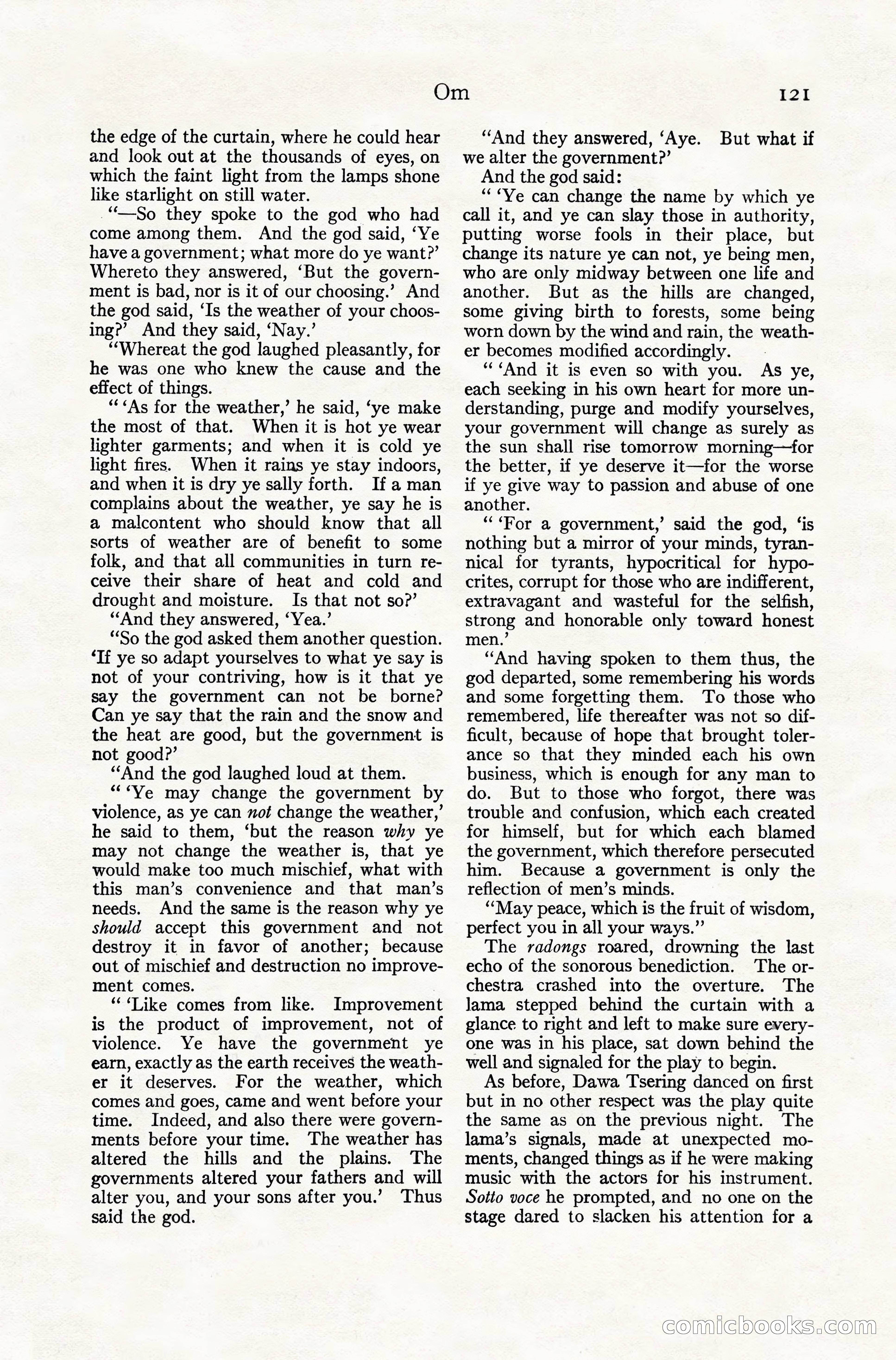
A restored page from Pulp Fiction, 1924. Page through the whole issue in the reader above.
📄 Transcribed text from this page (OCR, searchable)
Machine-transcribed from the original scan — historical spelling and the odd misread are preserved.
Om the edge of the curtain, where he could hear and look out at the thousands of eyes, on which the faint light from the lamps shone like starlight on still water. “So they spoke to the god who had come among them. And the god said, ‘Ye have a government; what more do ye want?’ Whereto they answered, ‘But the govern- ment is bad, nor is it of our choosing.’ And the god said, ‘Is the weather of your choos- ing?’ And they said, ‘Nay.’ ‘‘Whereat the god laughed pleasantly, for he was one who knew the cause and the effect of things. ‘*“As for the weather,’ he said, ‘ye make the most of that. When it is hot ye wear lighter garments; and when it is cold ye light fires. When it rains ye stay indoors, and when it is dry ye sally forth. If aman complains about the weather, ye say he is a malcontent who should know that all sorts of weather are of benefit to some folk, and that all communities in turn re- ceive their share of heat and cold and drought and moisture. Is that not so?’ ‘“‘And they answered, ‘Yea.’ “So the god asked them another question. ‘If ye so adapt yourselves to what ye say is not of your contriving, how is it that ye say the government can not be borne? Can ye say that the rain and the snow and the heat are good, but the government is not good?’ ‘“‘And the god laughed loud at them. ‘““Ve may change the government by violence, as ye can not change the weather,’ he said to them, ‘but the reason why ye may not change the weather is, that ye would make too much mischief, what with this man’s convenience and that man’s needs. And the same is the reason why ye should accept this government and not destroy it in favor of another; because out of mischief and destruction no improve- ment comes. , ‘“* “Like comes from like. Improvement is the product of improvement, not of violence. Ye have the government ye earn, exactly as the earth receives the weath- er it deserves. For the weather, which comes and goes, came and went before your time. Indeed, and also there were govern- ments before your time. The weather has altered the hills and the plains. The governments altered your fathers and will alter you, and your sons after you.’ Thus sald the god. 121 ‘“‘And they answered, ‘Aye. But what if we alter the government?’ And the god said: ‘“**VYe can change the name by which ye call it, and ye can slay those in authority, putting worse fools in their place, but change its nature ye can not, ye being men, who are only midway between one life and another. But as the hills are changed, some giving birth to forests, some being worn down by the wind and rain, the weath- er becomes modified accordingly. ‘“‘*And it is even so with you. As ye, each seeking in his own heart for more un- derstanding, purge and modify yourselves, your government will change as surely as the sun shall rise tomorrow morning—for the better, if ye deserve it—for the worse if ye give way to passion and abuse of one another. ‘““*For a government,’ said the god, ‘is nothing but a mirror of your minds, tyran- nical for tyrants, hypocritical for hypo- crites, corrupt for those who are indifferent, extravagant and wasteful for the selfish, strong and honorable only toward honest men.’ “And having spoken to them thus, the god departed, some remembering his words and some forgetting them. ‘To those who remembered, life thereafter was not so dif- ficult, because of hope that brought toler- ance so that they minded each his own business, which is enough for any man to do. But to those who forgot, there was trouble and confusion, which each created for himself, but for which each blamed the government, which therefore persecuted him. Because a government is only the reflection of men’s minds. ““May peace, which is the fruit of wisdom, perfect you in all your ways.” The radongs roared, drowning the last echo of the sonorous benediction. The or- chestra crashed into the overture. The lama stepped behind the curtain with a glance to right and left to make sure every- one was in his place, sat down behind the well and signaled for the play to begin. As before, Dawa Tsering danced on first but in no other respect was the play quite the same as on the previous night. The lama’s signals, made at unexpected mo- ments, changed things as if he were making music with the actors for his instrument. Sotto voce he prompted, and no one on the stage dared to slacken his attention for a comicloooks (© 5}