
Pulp Fiction, 1924 · page 104 of 194
Adventure Magazine Cover, November 10, 1924 — page 104: what you’re looking at
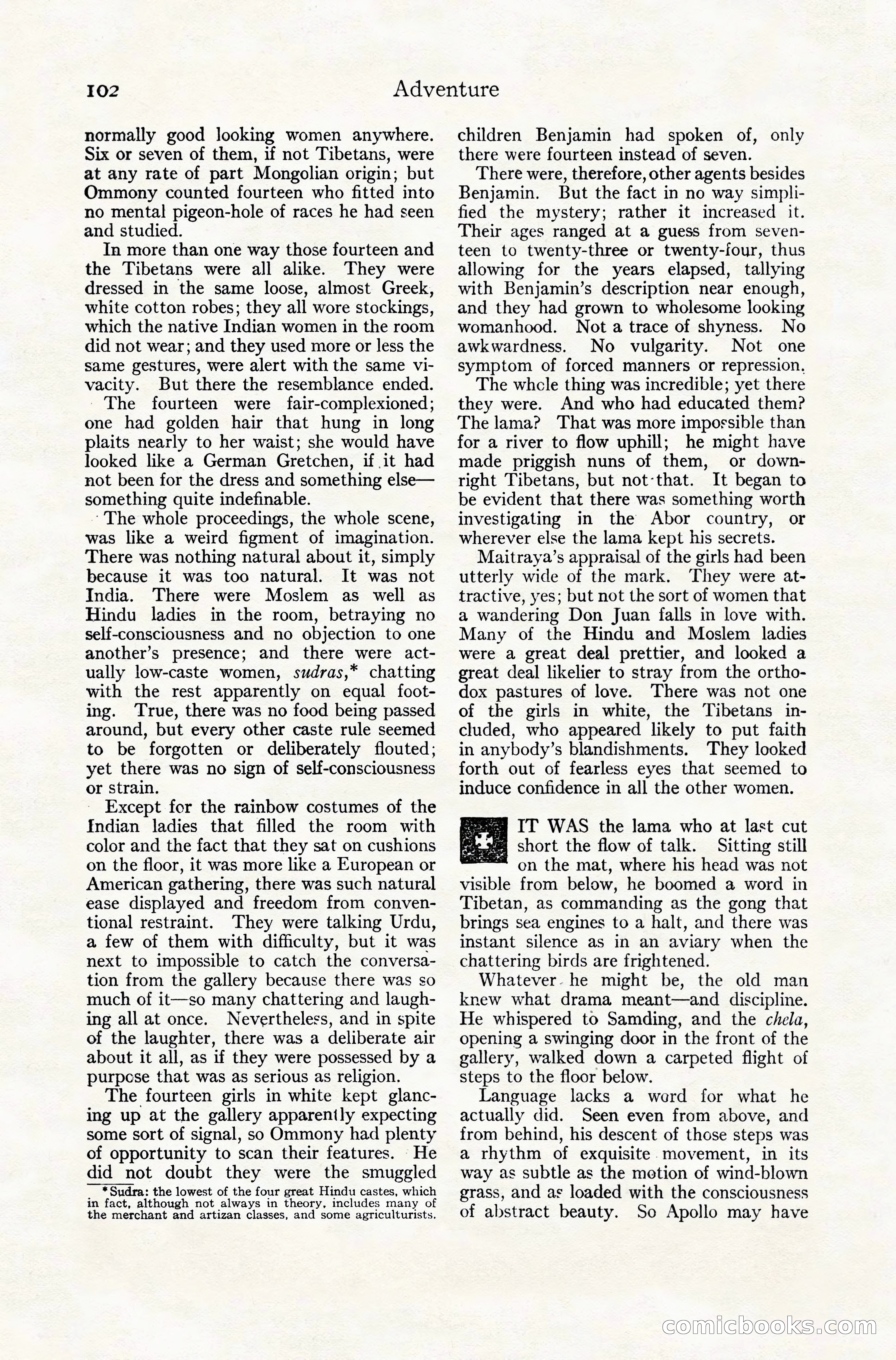
A restored page from Pulp Fiction, 1924. Page through the whole issue in the reader above.
📄 Transcribed text from this page (OCR, searchable)
Machine-transcribed from the original scan — historical spelling and the odd misread are preserved.
102 normally good looking women anywhere. Six or seven of them, if not Tibetans, were at any rate of part Mongolian origin; but Ommony counted fourteen who fitted into no mental pigeon-hole of races he had seen and studied. In more than one way those fourteen and the Tibetans were all alike. They were dressed in the same loose, almost Greek, white cotton robes; they all wore stockings, which the native Indian women in the room did not wear; and they used more or less the same gestures, were alert with the same vi- vacity. But there the resemblance ended. The fourteen were fair-complexioned; one had golden hair that hung in long plaits nearly to her waist; she would have looked like a German Gretchen, if it had not been for the dress and something else— something quite indefinable. ~ The whole proceedings, the whole scene, was like a weird figment of imagination. There was nothing natural about it, simply because it was too natural. It was not India. There were Moslem as well as Hindu ladies in the room, betraying no self-consciousness and no objection to one another’s presence; and there were act- ually low-caste women, sudras,* chatting with the rest apparently on equal foot- ing. ‘True, there was no food being passed around, but every other caste rule seemed to be forgotten or deliberately flouted; yet there was no sign of self-consciousness or strain. Except for the rainbow costumes of the Indian ladies that filled the room with color and the fact that they sat on cushions on the floor, it was more like a European or American gathering, there was such natural ease displayed and freedom from conven- tional restraint. They were talking Urdu, a few of them with difficulty, but it was next to impossible to catch the conversa- tion from the gallery because there was so much of it—so many chattering and laugh- ing all at once. Nevertheless, and in spite of the laughter, there was a deliberate air about it all, as if they were possessed by a purpcse that was as serious as religion. The fourteen girls in white kept glanc- ing up at the gallery apparently expecting some sort of signal, so Ommony had plenty of opportunity to scan their features. He did not doubt they were the smuggled _ *Sudra: the lowest of the four great Hindu castes, which in fact, although not always in theory, includes many of the merchant and artizan classes, and some agriculturists. Adventure children Benjamin had spoken of, only there were fourteen instead of seven. There were, therefore, other agents besides Benjamin. But the fact in no way simpli- fied the mystery; rather it increased it. Their ages ranged at a guess from seven- teen to twenty-three or twenty-four, thus allowing for the years elapsed, tallying with Benjamin’s description near enough, and they had grown to wholesome looking womanhood. Not a trace of shyness. No awkwardness. No vulgarity. Not one symptom of forced manners or repression. The whcle thing was incredible; yet there they were. And who had educated them? The lama? That was more impossible than for a river to flow uphill; he might have made priggish nuns of them, or down- right Tibetans, but not-that. It began to be evident that there was something worth investigating in the Abor country, or wherever else the lama kept his secrets. Maitraya’s appraisal of the girls had been utterly wide of the mark. They were at- tractive, yes; but not the sort of women that a wandering Don Juan falls in love with. Many of the Hindu and Moslem ladies were a great deal prettier, and looked a great deal likelier to stray from the ortho- dox pastures of love. There was not one of the girls in white, the Tibetans in- cluded, who appeared likely to put faith in anybody’s blandishments. They looked forth out of fearless eyes that seemed to induce confidence in all the other women. eeueq IT WAS the lama who at last cut Peevey short the flow of talk. Sitting still on the mat, where his head was not visible from below, he boomed a word in Tibetan, as commanding as the gong that brings sea engines to a halt, and there was instant silence as in an aviary when the chattering birds are fnghtened. Whatever. he might be, the old man knew what drama meant—and discipline. He whispered to Samding, and the chela, Opening a swinging door in the front of the gallery, walked down a carpeted flight of steps to the floor below. Language lacks a werd for what he actually did. Seen even from above, and from behind, his descent of those steps was a rhythm of exquisite movement, in its way as subtle as the motion of wind-blown grass, and as loaded with the consciousness of abstract beauty. So Apollo may have CoOMmiclhoo (© 5}