
Pulp Fiction, 1924 · page 99 of 204
Adventure Magazine Cover, October 30, 1924 — page 99: what you’re looking at
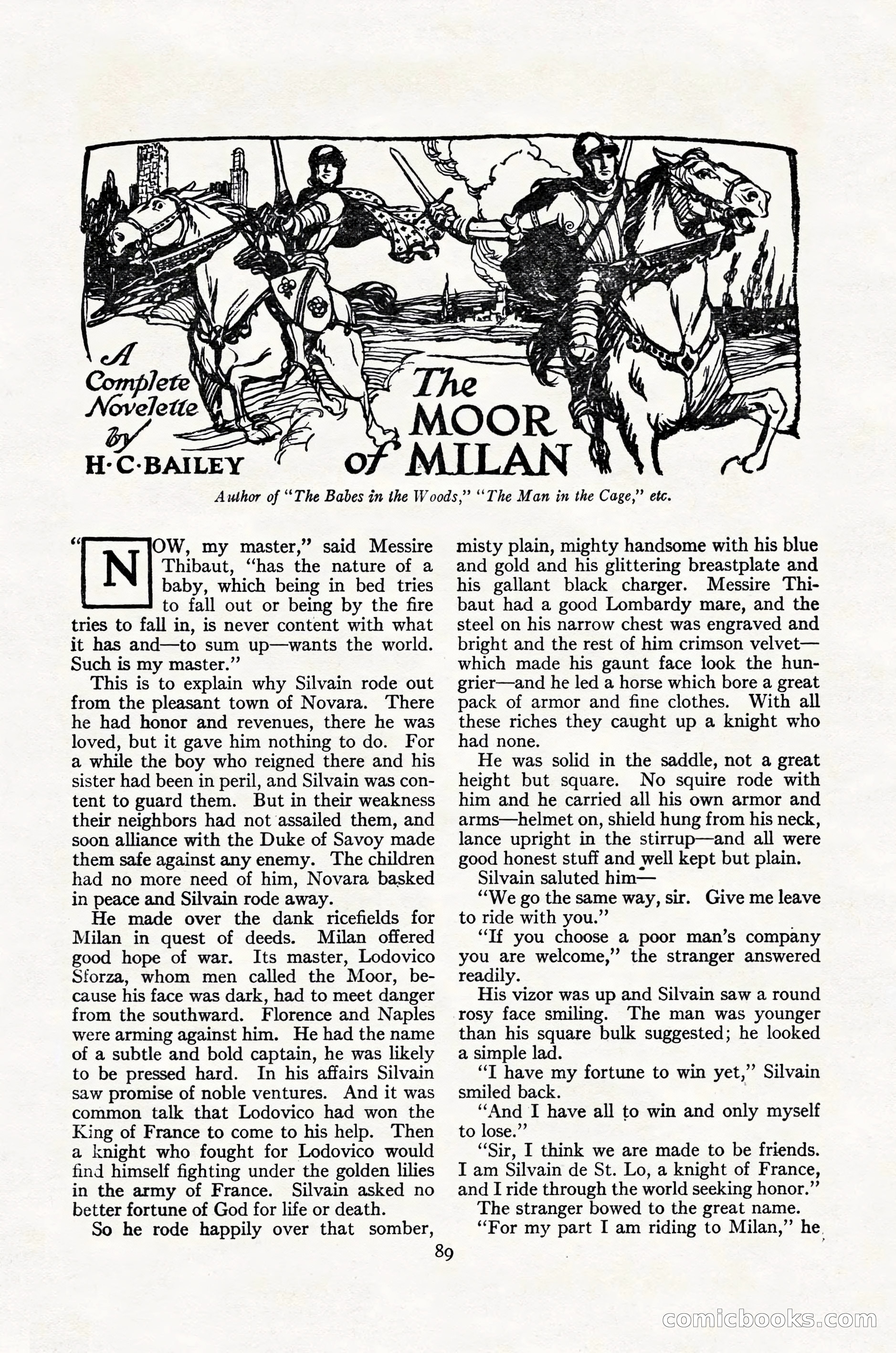
A restored page from Pulp Fiction, 1924. Page through the whole issue in the reader above.
📄 Transcribed text from this page (OCR, searchable)
Machine-transcribed from the original scan — historical spelling and the odd misread are preserved.
——— H:-C-BAILEY Author of ‘‘The Babes in the Woods,” ‘“‘The Man in the Cage,” etc. OW, my master,” said Messire N Thibaut, “has the nature of a baby, which being in bed tries to fall out or being by the fire tries to fall in, is never content with what it has and—to sum up—wants the world. Such is my master.” This is to explain why Silvain rode out from the pleasant town of Novara. There he had honor and revenues, there he was loved, but it gave him nothing to do. For a while the boy who reigned there and his sister had been in peril, and Silvain was con- tent to guard them. But in their weakness their neighbors had not assailed them, and soon alliance with the Duke of Savoy made them safe against any enemy. The children had no more need of him, Novara basked in peace and Silvain rode away. He made over the dank ricefields for Milan in quest of deeds. Milan offered good hope of war. Its master, Lodovico Sforza, whom men called the Moor, be- cause his face was dark, had to meet danger from the southward. Florence and Naples were arming against him. He had the name of a subtle and bold captain, he was likely to be pressed hard. In his affairs Silvain saw promise of noble ventures. And it was common talk that Lodovico had won the King of France to come to his help. Then a knight who fought for Lodovico would find himself fighting under the golden lilies in the army of France. Silvain asked no better fortune of God for life or death. So he rode happily over that somber, 89 misty plain, mighty handsome with his blue and gold and his glittering breastplate and his gallant black charger. Messire Thi- baut had a good Lombardy mare, and the steel on his narrow chest was engraved and bright and the rest of him crimson velvet— which made his gaunt face look the hun- grier—and he led a horse which bore a great pack of armor and fine clothes. With all these riches they caught up a knight who had none. He was solid in the saddle, not a great height but square. No squire rode with him and he carried all his own armor and arms—helmet on, shield hung from his neck, lance upright in the stirrup—and all were good honest stuff and well kept but plain. Silvain saluted him— ‘““We go the same way, sir. Give me leave to ride with you.” “If you choose a poor man’s company you are welcome,” the stranger answered readily. His vizor was up and Silvain saw a round rosy face smiling. The man was younger than his square bulk suggested; he looked a simple lad. “T have my fortune to win yet,” Silvain smiled back. ‘“‘And I have all to win and only myself to lose.”’ “Sir, I think we are made to be friends. I am Silvain de St. Lo, a knight of France, and I ride through the world seeking honor.” The stranger bowed to the great name. ‘For my part I am riding to Milan,” he. micloool C© inn