
Pulp Fiction, 1924 · page 85 of 204
Adventure Magazine Cover, October 30, 1924 — page 85: what you’re looking at
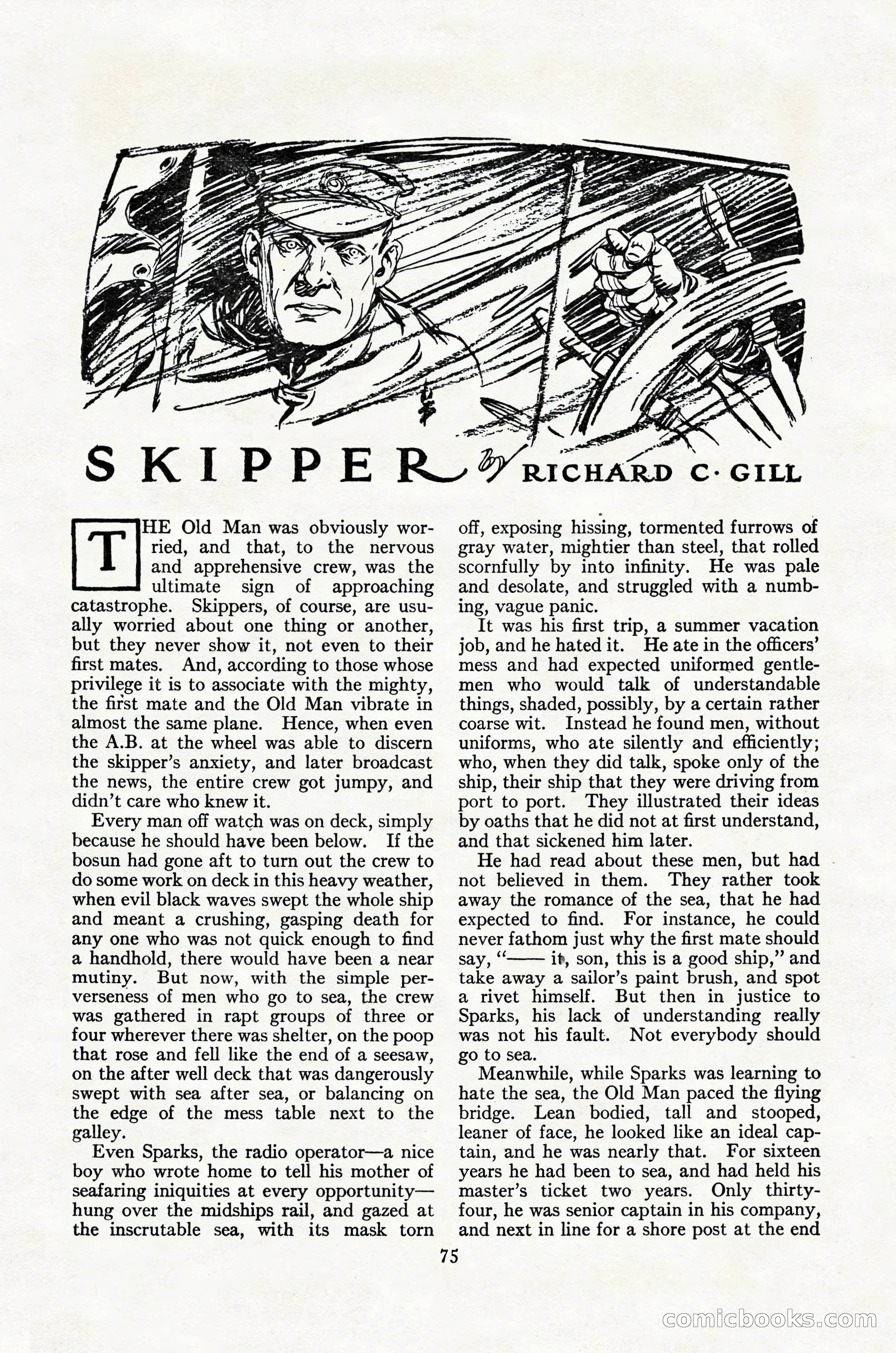
A restored page from Pulp Fiction, 1924. Page through the whole issue in the reader above.
📄 Transcribed text from this page (OCR, searchable)
Machine-transcribed from the original scan — historical spelling and the odd misread are preserved.
Y HE Old Man was obviously wor- aL: ried, and that, to the nervous and apprehensive crew, was the ultimate sign of approaching catastrophe. Skippers, of course, are usu- ally worried about one thing or another, but they never show it, not even to their first mates. And, according to those whose privilege it is to associate with the mighty, the first mate and the Old Man vibrate in almost the same plane. Hence, when even the A.B. at the wheel was able to discern the skipper’s anxiety, and later broadcast the news, the entire crew got jumpy, and didn’t care who knew it. Every man off watch was on deck, simply because he should have been below. If the bosun had gone aft to turn out the crew to do some work on deck in this heavy weather, when evil black waves swept the whole ship and meant a crushing, gasping death for any one who was not quick enough to find a handhold, there would have been a near mutiny. But now, with the simple per- verseness of men who go to sea, the crew was gathered in rapt groups of three or four wherever there was shelter, on the poop that rose and fell like the end of a seesaw, on the after well deck that was dangerously swept with sea after sea, or balancing on the edge of the mess table next to the galley. Even Sparks, the radio operator—a nice boy who wrote home to tell his mother of seafaring iniquities at every opportunity— hung over the midships rail, and gazed at the inscrutable sea, with its mask torn KIPPER. 75 pete an a ICHARD C: GILL off, exposing hissing, tormented furrows of gray water, mightier than steel, that rolled scornfully by into infinity. He was pale and desolate, and struggled with a numb- ing, vague panic. It was his first trip, a summer vacation job, and he hated it. He ate in the officers’ mess and had expected uniformed gentle- men who would talk of understandable things, shaded, possibly, by a certain rather coarse wit. Instead he found men, without uniforms, who ate silently and efficiently; who, when they did talk, spoke only of the ship, their ship that they were driving from port to port. They illustrated their ideas by oaths that he did not at first understand, and that sickened him later. He had read about these men, but had . not believed in them. They rather took away the romance of the sea, that he had expected to find. For instance, he could never fathom just why the first mate should say, “ it, son, this is a good ship,” and take away a sailor’s paint brush, and spot a rivet himself. But then in justice to Sparks, his lack of understanding really was not his fault. Not everybody should go to sea. Meanwhile, while Sparks was learning to hate the sea, the Old Man paced the flying bridge. Lean bodied, tall and stooped, leaner of face, he looked like an ideal cap- tain, and he was nearly that. For sixteen years he had been to sea, and had held his master’s ticket two years. Only thirty- four, he was senior captain in his company, and next in line for a shore post at the end MICLOOOK C© in