
Pulp Fiction, 1924 · page 21 of 204
Adventure Magazine Cover, October 30, 1924 — page 21: what you’re looking at
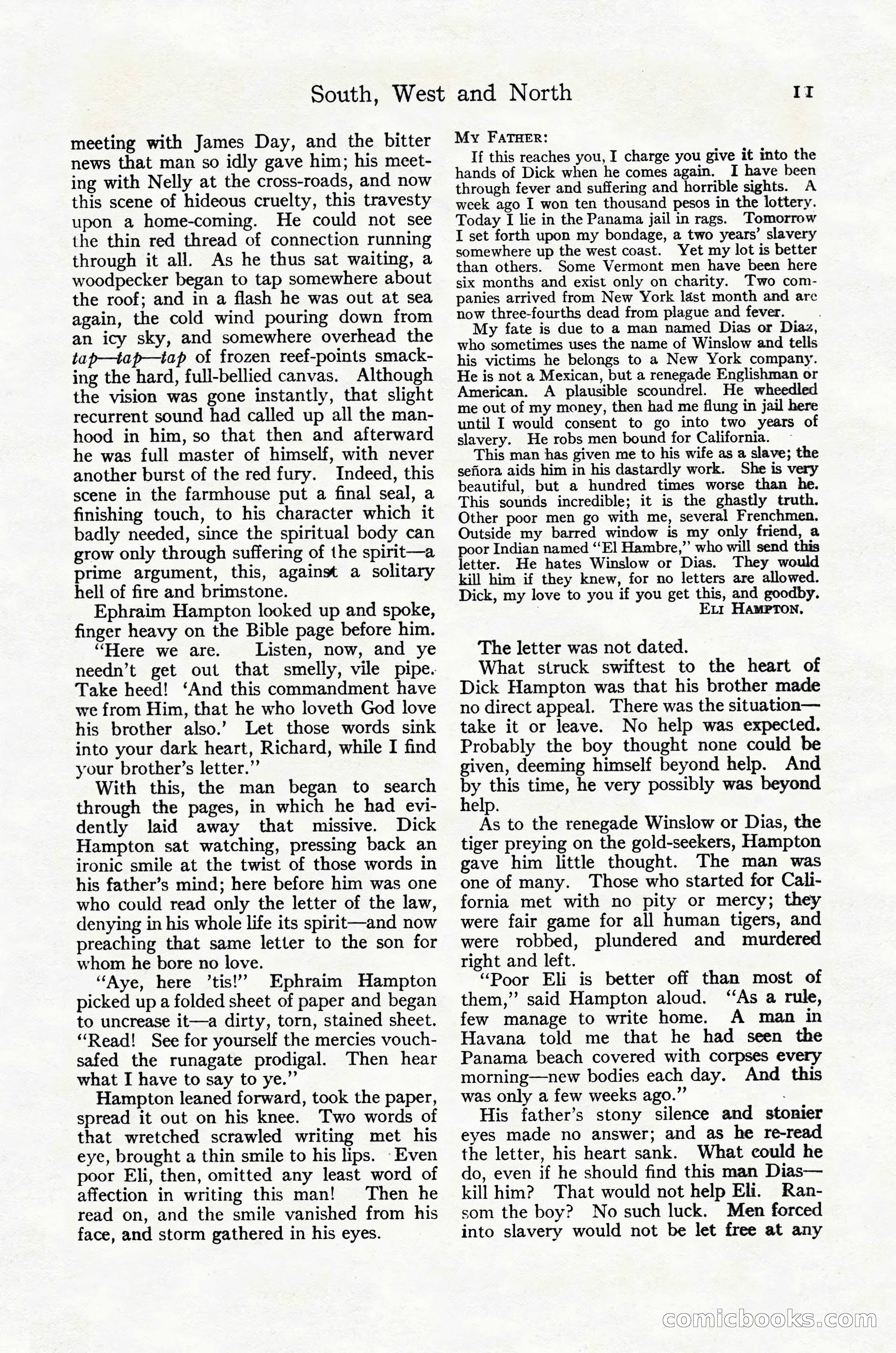
A restored page from Pulp Fiction, 1924. Page through the whole issue in the reader above.
📄 Transcribed text from this page (OCR, searchable)
Machine-transcribed from the original scan — historical spelling and the odd misread are preserved.
South, West and North II meeting with James Day, and the bitter news that man so idly gave him; his meet- ing with Nelly at the cross-roads, and now this scene of hideous cruelty, this travesty upon a home-coming. He could not see the thin red thread of connection running through it all. As he thus sat waiting, a woodpecker began to tap somewhere about the roof; and in a flash he was out at sea again, the cold wind pouring down from an icy sky, and somewhere overhead the tap—tap—tap of frozen reef-points smack- ing the hard, full-bellied canvas. Although the vision was gone instantly, that slight recurrent sound had called up all the man- hood in him, so that then and afterward he was full master of himself, with never another burst of the red fury. Indeed, this scene in the farmhouse put a final seal, a finishing touch, to his character which it badly needed, since the spiritual body can grow only through suffering of the spirit—a prime argument, this, against a solitary hell of fire and brimstone. Ephraim Hampton looked up and spoke, finger heavy on the Bible page before him. “Here we are. Listen, now, and ye needn’t get out that smelly, vile pipe. Take heed! ‘And this commandment have we from Him, that he who loveth God love his brother also.’ Let those words sink into your dark heart, Richard, while I find your brother’s letter.”’ With this, the man began to search through the pages, in which he had evi- dently laid away that missive. Dick Hampton sat watching, pressing back an ironic smile at the twist of those words in his father’s mind; here before him was one who could read only the letter of the law, denying in his whole life its spirit—and now preaching that same letter to the son for whom he bore no love. ‘Aye, here ’tis!”” Ephraim Hampton picked up a folded sheet of paper and began to uncrease it—a dirty, torn, stained sheet. “Read! See for yourself the mercies vouch- safed the runagate prodigal. Then hear what I have to say to ye.”’ Hampton leaned forward, took the paper, spread it out on his knee. Two words of that wretched scrawled writing met his eye, brought a thin smile to his lips. Even poor Eli, then, omitted any least word of affection in writing this man! Then he read on, and the smile vanished from his face, and storm gathered in his eyes. My FATHER: If this reaches you, I charge you give it into the hands of Dick when he comes again. I have been through fever and suffering and horrible sights. A week ago I won ten thousand pesos in the lottery. Today I lie in the Panama jail in rags. ‘Tomorrow I set forth upon my bondage, a two years’ slavery somewhere up the west coast. Yet my lot is better than others. Some Vermont men have been here six months and exist only on charity. Two com- panies arrived from New York last month and are now three-fourths dead from plague and fever. My fate is due to a man named Dias or Diaz, who sometimes uses the name of Winslow and tells his victims he belongs to a New York company. He is not a Mexican, but a renegade Englishman or American. A plausible scoundrel. He wheedled me out of my money, then had me flung in jail here until I would consent to go into two years of slavery. He robs men bound for California. This man has given me to his wife as a slave; the sefiora aids him in his dastardly work. She is very beautiful, but a hundred times worse than he. This sounds incredible; it is the ghastly truth. Other poor men go with me, several Frenchmen. Outside my barred window is my only friend, a poor Indian named ‘“‘E] Hambre,”’ who will send this letter. He hates Winslow or Dias. They would kill him if they knew, for no letters are allowed. Dick, my love to you if you get this, and goodby. EL1 HAMPTON, The letter was not dated. What struck swiftest to the heart of Dick Hampton was that his brother made no direct appeal. There was the situation— take it or leave. No help was expected. Probably the boy thought none could be given, deeming himself beyond help. And by this time, he very possibly was beyond help. As to the renegade Winslow or Dias, the tiger preying on the gold-seekers, Hampton gave him little thought. The man was one of many. Those who started for Cali- fornia met with no pity or mercy; they were fair game for all human tigers, and were robbed, plundered and murdered right and left. “Poor Eli is better off than most of them,” said Hampton aloud. ‘“‘As a rule, few manage to write home. A man in Havana told me that he had seen the Panama beach covered with corpses every morning—new bodies each day. And this was only a few weeks ago.” : His father’s stony silence and stonier eyes made no answer; and as he re-read the letter, his heart sank. What could he do, even if he should find this man Dias— kill him? That would not help Eli. Ran- som the boy? No such luck. Men forced into slavery would not be let free at any GOMIGIOOKS im