
Pulp Fiction, 1924 · page 200 of 204
Adventure Magazine Cover, October 30, 1924 — page 200: what you’re looking at
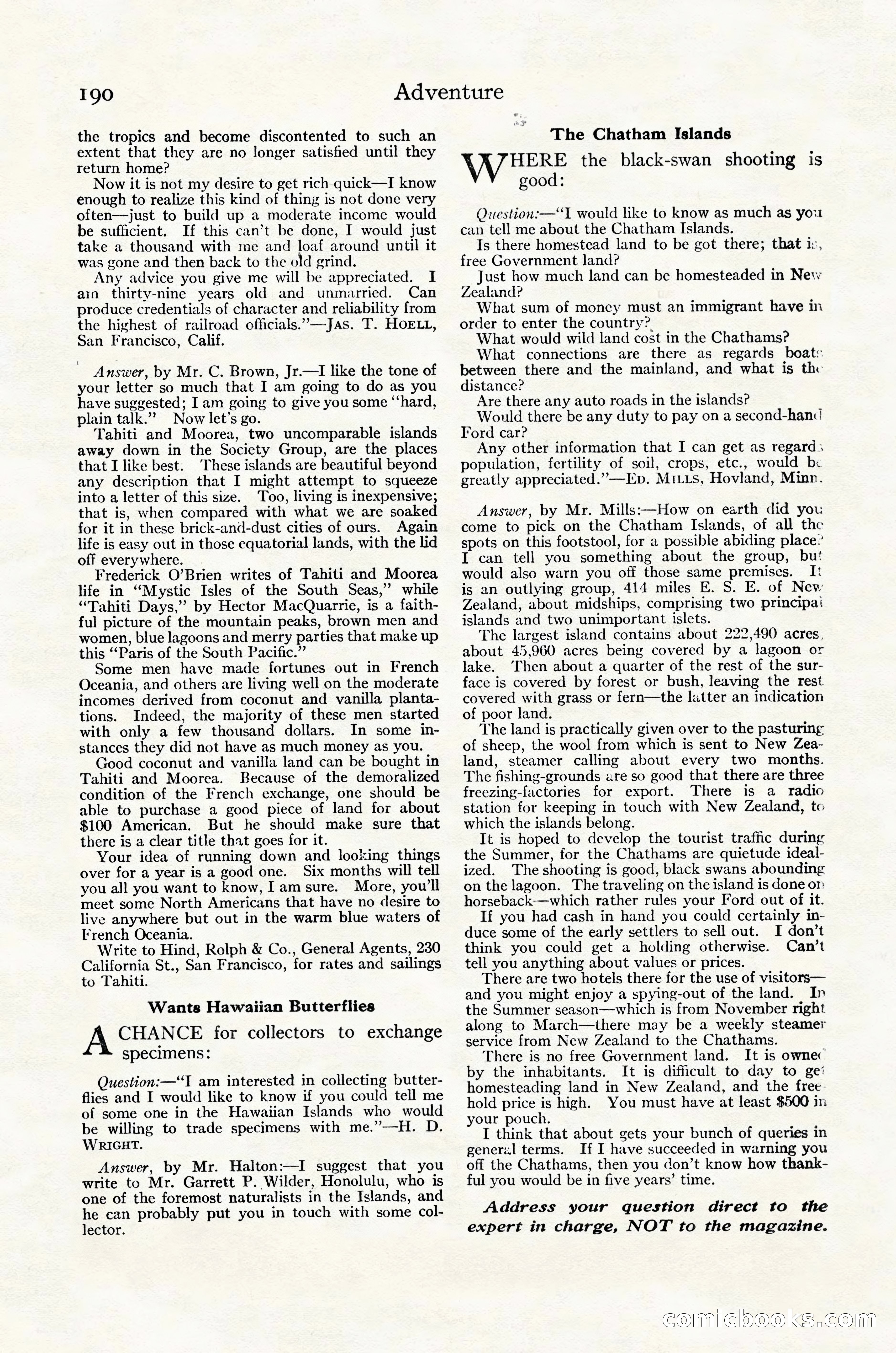
A restored page from Pulp Fiction, 1924. Page through the whole issue in the reader above.
📄 Transcribed text from this page (OCR, searchable)
Machine-transcribed from the original scan — historical spelling and the odd misread are preserved.
190 the tropics and become discontented to such an extent that they are no longer satisfied until they return home? Now it is not my desire to get rich quick—I know enough to realize this kind of thing is not done very often—just to build up a moderate income would be sufficient. If this can’t be done, I would just take a thousand with me and loaf around until it was gone and then back to the old grind. Any advice you give me will be appreciated. I ain thirty-nine years old and unmarried. Can produce credentials of character and reliability from the highest of railroad officials.”—Jas. T. HoELt, San Francisco, Calif. Answer, by Mr. C. Brown, Jr.—I like the tone of your letter so much that I am going to do as you have suggested; I am going to give you some “‘hard, plain talk.”’? Now let’s go. Tahiti and Moorea, two uncomparable islands away down in the Society Group, are the places that I like best. These islands are beautiful beyond any description that I might attempt to squeeze into a letter of this size. Too, living is inexpensive; that is, when compared with what we are soaked for it in these brick-and-dust cities of ours. Again life is easy out in those equatorial lands, with the lid off everywhere. Frederick O’Brien writes of Tahiti and Moorea life in ‘Mystic Isles of the South Seas,” while “Tahiti Days,’ by Hector MacQuarrie, is a faith- ful picture of the mountain peaks, brown men and women, blue lagoons and merry parties that make up this ‘“‘Paris of the South Pacific.” Some men have made fortunes out in French Oceania, and others are living well on the moderate incomes derived from coconut and vanilla planta- tions. Indeed, the majority of these men started with only a few thousand dollars. In some in- stances they did not have as much money as you. Good coconut and vanilla land can be bought in Tahiti and Moorea. Because of the demoralized condition of the French exchange, one should be able to purchase a good piece of land for about $100 American. But he should make sure that there is a clear title that goes for it. Your idea of running down and looking things over for a year is a good one. Six months will tell you all you want to know, [am sure. More, you'll meet some North Americans that have no desire to live anywhere but out in the warm blue waters of French Oceania. Write to Hind, Rolph & Co., General Agents, 230 California St., San Francisco, for rates and sailings to Tahiti. Wants Hawaiian Butterflies CHANCE for collectors to exchange specimens: Question: —“TI am interested in collecting butter- flies and I would like to know if you could tell me of some one in the Hawaiian Islands who would be willing to trade specimens with me.”—H. D. WRIGHT. Answer, by Mr. Halton:—I suggest that you write to Mr. Garrett P. Wilder, Honolulu, who is one of the foremost naturalists in the Islands, and he can probably put you in touch with some col- lector. Adventure The Chatham Islands Ves the black-swan shooting is good: Question: —“I would like to know as much as you can tell me about the Chatham Islands. Is there homestead land to be got there; that i:, free Government land? Just how much land can be homesteaded in New Zealand? What sum of moncy must an immigrant have in order to enter the country? What would wild land cost in the Chathams? What connections are there as regards boat: between there and the mainland, and what is th: distance? Are there any auto roads in the islands? Would there be any duty to pay on a second-hand Ford car? Any other information that I can get as regard. population, fertility of soil, crops, etc., would b: greatly appreciated.’’—Ep. Mitts, Hovland, Minn. Answer, by Mr. Mills:—How on earth did you come to pick on the Chatham Islands, of all the spots on this footstool, for a possible abiding place’ I can tell you something about the group, but would also warn you off those same premises. It is an outlying group, 414 miles E. S. E. of New Zealand, about midships, comprising two principai islands and two unimportant islets. The largest island contains about 222,490 acres, about 45,960 acres being covered by a lagoon or lake. Then about a quarter of the rest of the sur- face is covered by forest or bush, leaving the rest covered with grass or fern—the latter an indication of poor land. The land is practically given over to the pasturing of sheep, the wool from which is sent to New Zea- land, steamer calling about every two months. The fishing-grounds ure so good that there are three freezing-factories for export. There is a radio station for keeping in touch with New Zealand, to which the islands belong. It is hoped to develop the tourist traffic during the Summer, for the Chathams are quietude ideal- ized. The shooting is good, black swans abounding on the lagoon. The traveling on the island is done or. horseback—which rather rules your Ford out of it. If you had cash in hand you could certainly in- duce some of the early settlers to sell out. I don’t think you could get a holding otherwise. Can’t tell you anything about values or prices. There are two hotels there for the use of visitors— and you might enjoy a spying-out of the land. In the Summer season—which is from November right along to March—there may be a weekly steamer service from New Zealand to the Chathams. There is no free Government land. It is ownec by the inhabitants. It is difficult to day to ge’ homesteading land in New Zealand, and the free hold price is high. You must have at least $500 in your pouch. I think that about gets your bunch of queries in general terms. If I have succeeded in warning you off the Chathams, then you don’t know how thank- ful you would be in five years’ time. Address your question direct to the expert in charge, NOT to the magazine. COMmiclboookSs.E