
Pulp Fiction, 1924 · page 189 of 204
Adventure Magazine Cover, October 30, 1924 — page 189: what you’re looking at
A restored page from Pulp Fiction, 1924. Page through the whole issue in the reader above.
📄 Transcribed text from this page (OCR, searchable)
Machine-transcribed from the original scan — historical spelling and the odd misread are preserved.
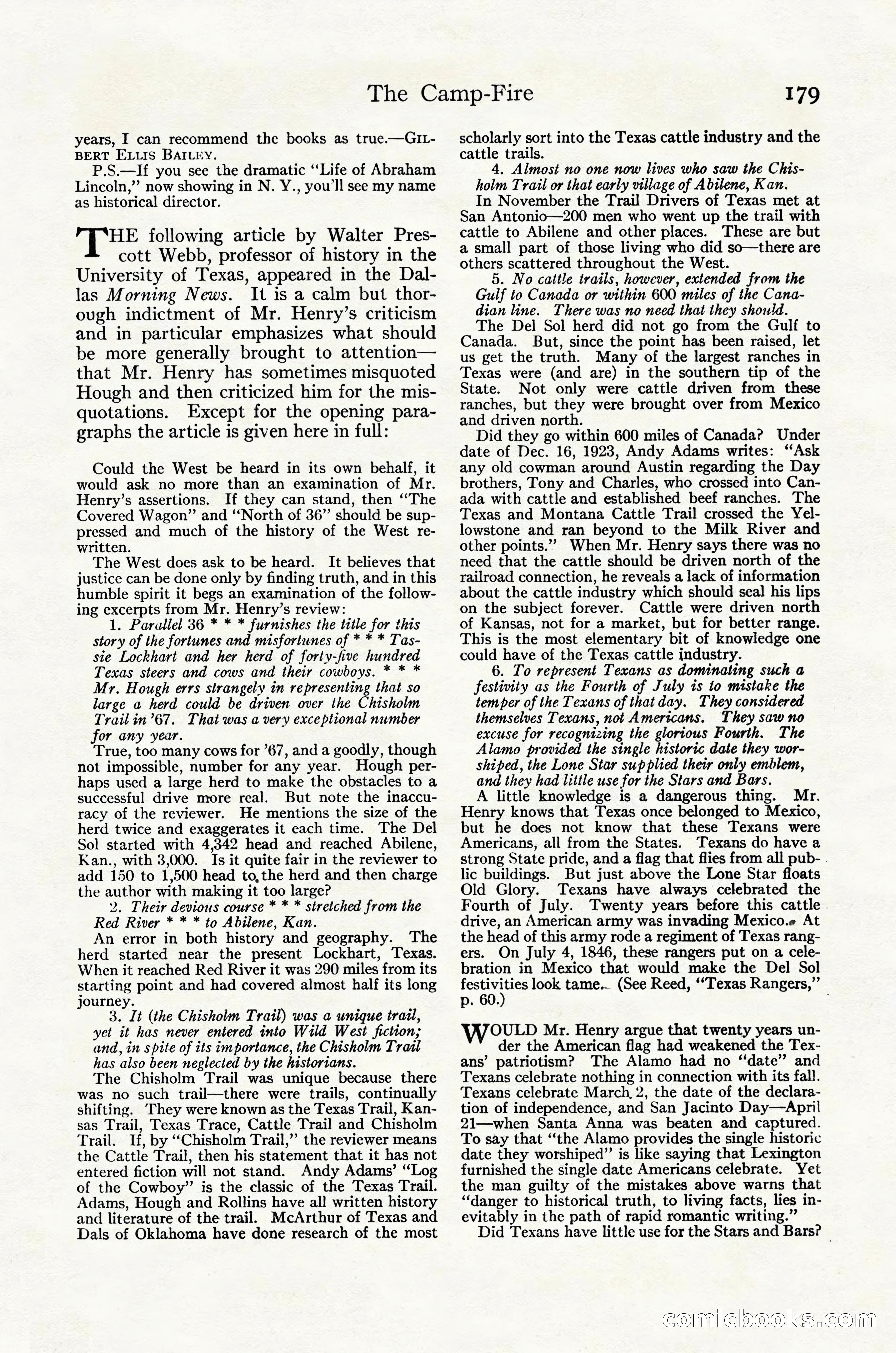
The Camp-Fire years, I can recommend the books as true.—GIL- BERT ELLIS BAILEY. P.S.—If you see the dramatic ‘Life of Abraham Lincoln,” now showing in N. Y., you'll see my name as historical director. eke following article by Walter Pres- cott Webb, professor of history in the University of Texas, appeared in the Dal- las Morning News. It is a calm but thor- ough indictment of Mr. Henry’s criticism and in particular emphasizes what should be more generally brought to attention— that Mr. Henry has sometimes misquoted Hough and then criticized him for the mis- quotations. Except for the opening para- graphs the article is given here in full: Could the West be heard in its own behalf, it would ask no more than an examination of Mr. Henry’s assertions. If they can stand, then ‘“‘The Covered Wagon” and ‘“‘North of 36” should be sup- pressed and much of the history of the West re- written. The West does ask to be heard. It believes that justice can be done only by finding truth, and in this humble spirit it begs an examination of the follow- ing excerpts from Mr. Henry’s review: 1. Parallel 36 * * * furnishes the title for this story of the fortunes and misfortunes of * * * Tas- ste Lockhart and her herd of forty-five hundred Texas steers and cows and their cowboys. * * * Mr. Hough errs strangely in representing that so large a herd could be driven over the Chisholm Trail in’67. That was a very exceptional number for any year. True, too many cows for ’67, and a goodly, though not impossible, number for any year. Hough per- haps used a large herd to make the obstacles to a successful drive more real. But note the inaccu- racy of the reviewer. He mentions the size of the herd twice and exaggerates it each time. The Del Sol started with 4,342 head and reached Abilene, Kan., with 3,000. Is it quite fair in the reviewer to add 150 to 1,500 head to,the herd and then charge the author with making it too large? 2. Their devious course * * * stretched from the Red River * * * to Abilene, Kan. An error in both history and geography. The herd started near the present Lockhart, Texas. When it reached Red River it was 290 miles from its starting point and had covered almost half its long journey. 3. It (the Chisholm Trail) was a unique trail, yet it has never entered into Wild West fiction; and, in spite of its importance, the Chisholm Trail has also been neglected by the historians. The Chisholm Trail was unique because there was no such trail—there were trails, continually shifting. They were known as the Texas Trail, Kan- sas Trail, Texas Trace, Cattle Trail and Chisholm Trail. If, by “(Chisholm Trail,’”’ the reviewer means the Cattle Trail, then his statement that it has not entered fiction will not stand. Andy Adams’ ‘Log of the Cowboy” is the classic of the Texas Trail. Adams, Hough and Rollins have all written history and literature of the trail. McArthur of Texas and Dals of Oklahoma have done research of the most 179 scholarly sort into the Texas cattle industry and the cattle trails. 4. Almost no one now lives who saw the Chis- holm Trail or that early village of Abilene, Kan. In November the Trail Drivers of Texas met at San Antonio—200 men who went up the trail with cattle to Abilene and other places. These are but a small part of those living who did so—there are others scattered throughout the West. 5. No cattle trails, however, extended from the Gulf to Canada or within 600 miles of the Cana- dian line. There was no need that they should. The Del Sol herd did not go from the Gulf to Canada. But, since the point has been raised, let us get the truth. Many of the largest ranches in Texas were (and are) in the southern tip of the State. Not only were cattle driven from these ranches, but they were brought over from Mexico and driven north. Did they go within 600 miles of Canada? Under date of Dec. 16, 1923, Andy Adams writes: “Ask any old cowman around Austin regarding the Day brothers, Tony and Charles, who crossed into Can- ada with cattle and established beef ranches. The Texas and Montana Cattle Trail crossed the Yel- lowstone and ran beyond to the Milk River and other points.’’ When Mr. Henry says there was no need that the cattle should be driven north of the railroad connection, he reveals a lack of information about the cattle industry which should seal his lips on the subject forever. Cattle were driven north of Kansas, not for a market, but for better range. This is the most elementary bit of knowledge one could have of the Texas cattle industry. 6. To represent Texans as dominating such a festivity as the Fourth of July is to mistake the temper of the Texans of that day. They considered themselves Texans, not Americans. They saw no excuse for recognizing the glorious Fourth. The Alamo provided the single historic date they wor- shiped, the Lone Star supplied their only emblem, and they had little use for the Stars and Bars. A little knowledge is a dangerous thing. Mr. Henry knows that Texas once belonged to Mexico, but he does not know that these Texans were Americans, all from the States. Texans do have a strong State pride, and a flag that flies from all pub- . lic buildings. But just above the Lone Star floats Old Glory. Texans have always celebrated the Fourth of July. Twenty years before this cattle drive, an American army was invading Mexico.« At the head of this army rode a regiment of Texas rang- ers. On July 4, 1846, these rangers put on a cele- bration in Mexico that would make the Del Sol festivities look tame... (See Reed, “Texas Rangers,” p. 60 WOULD Mr. Henry argue that twenty years un- der the American flag had weakened the Tex- ans’ patriotism? The Alamo had no “date” and Texans celebrate nothing in connection with its fall. Texans celebrate March, 2, the date of the declara- tion of independence, and San Jacinto Day—April 21—when Santa Anna was beaten and captured. To say that “‘the Alamo provides the single historic date they worshiped”’ is like saying that Lexington furnished the single date Americans celebrate. Yet the man guilty of the mistakes above warns that “danger to historical truth, to living facts, lies in- evitably in the path of rapid romantic writing.” Did Texans have little use for the Stars and Bars? 1DOOLK © in