
Pulp Fiction, 1924 · page 185 of 204
Adventure Magazine Cover, October 30, 1924 — page 185: what you’re looking at
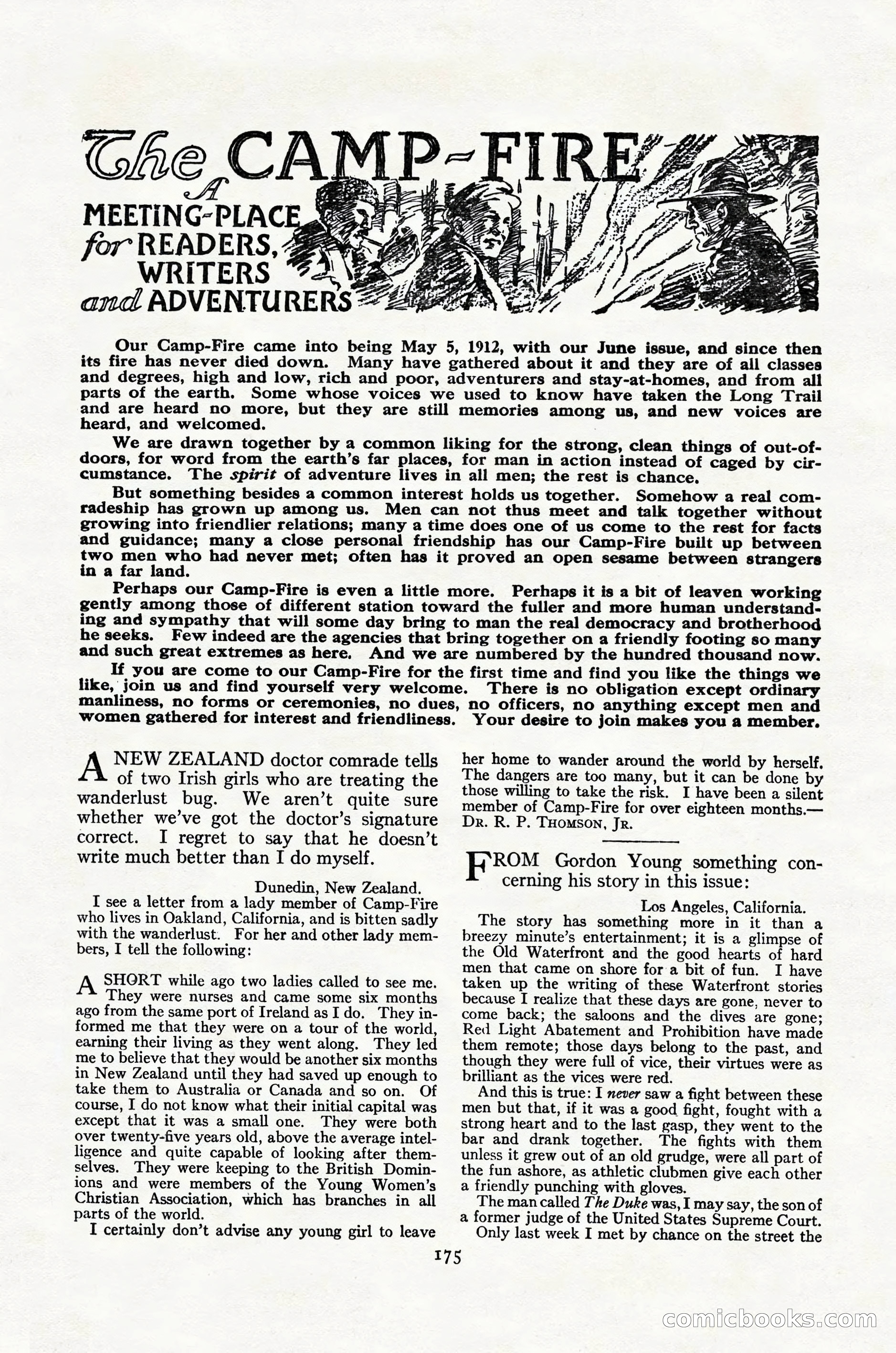
A restored page from Pulp Fiction, 1924. Page through the whole issue in the reader above.
📄 Transcribed text from this page (OCR, searchable)
Machine-transcribed from the original scan — historical spelling and the odd misread are preserved.
Ghe CAMP-] WRITERS and ADVENTURERS Our Camp-Fire came into being May 5, 1912, with our June issue, and since then its fire has never died down. Many have gathered about it and they are of all classes and degrees, high and low, rich and poor, adventurers and stay-at-homes, and from all parts of the earth, Some whose voices we used to know have taken the Long Trail and are heard no more, but they are still memories among us, and new voices are heard, and welcomed. We are drawn together by a common liking for the strong, clean things of out-of- doors, for word from the earth’s far places, for man in action instead of caged by cir- cumstance. The spirit of adventure lives in all men; the rest is chance, But something besides a common interest holds us together. Somehow a real com- radeship has grown up among us. Men can not thus meet and talk together without growing into friendlier relations; many a time does one of us come to the rest for facts and guidance; many a close personal friendship has our Camp-Fire built up between two men who had never met; often has it proved an open sesame between strangers in a far land. Perhaps our Camp-Fire is even a little more. Perhaps it is a bit of leaven working gently among those of different station toward the fuller and more human understand- ing and sympathy that will some day bring to man the real democracy and brotherhood SF Pe coy —_— > ‘aA 2 ag ce Big gt hee S —e he seeks. and such great extremes as here, Few indeed are the agencies that bring together on a friendly footing so many And we are numbered by the hundred thousand now. If you are come to our Camp-Fire for the first time and find you like the things we like, NEW ZEALAND doctor comrade tells of two Irish girls who are treating the wanderlust bug. We aren’t quite sure whether we’ve got the doctor’s signature correct. I regret to say that he doesn’t write much better than I do myself. Dunedin, New Zealand. I see a letter from a lady member of Camp-Fire who lives in Oakland, California, and is bitten sadly with the wanderlust. For her and other lady mem- bers, I tell the following: A SHORT while ago two ladies called to see me. They were nurses and came some six months ago from the same port of Ireland as I do. They in- formed me that they were on a tour of the world, earning their living as they went along. They led me to believe that they would be another six months in New Zealand until they had saved up enough to take them to Australia or Canada and so on. Of course, I do not know what their initial capital was except that it was a small one. They were both over twenty-five years old, above the average intel- ligence and quite capable of looking after them- selves. They were keeping to the British Domin- ions and were members of the Young Women’s Christian Association, which has branches in all parts of the world. I certainly don’t advise any young girl to leave ‘join us and find yourself very welcome. manliness, no forms or ceremonies, no dues, women gathered for interest and friendliness. There is no obligation except ordinary no officers, no anything except men and Your desire to join makes you a member, her home to wander around the world by herself, The dangers are too many, but it can be done by those willing to take the risk. I have been a silent member of Camp-Fire for over eighteen months.— Dr. R. P. THomson, Jr. ROM Gordon Young something con- cerning his story in this issue: Los Angeles, California. The story has something more in it than a breezy minute’s entertainment; it is a glimpse of the Old Waterfront and the good hearts of hard men that came on shore for'a bit of fun. I have taken up the writing of these Waterfront stories because I realize that these days are gone, never to come back; the saloons and the dives are gone; Red Light Abatement and Prohibition have made them remote; those days belong to the past, and though they were full of vice, their virtues were as brilliant as the vices were red. And this is true: I never saw a fight between these men but that, if it was a good fight, fought with a strong heart and to the last gasp, they went to the bar and drank together. The fights with them unless it grew out of an old grudge, were all part of the fun ashore, as athletic clubmen give each other a friendly punching with gloves. The man called The Duke was, I may say, the son of a former judge of the United States Supreme Court. Only last week I met by chance on the street the 175 C© in ADOOK