
Pulp Fiction, 1924 · page 161 of 204
Adventure Magazine Cover, October 30, 1924 — page 161: what you’re looking at
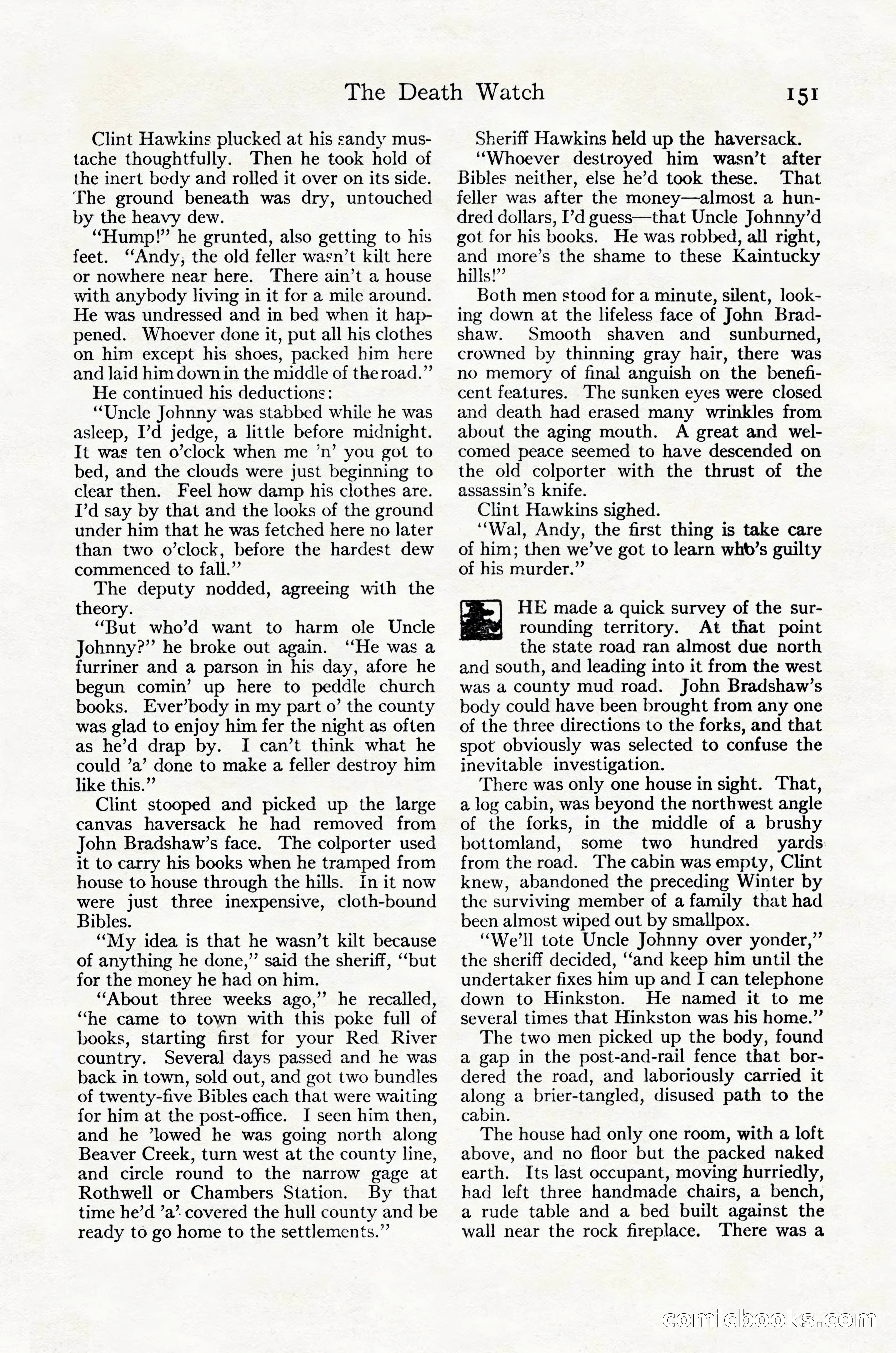
A restored page from Pulp Fiction, 1924. Page through the whole issue in the reader above.
📄 Transcribed text from this page (OCR, searchable)
Machine-transcribed from the original scan — historical spelling and the odd misread are preserved.
The Death Watch Clint Hawkins plucked at his sandy mus- tache thoughtfully. Then he took hold of the inert body and rolled it over on its side. The ground beneath was dry, untouched by the heavy dew. “Hump!” he grunted, also getting to his feet. ‘Andy; the old feller wasn’t kilt here or nowhere near here. There ain’t a house with anybody living in it for a mile around. He was undressed and in bed when it hap- pened. Whoever done it, put all his clothes on him except his shoes, packed him here and laid him down in the middle of the road.” He continued his deductions: “Uncle Johnny was stabbed while he was asleep, I’d jedge, a little before midnight. It was ten o’clock when me ’n’ you got to bed, and the clouds were just beginning to clear then. Feel how damp his clothes are. I’d say by that and the looks of the ground under him that he was fetched here no later than two o’clock, before the hardest dew commenced to fall.”’ The deputy nodded, agreeing with the theory. “But who’d want to harm ole Uncle Johnny?” he broke out again. ‘He was a furriner and a parson in his day, afore he begun comin’ up here to peddle church books. Ever’body in my part o’ the county was glad to enjoy him fer the night as often as he’d drap by. I can’t think what he could ’a’ done to make a feller destroy him like this.” Clint stooped and picked up the large canvas haversack he had removed from John Bradshaw’s face. The colporter used it to carry his books when he tramped from house to house through the hills. in it now were just three inexpensive, cloth-bound Bibles. “My idea is that he wasn’t kilt because of anything he done,” said the sheriff, ‘‘but for the money he had on him. “About three weeks ago,’ he recalled, ‘“‘he came to town with this poke full of books, starting first for your Red River country. Several days passed and he was back in town, sold out, and got two bundles of twenty-five Bibles each that were waiting for him at the post-office. I seen him then, and he ‘lowed he was going north along Beaver Creek, turn west at the county line, and circle round to the narrow gage at Rothwell or Chambers Station. By that time he’d ’a’ covered the hull county and be ready to go home to the settlements.” 151 Sheriff Hawkins held up the haversack. “Whoever destroyed him wasn’t after Bibles neither, else he’d took these. That feller was after the money—almost a hun- dred dollars, I’d guess—that Uncle Johnny’d got for his books. He was robbed, all right, and more’s the shame to these Kaintucky hills!” Both men stood for a minute, silent, look- ing down at the lifeless face of John Brad- shaw. Smooth shaven and_ sunburned, crowned by thinning gray hair, there was no memory of final anguish on the benefi- cent features. The sunken eyes were closed and death had erased many wrinkles from about the aging mouth. A great and wel- comed peace seemed to have descended on the old colporter with the thrust of the assassin’s knife. Clint Hawkins sighed. ‘‘Wal, Andy, the first thing is take care of him; then we’ve got to learn whb’s guilty of his murder.” HE made a quick survey of the sur- 2-8) rounding territory. At that point the state road ran almost due north and south, and leading into it from the west was a county mud road. John Bradshaw’s body could have been brought from any one of the three directions to the forks, and that spot obviously was selected to confuse the inevitable investigation. There was only one house in sight. That, a log cabin, was beyond the northwest angle of the forks, in the middle of a brushy bottomland, some two hundred yards from the road. The cabin was empty, Clint knew, abandoned the preceding Winter by the surviving member of a family that had been almost wiped out by smallpox. “We'll tote Uncle Johnny over yonder,” the sheriff decided, ‘‘and keep him until the undertaker fixes him up and I can telephone down to Hinkston. He named it to me several times that Hinkston was his home.” The two men picked up the body, found a gap in the post-and-rail fence that bor- dered the road, and laboriously carried it along a brier-tangled, disused path to the cabin. The house had only one room, with a loft above, and no floor but the packed naked earth. Its last occupant, moving hurriedly, had left three handmade chairs, a bench, a rude table and a bed built against the wall near the rock fireplace. There was a cComicbooks.c© in