
Pulp Fiction, 1924 · page 132 of 204
Adventure Magazine Cover, October 30, 1924 — page 132: what you’re looking at
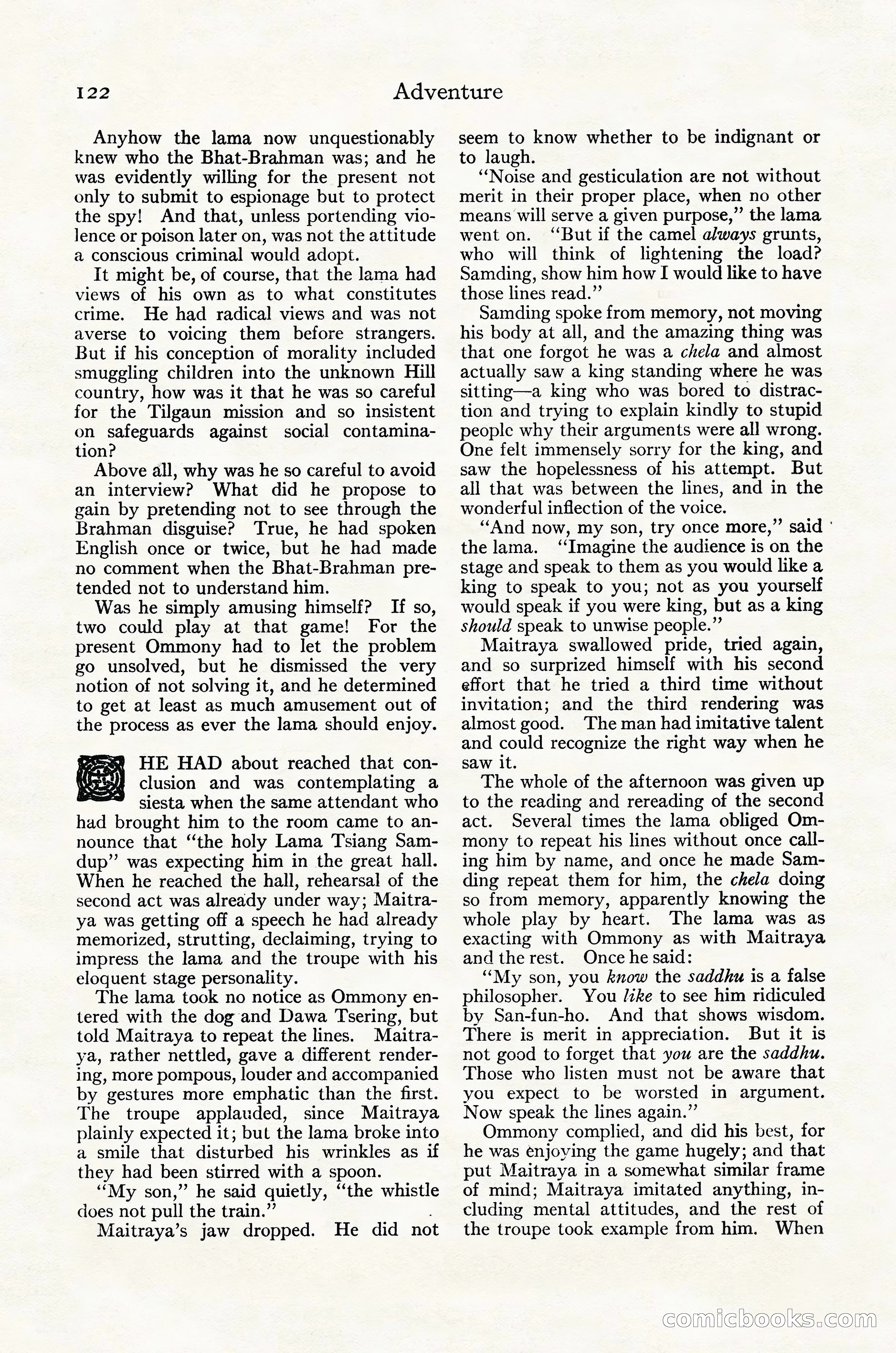
A restored page from Pulp Fiction, 1924. Page through the whole issue in the reader above.
📄 Transcribed text from this page (OCR, searchable)
Machine-transcribed from the original scan — historical spelling and the odd misread are preserved.
22 Anyhow the lama now unquestionably knew who the Bhat-Brahman was; and he was evidently willing for the present not only to submit to espionage but to protect the spy! And that, unless portending vio- lence or poison later on, was not the attitude a conscious criminal would adopt. It might be, of course, that the lama had views of his own as to what constitutes crime. He had radical views and was not averse to voicing them before strangers. But if his conception of morality included smuggling children into the unknown Hill country, how was it that he was so careful for the Tilgaun mission and so insistent on safeguards against social contamina- tion? Above all, why was he so careful to avoid an interview? What did he propose to gain by pretending not to see through the Brahman disguise? True, he had spoken English once or twice, but he had made no comment when the Bhat-Brahman pre- tended not to understand him. Was he simply amusing himself? If so, two could play at that game! For the present Ommony had to let the problem go unsolved, but he dismissed the very notion of not solving it, and he determined to get at least as much amusement out of the process as ever the lama should enjoy. HE HAD about reached that con- clusion and was contemplating a siesta when the same attendant who had brought him to the room came to an- nounce that “the holy Lama Tsiang Sam- dup” was expecting him in the great hall. When he reached the hall, rehearsal of the second act was already under way; Maitra- ya was getting off a speech he had already memorized, strutting, declaiming, trying to impress the lama and the troupe with his eloquent stage personality. The lama took no notice as Ommony en- tered with the dog and Dawa Tsering, but told Maitraya to repeat the lines. Maitra- ya, rather nettled, gave a different render- ing, more pompous, louder and accompanied by gestures more emphatic than the first. The troupe applauded, since Maitraya plainly expected it; but the lama broke into a smile that disturbed his wrinkles as if they had been stirred with a spoon. ‘‘My son,” he said quietly, “the whistle does not pull the train.”’ Maitraya’s jaw dropped. He did no Adventure seem to know whether to be indignant or to laugh. “Noise and gesticulation are not without merit in their proper place, when no other means will serve a given purpose,” the lama went on. “But if the camel always grunts, who will think of lightening the load? Samding, show him how I would like to have those lines read.” Samding spoke from memory, not moving his body at all, and the amazing thing was that one forgot he was a chela and almost actually saw a king standing where he was sitting—a king who was bored to distrac- tion and trying to explain kindly to stupid people why their arguments were all wrong. One felt immensely sorry for the king, and saw the hopelessness of his attempt. But all that was between the lines, and in the wonderful inflection of the voice. “And now, my son, try once more,” said ° the lama. ‘Imagine the audience is on the stage and speak to them as you would like a king to speak to you; not as you yourself would speak if you were king, but as a king should speak to unwise people.” Maitraya swallowed pride, tried again, and so surprized himself with his second effort that he tried a third time without invitation; and the third rendering was almost good. The man had imitative talent and could recognize the right way when he saw it. The whole of the afternoon was given up to the reading and rereading of the second act. Several times the lama obliged Om- mony to repeat his lines without once call- ing him by name, and once he made Sam- ding repeat them for him, the chela doing so from memory, apparently knowing the whole play by heart. The lama was as exacting with Ommony as with Maitraya and the rest. Once he said: “My son, you know the saddhu is a false philosopher. You /ike to see him ridiculed by San-fun-ho. And that shows wisdom. There is merit in appreciation. But it is not good to forget that you are the saddhu. Those who listen must not be aware that you expect to be worsted in argument. Now speak the lines again.” Ommony complied, and did his best, for he was enjoving the game hugely; and that put Maitraya in a somewhat similar frame of mind; Maitraya imitated anything, in- cluding mental attitudes, and the rest of the troupe took example from him. When Ccomicbooks.c© inn