
Pulp Fiction, 1924 · page 13 of 204
Adventure Magazine Cover, October 30, 1924 — page 13: what you’re looking at
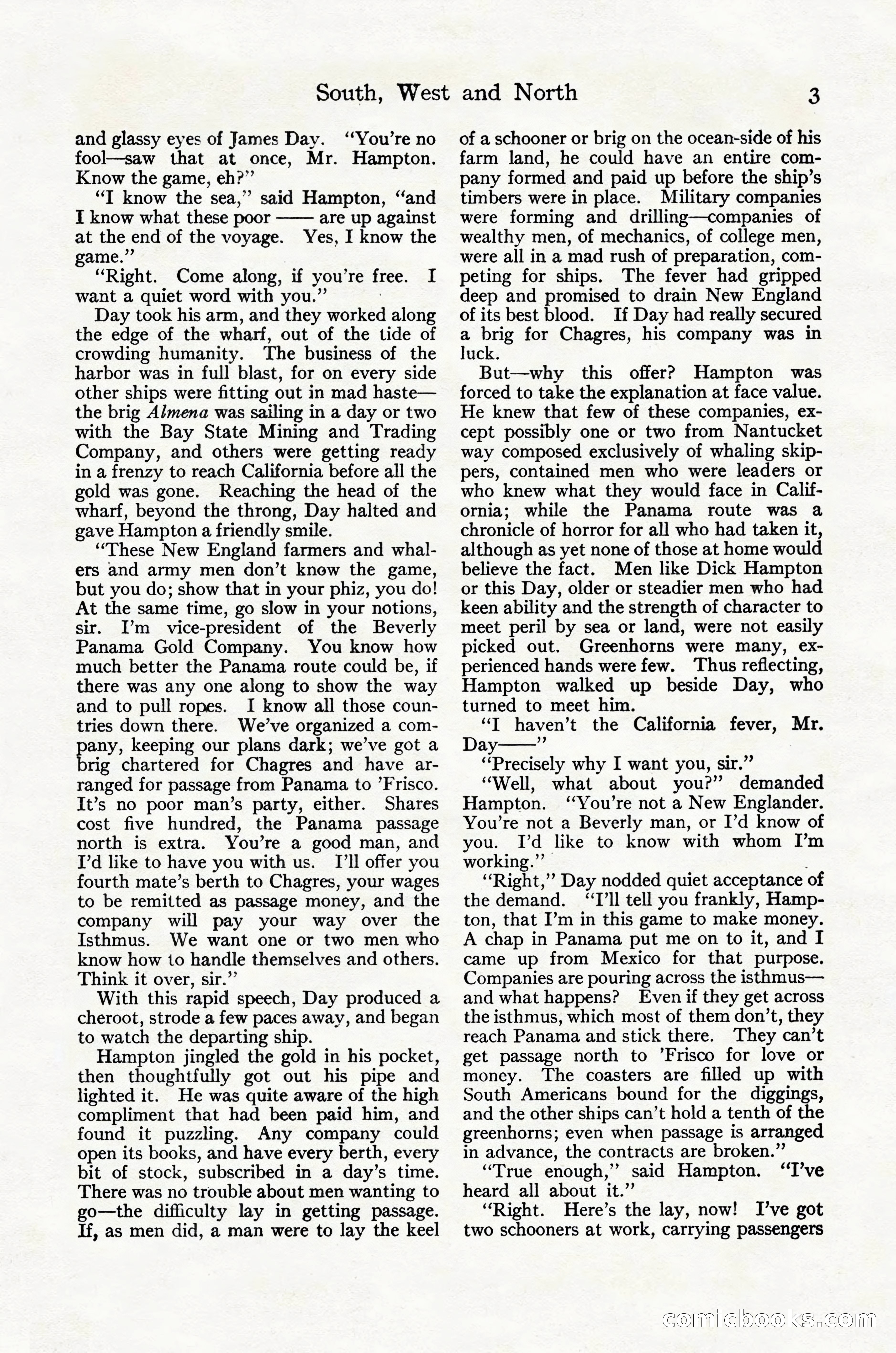
A restored page from Pulp Fiction, 1924. Page through the whole issue in the reader above.
📄 Transcribed text from this page (OCR, searchable)
Machine-transcribed from the original scan — historical spelling and the odd misread are preserved.
South, West and North 3 “You’re no Hampton. and glassy eyes of James Day. fool—saw that at once, Mr. Know the game, eh?” “T know the sea,” said Hampton, ‘‘and I know what these poor are up against at the end of the voyage. Yes, I know the game.” “Right. Come along, if you're free. I want a quiet word with you.’ Day took his arm, and they worked along the edge of the wharf, out of the tide of crowding humanity. The business of the harbor was in full blast, for on every side other ships were fitting out in mad haste— the brig Almena was sailing in a day or two with the Bay State Mining and Trading Company, and others were getting ready in a frenzy to reach California before all the gold was gone. Reaching the head of the wharf, beyond the throng, Day halted and gave Hampton a friendly smile. “These New England farmers and whal- ers and army men don’t know the game, but you do; show that in your phiz, you do! At the same time, go slow in your notions, sir. I’m vice-president of the Beverly Panama Gold Company. You know how much better the Panama route could be, if there was any one along to show the way and to pull ropes. I know all those coun- tries down there. We’ve organized a com- pene keeping our plans dark; we’ve got a rig chartered for Chagres and have ar- ranged for passage from Panama to ’Frisco. It’s no poor man’s party, either. Shares cost five hundred, the Panama passage north is extra. You’re a good man, and I’d like to have you with us. I'll offer you fourth mate’s berth to Chagres, your wages to be remitted as passage money, and the company will pay your way over the Isthmus. We want one or two men who know how to handle themselves and others. Think it over, sir.”’ With this rapid speech, Day produced a cheroot, strode a few paces away, and began to watch the departing ship. Hampton jingled the gold in his pocket, then thoughtfully got out his pipe and lighted it. He was quite aware of the high compliment that had been paid him, and found it puzzling. Any company could open its books, and have every berth, every bit of stock, subscribed in a day’s time. There was no trouble about men wanting to go—the difficulty lay in getting passage. If, as men did, a man were to lay the keel of a schooner or brig on the ocean-side of his farm land, he could have an entire com- pany formed and paid up before the ship’s timbers were in place. Military companies were forming and drilling—companies of wealthy men, of mechanics, of college men, were all in a mad rush of preparation, com- peting for ships. The fever had gripped deep and promised to drain New England of its best blood. If Day had really secured a brig for Chagres, his company was in luck. But—why this offer? Hampton was forced to take the explanation at face value. He knew that few of these companies, ex- cept possibly one or two from Nantucket way composed exclusively of whaling skip- pers, contained men who were leaders or who knew what they would face in Calif- ornia; while the Panama route was a chronicle of horror for all who had taken it, although as yet none of those at home would believe the fact. Men like Dick Hampton or this Day, older or steadier men who had keen ability and the strength of character to meet peril by sea or land, were not easily picked out. Greenhorns were many, ex- perienced hands were few. ‘Thus reflecting, Hampton walked up beside Day, who turned to meet him. ze | haven’ t the California fever, Mr. Day “Precisely why I want you, sir.’ “Well, what about you?” face Hampton. ‘‘You’re not a New Englander. You’re not a Beverly man, or I’d know of you. IT d like to know with whom I’m working.”’ “Right,” Day nodded quiet acceptance of the demand. ‘“‘I’ll tell you frankly, Hamp- ton, that I’m in this game to make money. A chap in Panama put me on to it, and I came up from Mexico for that purpose. Companies are pouring across the isthmus— and what happens? Evenif they get across the isthmus, which most of them don’t, they reach Panama and stick there. They can’t get passage north to ’Frisco for love or money. The coasters are filled up with South Americans bound for the diggings, and the other ships can’t hold a tenth of the greenhorns; even when passage is arranged in advance, the contracts are broken.” “True enough,” said Hampton. “I’ve heard all about it.” “Right. Here’s the lay, now! I’ve got two schooners at work, carrying passengers cCoMmicbooks.c© in