
Pulp Fiction, 1924 · page 127 of 204
Adventure Magazine Cover, October 30, 1924 — page 127: what you’re looking at
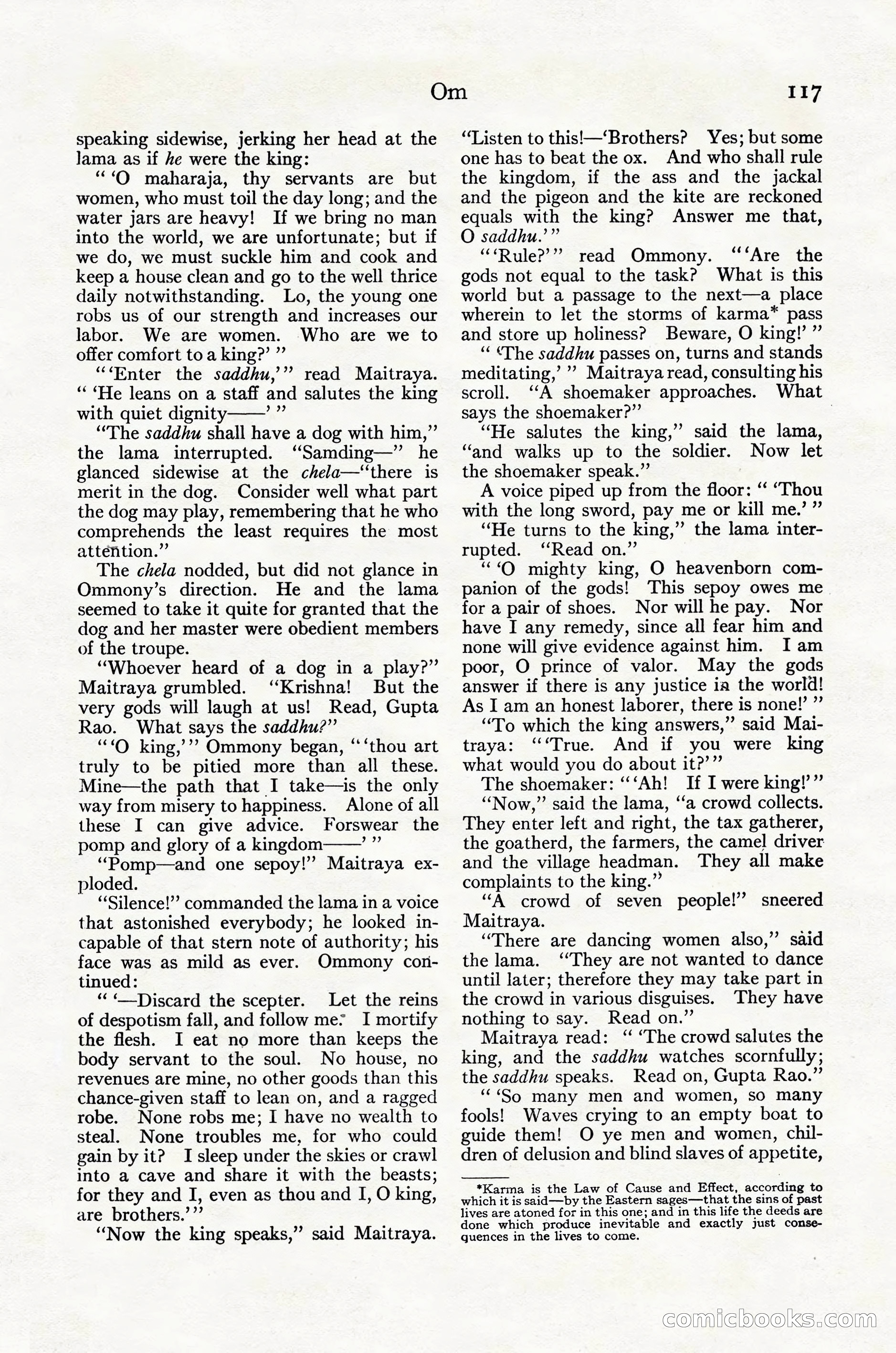
A restored page from Pulp Fiction, 1924. Page through the whole issue in the reader above.
📄 Transcribed text from this page (OCR, searchable)
Machine-transcribed from the original scan — historical spelling and the odd misread are preserved.
Om speaking sidewise, jerking her head at the Jama as if he were the king: ‘““‘Q maharaja, thy servants are but women, who must toil the day long; and the water jars are heavy! If we bring no man into the world, we are unfortunate; but if we do, we must suckle him and cook and keep a house clean and go to the well thrice daily notwithstanding. Lo, the young one robs us of our strength and increases our labor. We are women. Who are we to offer comfort toa king?’ ” “Enter the saddhu,’”’ read Maitraya. ‘He leans on a staff and salutes the king with quiet dignity ee “The saddhu shall have a dog with him,”’ the lama interrupted. ‘‘Samding—” he glanced sidewise at the chela—‘‘there is merit in the dog. Consider well what part the dog may play, remembering that he who comprehends the least requires the most attention.” The chela nodded, but did not glance in Ommony’s direction. He and the lama seemed to take it quite for granted that the dog and her master were obedient members of the troupe. ‘“‘Whoever heard of a dog in a play?” Maitraya grumbled. “Krishna! But the very gods will laugh at us! Read, Gupta Rao. What says the saddhu?”’ ‘““Q king,’’?’ Ommony began, “ ‘thou art truly to be pitied more than all these. Mine—the path that I take—is the only way from misery to happiness. Alone of all these I can give advice. Forswear the pomp and glory of a kingdom a “Pomp—and one sepoy!’’ Maitraya ex- ploded. “Silence!’’? commanded the lama in a voice that astonished everybody; he looked in- capable of that stern note of authority; his face was as mild as ever. Ommony con- tinued: ‘““‘_Tiscard the scepter. Let the reins of despotism fall, and follow me? I mortify the flesh. I eat no more than keeps the body servant to the soul. No house, no revenues are mine, no other goods than this chance-given staff to lean on, and a ragged robe. None robs me; I have no wealth to steal. None troubles me, for who could gain by it? I sleep under the skies or crawl into a cave and share it with the beasts; for they and J, even as thou and I, O king, are brothers.’”’ “Now the king speaks,”’ said Maitraya. 9 cee 117 “Tisten to this)\—‘Brothers? Yes; but some one has to beat the ox. And who shall rule the kingdom, if the ass and the jackal and the pigeon and the kite are reckoned equals with the king? Answer me that, O saddhu.’”’ ““Rule?’” read Ommony. ‘“‘Are the gods not equal to the task? What is this world but a passage to the next—a place wherein to let the storms of karma* pass and store up holiness? Beware, O king!’ ” “ (The saddhu passes on, turns and stands meditating,’ ”’ Maitraya read, consulting his scroll. ‘‘A shoemaker approaches. says the shoemaker?”’ “He salutes the king,” said the lama, “and walks up to the soldier. Now let the shoemaker speak.”’ A voice piped up from the floor: ‘‘ “Thou with the long sword, pay me or kill me.’ ”’ “He turns to the king,” the lama inter- rupted. ‘Read on.” ““Q mighty king, O heavenborn com- panion of the gods! This sepoy owes me for a pair of shoes. Nor will he pay. Nor have I any remedy, since all fear him and none will give evidence against him. I am poor, O prince of valor. May the gods answer if there is any justice ia the world! As I am an honest laborer, there is none!’ ”’ “To which the king answers,” said Mai- traya: ‘“‘True. And if you were king what would you do about it?’”’ The shoemaker: “‘‘Ah! If I were king!” “Now,” said the lama, ‘‘a crowd collects. They enter left and right, the tax gatherer, the goatherd, the farmers, the camel driver and the village headman. They all make complaints to the king.” ‘““A crowd of seven people!’ sneered Maitraya. “There are dancing women also,” said the lama. ‘They are not wanted to dance until later; therefore they may take part in the crowd in various disguises. ‘They have nothing to say. Read on.” Maitraya read: ‘ ‘The crowd salutes the king, and the saddhu watches scornfully; the saddhu speaks. Read on, Gupta Rao.” ‘‘<So many men and women, so many fools! Waves crying to an empty boat to guide them! O ye men and women, chil- dren of delusion and blind slaves of appetite, d *Karma is the Law of Cause and Effect, according to which it is said—by the Eastern sages—that the sins of past lives are atoned for in this one; and in this life the deeds are done which produce inevitable and exactly just conse- guences in the lives to come. micloool What | C© inn