
Pulp Fiction, 1924 · page 120 of 204
Adventure Magazine Cover, October 30, 1924 — page 120: what you’re looking at
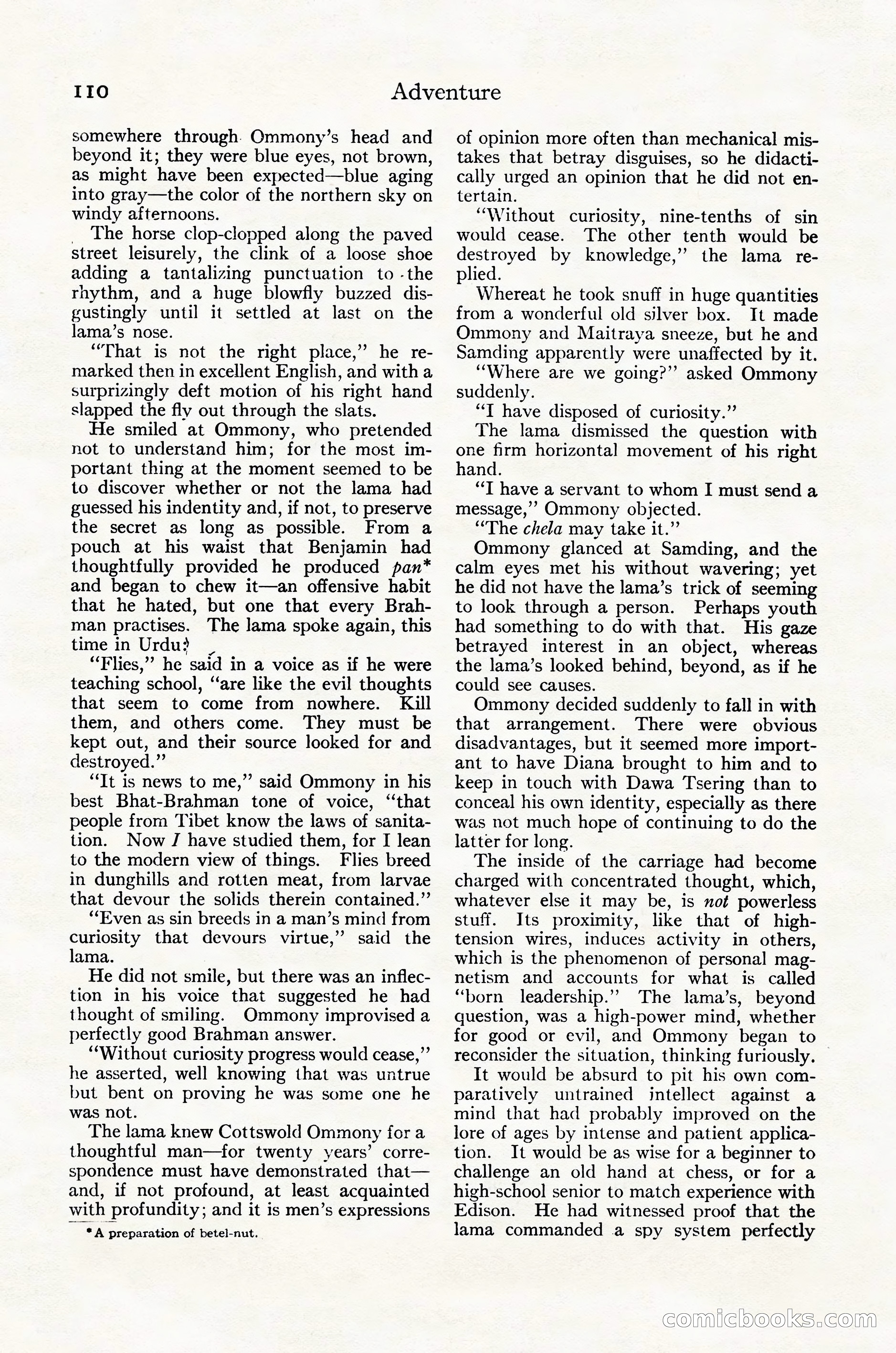
A restored page from Pulp Fiction, 1924. Page through the whole issue in the reader above.
📄 Transcribed text from this page (OCR, searchable)
Machine-transcribed from the original scan — historical spelling and the odd misread are preserved.
Ito somewhere through. Ommony’s head and beyond it; they were blue eyes, not brown, as might have been expected—blue aging into gray—the color of the northern sky on windy afternoons. _ The horse clop-clopped along the paved street leisurely, the clink of a loose shoe adding a tantalizing punctuation to -the rhythm, and a huge blowfly buzzed dis- gustingly until it settled at last on the lama’s nose. “That is not the right place,” he re- marked then in excellent English, and with a surprizingly deft motion of his right hand slapped the fly out through the slats. He smiled at Ommony, who pretended not to understand him; for the most im- portant thing at the moment seemed to be to discover whether or not the lama had guessed his indentity and, if not, to preserve the secret as long as possible. From a pouch at his waist that Benjamin had thoughtfully provided he produced pan* and began to chew it—an offensive habit that he hated, but one that every Brah- man practises. The lama spoke again, this time in Urdu} “Flies,” he said in a voice as if he were teaching school, ‘‘are like the evil thoughts that seem to come from nowhere. Kill them, and others come. They must be kept out, and their source looked for and destroyed.”’ “It is news to me,” said Ommony in his best Bhat-Brahman tone of voice, “that people from Tibet know the laws of sanita- tion. Now / have studied them, for I lean to the modern view of things. Flies breed in dunghills and rotten meat, from larvae that devour the solids therein contained.” ‘“‘Even as sin breeds in a man’s mind from Curlosity that devours virtue,” said the lama. He did not smile, but there was an inflec- tion in his voice that suggested he had thought of smiling. Ommony improvised a perfectly good Brahman answer. “Without curiosity progress would cease,”’ he asserted, well knowing that was untrue but bent on proving he was some one he was not. The lama knew Cottswold Ommony for a thoughtful man—for twenty years’ corre- spondence must have demonstrated that— and, if not profound, at least acquainted with profundity; and it is men’s expressions *A preparation of betel-nut. Adventure of opinion more often than mechanical mis- takes that betray disguises, so he didacti- cally urged an opinion that he did not en- tertain. “Without curiosity, nine-tenths of sin would cease. The other tenth would be destroyed by knowledge,” the lama re- plied. Whereat he took snuff in huge quantities from a wonderful old silver box. It made Ommony and Maitraya sneeze, but he and Samding apparently were unaffected by it. ‘Where are we going?” asked Ommony suddenly. “IT have disposed of curiosity.”’ The lama dismissed the question with one firm horizontal movement of his right hand. “T have a servant to whom I must send a message,” Ommony objected. “The chela may take it.”’ Ommony glanced at Samding, and the calm eyes met his without wavering; yet he did not have the lama’s trick of seeming to look through a person. Perhaps youth had something to do with that. His gaze betrayed interest in an object, whereas the lama’s looked behind, beyond, as if he could see causes. Ommony decided suddenly to fall in with that arrangement. There were obvious disadvantages, but it seemed more import- ant to have Diana brought to him and to keep in touch with Dawa Tsering than to conceal his own identity, especially as there was not much hope of continuing to do the latter for long. The inside of the carriage had become charged with concentrated thought, which, whatever else it may be, is not powerless stuff. Its proximity, like that of high- tension wires, induces activity in others, which is the phenomenon of personal mag- netism and accounts for what is called “born leadership.”” The lama’s, beyond question, was a high-power mind, whether for good or evil, and Ommony began to reconsider the situation, thinking furiously. It would be absurd to pit his own com- paratively untrained intellect against a mind that had probably improved on the lore of ages by intense and patient applica- tion. It would be as wise for a beginner to challenge an old hand at chess, or for a high-school senior to match experience with Edison. He had witnessed proof that the lama commanded a spy system perfectly DOO“ © inn