
Pulp Fiction, 1924 · page 114 of 204
Adventure Magazine Cover, October 30, 1924 — page 114: what you’re looking at
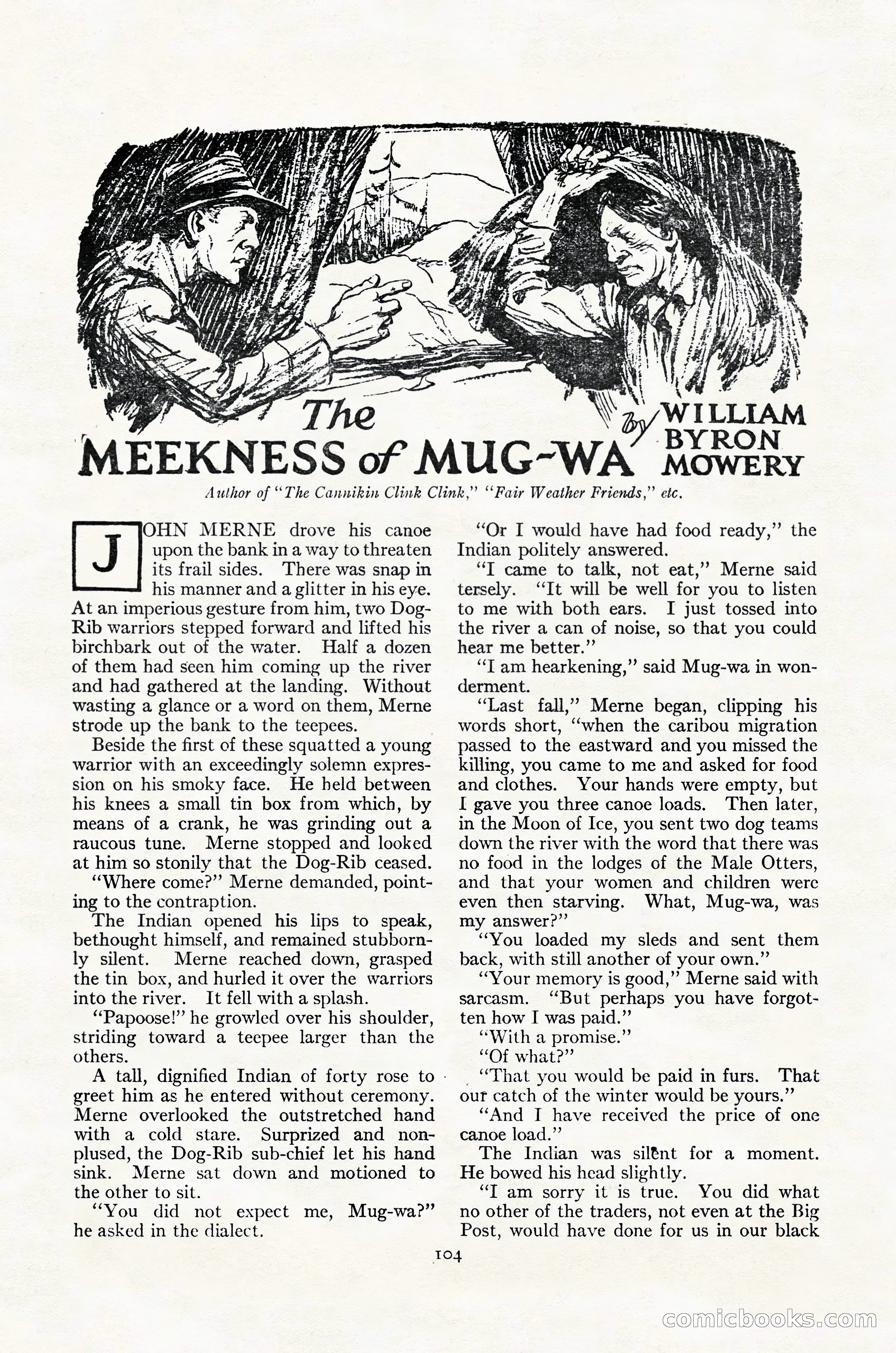
A restored page from Pulp Fiction, 1924. Page through the whole issue in the reader above.
📄 Transcribed text from this page (OCR, searchable)
Machine-transcribed from the original scan — historical spelling and the odd misread are preserved.
MEEKN ESS of MUG- arr BYRON MWe RY Author of ‘The Cannikin Clink Clink,” “Fair Weather Friends,” OHN MERNE drove his canoe J upon the bank in a way to threaten its frail sides. There was snap in his manner and a glitter in his eye. At an imperious gesture from him, two Dog- Rib warriors stepped forward and lifted his birchbark out of the water. Half a dozen of them had seen him coming up the river and had gathered at the landing. Without wasting a glance or a word on them, Merne strode up the bank to the teepees. Beside the first of these squatted a young warrior with an exceedingly solemn expres- sion on his smoky face. He held between his knees a small tin box from which, by means of a crank, he was grinding out a raucous tune. Merne stopped and looked at him so stonily that the Dog-Rib ceased. ‘““Where come?”’ Merne demanded, point- ing to the contraption. The Indian opened his lips to speak, bethought himself, and remained stubborn- ly silent. Merne reached down, grasped the tin box, and hurled it over the warriors into the river. It fell with a splash. “‘Papoose!”’ he growled over his shoulder, striding toward a teepee larger than the others. A tall, dignified Indian of forty rose to - greet him as he entered without ceremony. Merne overlooked the outstretched hand with a cold stare. Surprized and non- plused, the Dog-Rib sub-chief let his hand sink. Merne sat down and motioned to the other to sit. “Or I would have had food ready,” the Indian politely answered. “T came to talk, not eat,’ Merne said tersely. ‘It will be well for you to listen to me with both ears. I just tossed into the river a can of noise, so that you could hear me better.” “T am hearkening,” said Mug-wa in won- derment. “Last fall,” Merne began, clipping his words short, “‘when the caribou migration passed to the eastward and you missed the killing, you came to me and asked for food and clothes. Your hands were empty, but I gave you three canoe loads. Then later, in the Moon of Ice, you sent two dog teams down the river with the word that there was no food in the lodges of the Male Otters, and that your women and children were even then starving. What, Mug-wa, was my answer?” “You loaded my sleds and sent them back, with still another of your own.” “Your memory is good,” Merne said with sarcasm. ‘But perhaps you have forgot- ten how I was paid.” “With a promise.”’ “Of what?” “That you would be paid in furs. That our catch of the winter would be yours.” ‘‘And I have received the price of one canoe load.” The Indian was silént for a moment. He bowed his head slightly. “T am sorry it is true. You did what “You did not expect me, Mug-wa?’” no other of the traders, not even at the Big he asked in the dialect. Post, would have done for us in our black To4 COMmiclbooks