
Pulp Fiction, 1924 · page 88 of 196
Adventure Magazine Cover — page 88: what you’re looking at
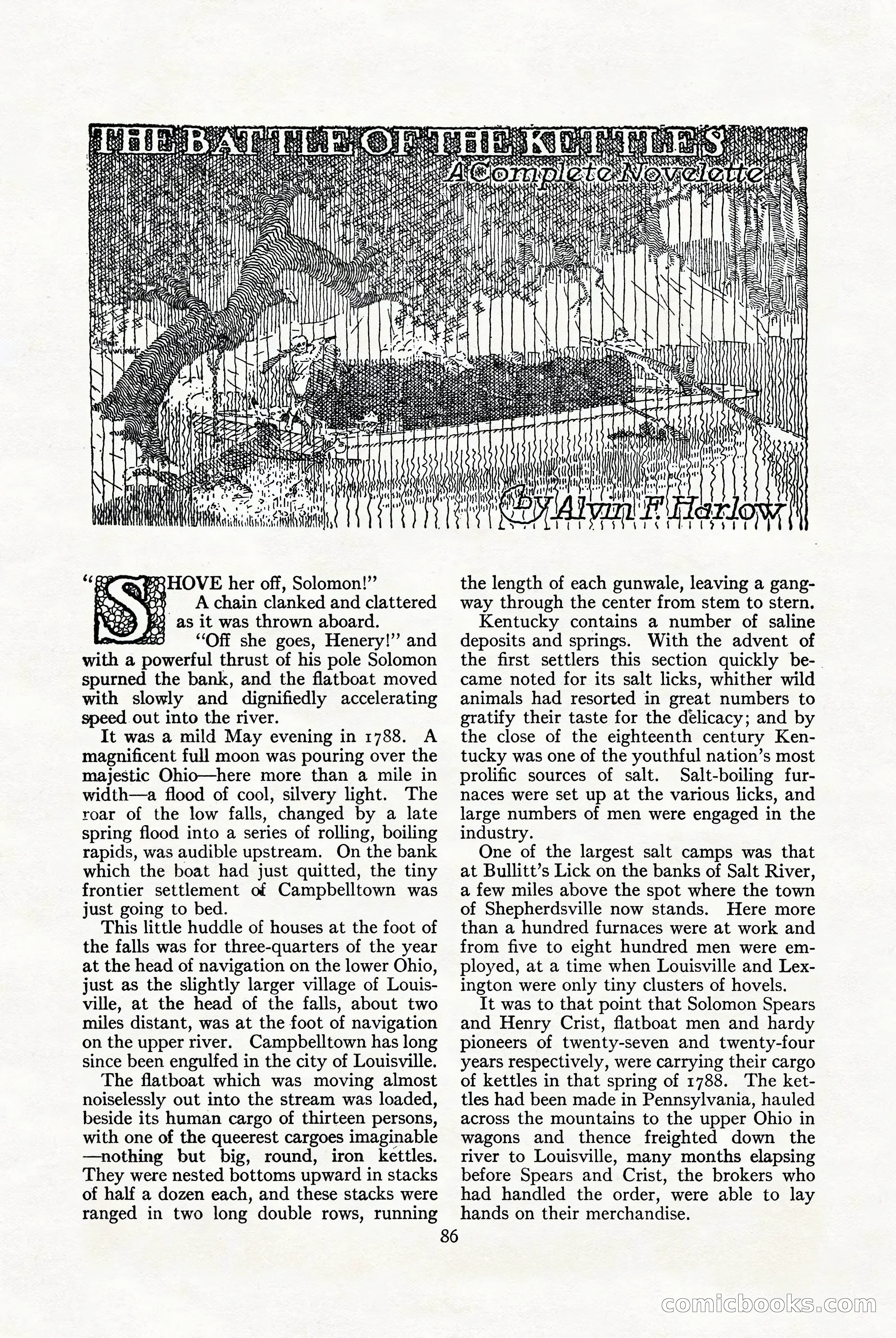
A restored page from Pulp Fiction, 1924. Page through the whole issue in the reader above.
📄 Transcribed text from this page (OCR, searchable)
Machine-transcribed from the original scan — historical spelling and the odd misread are preserved.
“by ore IN “4 aes © : * Ste Srey yeres > . J bry ges Hes N 8 bei 4, x PORT CUNT t wh Le 76} RR BE NST Eh eSealagtanserglee 3 ue he sce NO iN se i Wai nat mRHO RA }, Sine ‘9 Ny e . ‘y, i a) { ot i ] , 1 RHOVE her off, Solomon!”’ ) A chain clanked and clattered BY as it was thrown aboard. o ““Off she goes, Henery!’’ and with a powerful thrust of his pole Solomon spurned the bank, and the flatboat moved with slowly and dignifiedly accelerating speed out into the river. It was a mild May evening in 1788. A magnificent full moon was pouring over the majestic Ohio—here more than a mile in width—a flood of cool, silvery light. The roar of the low falls, changed by a late spring flood into a series of rolling, boiling rapids, was audible upstream. On the bank which the boat had just quitted, the tiny frontier settlement of Campbelltown was just going to bed. This little huddle of houses at the foot of the falls was for three-quarters of the year at the head of navigation on the lower Ohio, just as the slightly larger village of Louis- ville, at the head of the falls, about two miles distant, was at the foot of navigation on the upper river. Campbelltown has long since been engulfed in the city of Louisville. The flatboat which was moving almost noiselessly out into the stream was loaded, beside its human cargo of thirteen persons, with one of the queerest cargoes imaginable —nothing but big, round, iron kettles. They were nested bottoms upward in stacks of half a dozen each, and these stacks were ranged in two long double rows, running DD J "gS PLATT he Rd) 77 | RANA WW) Ai dan s o sr .) 86 4 1 ' } i AA) Tru CEOTTT Di oxt i OUU AD) P. vA bal . 2 Y 1 Sa « >. _ ee , ose f [Ad (ize a. types oces DD yp ry Uith Mf yy) pp i Vil a DDD 6h WU, a) Hl Ts d \ , cw 1 Wade 14M 1! ap Alvin! Fifer Era VEE TTS VT rt the length of each gunwale, leaving a gang- way through the center from stem to stern. Kentucky contains a number of saline deposits and springs. With the advent of the first settlers this section quickly be-_ came noted for its salt licks, whither wild animals had resorted in great numbers to gratify their taste for the delicacy; and by the close of the eighteenth century Ken- tucky was one of the youthful nation’s most prolific sources of salt. Salt-boiling fur- naces were set up at the various licks, and large numbers of men were engaged in the industry. One of the largest salt camps was that at Bullitt’s Lick on the banks of Salt River, a few miles above the spot where the town of Shepherdsville now stands. Here more than a hundred furnaces were at work and from five to eight hundred men were em- ployed, at a time when Louisville and Lex- ington were only tiny clusters of hovels. It was to that point that Solomon Spears and Henry Crist, flatboat men and hardy pioneers of twenty-seven and twenty-four years respectively, were carrying their cargo of kettles in that spring of 1788. The ket- tles had been made in Pennsylvania, hauled across the mountains to the upper Ohio in wagons and thence freighted down the river to Louisville, many months elapsing before Spears and Crist, the brokers who had handled the order, were able to lay hands on their merchandise. CO OO C@