
Pulp Fiction, 1924 · page 70 of 196
Adventure Magazine Cover — page 70: what you’re looking at
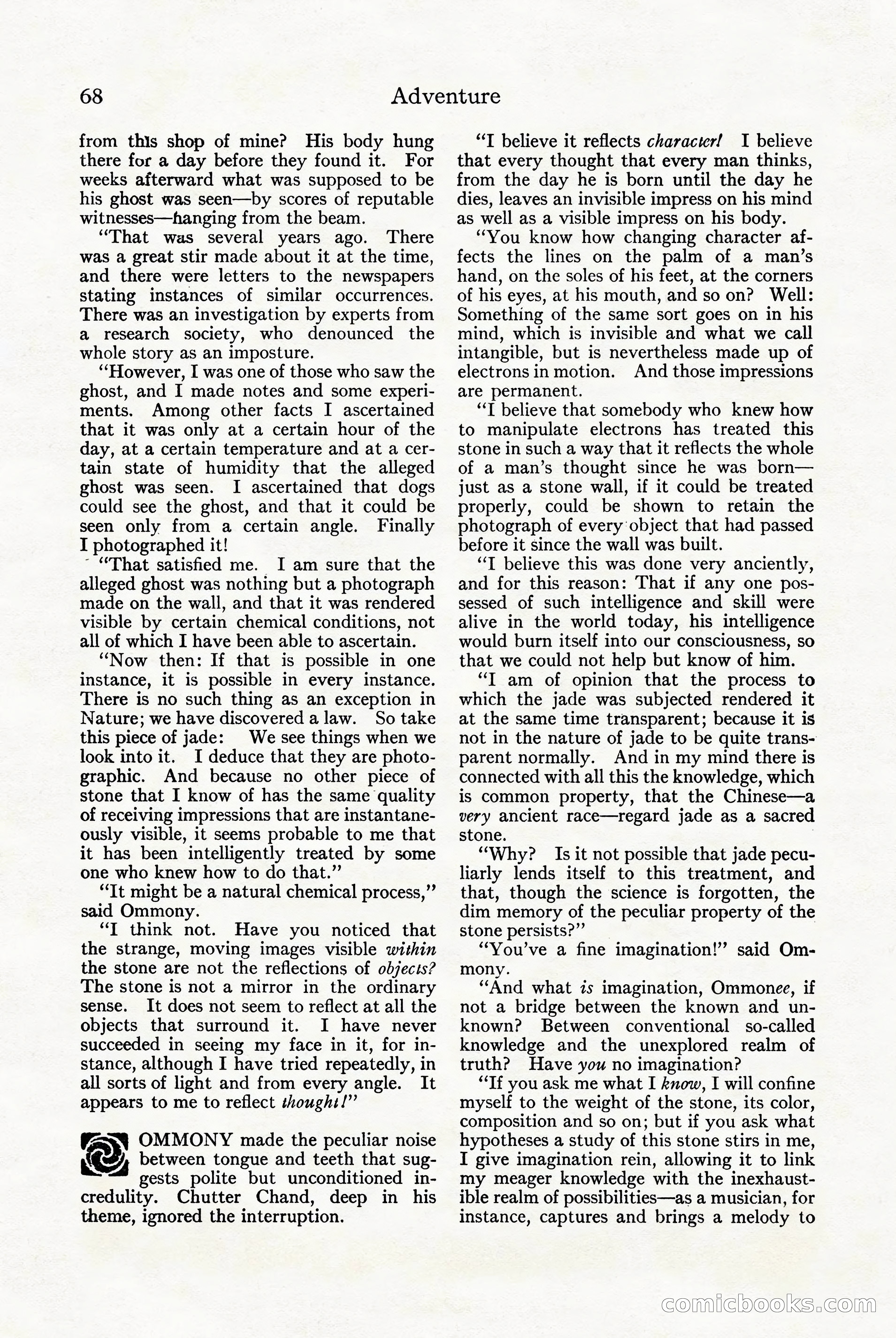
A restored page from Pulp Fiction, 1924. Page through the whole issue in the reader above.
📄 Transcribed text from this page (OCR, searchable)
Machine-transcribed from the original scan — historical spelling and the odd misread are preserved.
68 from this shop of mine? His body hung there for a day before they found it. For weeks afterward what was supposed to be his ghost was seen—by scores of reputable witnesses—hanging from the beam. “That was several years ago. There was a great stir made about it at the time, and there were letters to the newspapers stating instances of similar occurrences. There was an investigation by experts from a research society, who denounced the whole story as an imposture. ‘“‘However, I was one of those who saw the ghost, and I made notes and some experi- ments. Among other facts I ascertained that it was only at a certain hour of the day, at a certain temperature and at a cer- tain state of humidity that the alleged ghost was seen. I ascertained that dogs could see the ghost, and that it could be seen only from a certain angle. Finally I photographed it! ~ “That satisfied me. I am sure that the alleged ghost was nothing but a photograph made on the wall, and that it was rendered visible by certain chemical conditions, not all of which I have been able to ascertain. ‘“‘Now then: If that is possible in one instance, it is possible in every instance. There is no such thing as an exception in Nature; we have discovered a law. So take this piece of jade: We see things when we look into it. I deduce that they are photo- graphic. And because no other piece of stone that I know of has the same quality of receiving impressions that are instantane- ously visible, it seems probable to me that it has been intelligently treated by some one who knew how to do that.” “It might be a natural chemical process,” said Ommony. “I think not. Have you noticed that the strange, moving images visible within the stone are not the reflections of objects? The stone is not a mirror in the ordinary sense. It does not seem to reflect at all the objects that surround it. I have never succeeded in seeing my face in it, for in- stance, although I have tried repeatedly, in all sorts of light and from every angle. It appears to me to reflect thoughil”’ ay OMMONY made the peculiar noise Kc, between tongue and teeth that sug- gests polite but unconditioned in- credulity. Chutter Chand, deep in his theme, ignored the interruption. Adventure “I believe it reflects character! I believe that every thought that every man thinks, from the day he is born until the day he dies, leaves an invisible impress on his mind as well as a visible impress on his body. “You know how changing character af- fects the lines on the palm of a man’s hand, on the soles of his feet, at the corners of his eyes, at his mouth, and so on? Well: Something of the same sort goes on in his mind, which is invisible and what we call intangible, but is nevertheless made up of electrons in motion. And those impressions are permanent. “T believe that somebody who knew how to manipulate electrons has treated this stone in such a way that it reflects the whole of a man’s thought since he was born— just as a stone wall, if it could be treated properly, could be shown to retain the photograph of every object that had passed before it since the wall was built. “T believe this was done very anciently, and for this reason: That if any one pos- sessed of such intelligence and skill were alive in the world today, his intelligence would burn itself into our consciousness, so that we could not help but know of him. “IT am of opinion that the process to which the jade was subjected rendered it at the same time transparent; because it is not in the nature of jade to be quite trans- parent normally. And in my mind there is connected with all this the knowledge, which is common property, that the Chinese—a very ancient race—regard jade as a sacred stone. 3 “Why? Is it not possible that jade pecu- liarly lends itself to this treatment, and that, though the science is forgotten, the dim memory of the peculiar property of the stone persists?” “You’ve a fine imagination!’’ said Om- mony. ‘‘And what zs imagination, Ommonee, if not a bridge between the known and un- known? Between conventional so-called knowledge and the unexplored realm of truth? Have you no imagination? “If you ask me what I know, I will confine myself to the weight of the stone, its color, composition and so on; but if you ask what hypotheses a study of this stone stirs in me, I give imagination rein, allowing it to link my meager knowledge with the inexhaust- ible realm of possibilities—as a musician, for instance, captures and brings a melody to MICLOOOK C@