
Pulp Fiction, 1924 · page 66 of 196
Adventure Magazine Cover — page 66: what you’re looking at
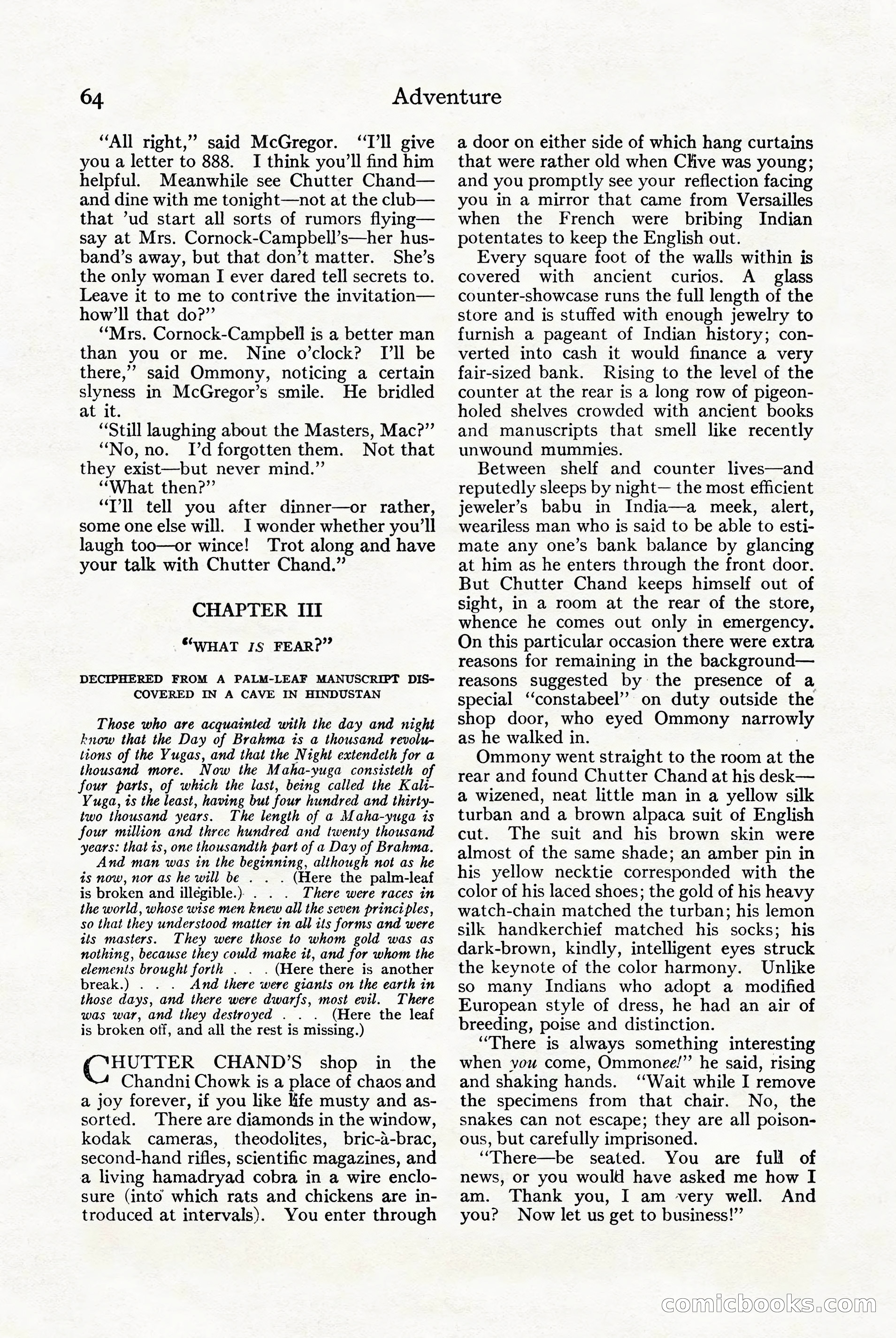
A restored page from Pulp Fiction, 1924. Page through the whole issue in the reader above.
📄 Transcribed text from this page (OCR, searchable)
Machine-transcribed from the original scan — historical spelling and the odd misread are preserved.
64 “All right,” said McGregor. ‘“‘T’ll give you a letter to 888. I think you’ll find him helpful. Meanwhile see Chutter Chand— and dine with me tonight—not at the club— that ’ud start all sorts of rumors flying— say at Mrs. Cornock-Campbell’s—her hus- band’s away, but that don’t matter. She’s the only woman I ever dared tell secrets to. Leave it to me to contrive the invitation— how’ll that do?” “Mrs. Cornock-Campbell is a better man than you or me. Nine o’clock? I'll be there,’”’ said Ommony, noticing a certain slyness in McGregor’s smile. He bridled at it. “Still laughing about the Masters, Mac?” “No, no. Id forgotten them. Not that they exist—but never mind.” “What then?” “Y’ll tell you after dinner—or rather, some one else will. I wonder whether you'll laugh too—or wince! Trot along and have your talk with Chutter Chand.” CHAPTER III SOWHAT IS FEAR?” DECIPHERED FROM A PALM-LEAF MANUSCRIPT DIS- COVERED IN A CAVE IN HINDUSTAN Those who are acquainted with the day and night know that the Day of Brahma ts a thousand revolu- tions of the Yugas, and that the Night extendeth for a thousand more. Now the Maha-yuga consisteth of four parts, of which the last, being called the Kalt- Yuga, is the least, having but four hundred and thirty- two thousand years. The length of a Maha-yuga ts four million and three hundred and twenty thousand years: that is, one thousandth part of a Day of Brahma. And man was in the beginning, although not as he ts now, nor as he will be . . . (Here the palm-leaf is broken and illegible.) . . There were races in the world, whose wise men knew all the seven principles, so that they understood matter in all its forms and were its masters. They were those to whom gold was as nothing, because they could make it, and for whom the elements brought forth . . . (Here there is another break.) . . . And there were giants on the earth in those days, and there were dwarfs, most evil. There was war, and they destroyed . (Here the leaf is broken off, and all the rest is missing.) HUTTER CHAND’S shop in the Chandni Chowk is a place of chaos and a joy forever, if you like life musty and as- sorted. There are diamonds in the window, kodak cameras, theodolites, bric-a-brac, second-hand rifles, scientific magazines, and a living hamadryad cobra in a wire enclo- sure (into which rats and chickens are in- troduced at intervals). You enter through Adventure a door on either side of which hang curtains that were rather old when Clive was young; and you promptly see your reflection facing you in a mirror that came from Versailles when the French were bribing Indian potentates to keep the English out. Every square foot of the walls within is covered with ancient curios. A_ glass counter-showcase runs the full length of the store and is stuffed with enough jewelry to furnish a pageant of Indian history; con- verted into cash it would finance a very fair-sized bank. Rising to the level of the counter at the rear is a long row of pigeon- holed shelves crowded with ancient books and manuscripts that smell like recently unwound mummies. Between shelf and counter lives—and reputedly sleeps by night— the most efficient jeweler’s babu in India—a meek, alert, weariless man who is said to be able to esti- mate any one’s bank balance by glancing at him as he enters through the front door. But Chutter Chand keeps himself out of sight, in a room at the rear of the store, whence he comes out only in emergency. On this particular occasion there were extra reasons for remaining in the background— reasons suggested by the presence of a special ‘‘constabeel’” on duty outside the shop door, who eyed Ommony narrowly as he walked in. . Ommony went straight to the room at th rear and found Chutter Chand at his desk— a wizened, neat little man in a yellow silk turban and a brown alpaca suit of English cut. The suit and his brown skin were almost of the same shade; an amber pin in his yellow necktie corresponded with the color of his laced shoes; the gold of his heavy watch-chain matched the turban; his lemon silk handkerchief matched his socks; his dark-brown, kindly, intelligent eyes struck the keynote of the color harmony. Unlike so many Indians who adopt a modified European style of dress, he had an air of breeding, poise and distinction. “There is always something interesting when vou come, Ommonee!”’ he said, rising and shaking hands. ‘‘Wait while I remove the specimens from that chair. No, the snakes can not escape; they are all poison- ous, but carefully imprisoned. ‘“‘There—be seated. You are full of news, or you would have asked me how I am. Thank you, I am very well. And your Now let us get to business!”’ OO © inn