
Pulp Fiction, 1924 · page 42 of 196
Adventure Magazine Cover — page 42: what you’re looking at
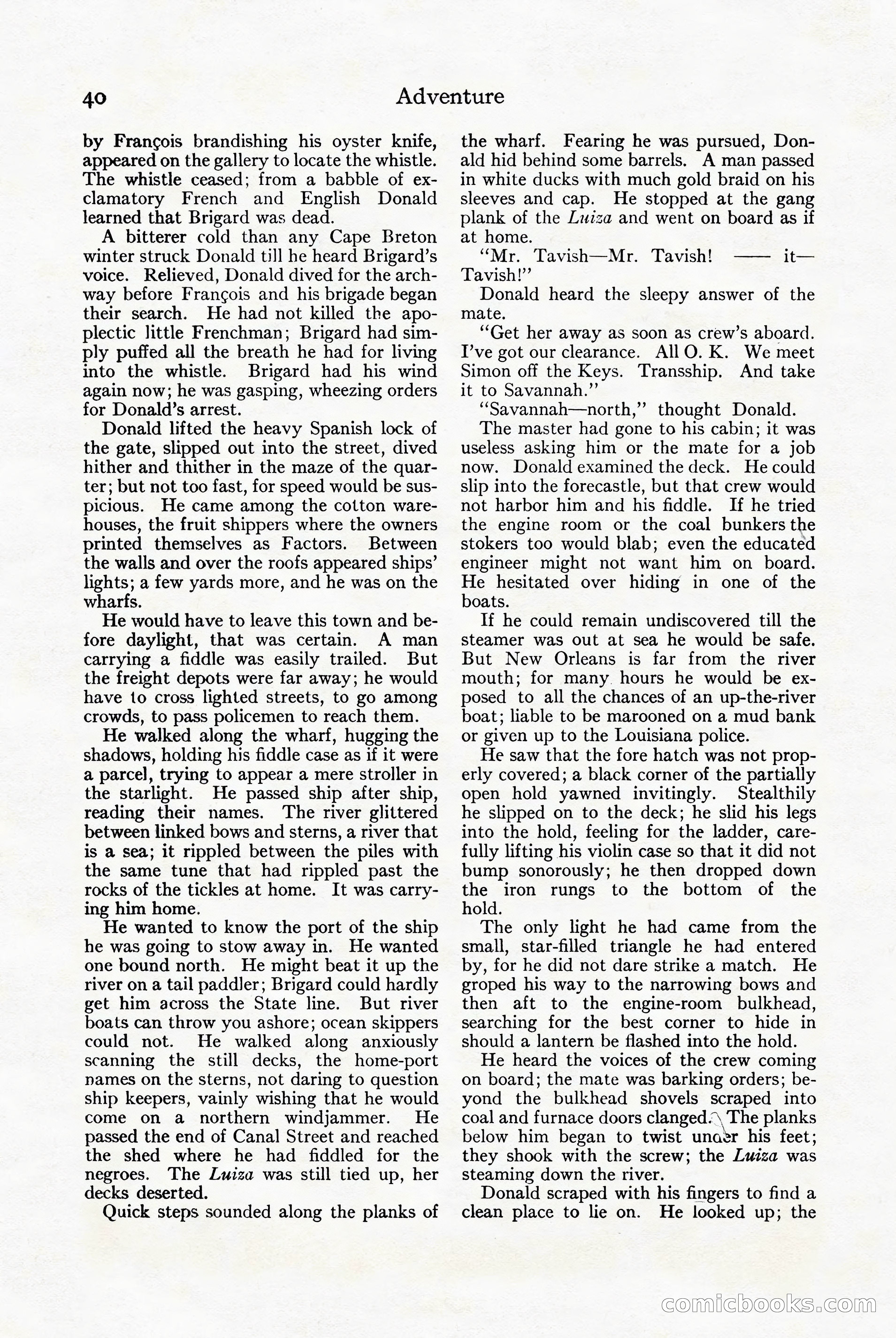
A restored page from Pulp Fiction, 1924. Page through the whole issue in the reader above.
📄 Transcribed text from this page (OCR, searchable)
Machine-transcribed from the original scan — historical spelling and the odd misread are preserved.
40 by Francois brandishing his oyster knife, appeared on the gallery to locate the whistle. The whistle ceased; from a babble of ex- clamatory French and English Donald learned that Brigard was dead. A bitterer cold than any Cape Breton winter struck Donald till he heard Brigard’s voice. Relieved, Donald dived for the arch- way before Francois and his brigade began their search. He had not killed the apo- plectic little Frenchman; Brigard had sim- ply puffed all the breath he had for living into the whistle. Brigard had his wind again now; he was gasping, wheezing orders for Donald’s arrest. Donald lifted the heavy Spanish lock of the gate, slipped out into the street, dived hither and thither in the maze of the quar- ter; but not too fast, for speed would be sus- picious. He came among the cotton ware- houses, the fruit shippers where the owners printed themselves as Factors. Between the walls and over the roofs appeared ships’ lights; a few yards more, and he was on the wharfs. He would have to leave this town and be- fore daylight, that was certain. A man carrying a fiddle was easily trailed. But the freight depots were far away; he would have to cross lighted streets, to go among crowds, to pass policemen to reach them. He walked along the wharf, hugging the shadows, holding his fiddle case as if it were a parcel, trying to appear a mere stroller in the starlight. He passed ship after ship, reading their names. The river glittered between linked bows and sterns, a river that is a sea; it rippled between the piles with the same tune that had rippled past the rocks of the tickles at home. It was carry- ing him home. He wanted to know the port of the ship he was going to stow away in. He wanted one bound north. He might beat it up the river on a tail paddler; Brigard could hardly get him across the State line. But river boats can throw you ashore; ocean skippers could not. He walked along anxiously scanning the still decks, the home-port names on the sterns, not daring to question ship keepers, vainly wishing that he would come on a northern windjammer. He passed the end of Canal Street and reached the shed where he had fiddled for the negroes. The Luiza was still tied up, her decks deserted. Quick steps sounded along the planks of Adventure the wharf. Fearing he was pursued, Don- ald hid behind some barrels. A man passed in white ducks with much gold braid on his sleeves and cap. He stopped at the gang plank of the Luiza and went on board as if at home. “Mr. Tavish!”’ Donald heard the sleepy answer of the mate. “Get her away as soon as crew’s aboard. I’ve got our clearance. AllO. K. We meet Simon off the Keys. Transship. And take it to Savannah.” ‘““Savannah—north,” thought Donald. The master had gone to his cabin; it was useless asking him or the mate for a job now. Donald examined the deck. He could slip into the forecastle, but that crew would not harbor him and his fiddle. If he tried the engine room or the coal bunkers the stokers too would blab; even the educated engineer might not want him on board. He hesitated over hiding in one of the boats. If he could remain undiscovered till the steamer was out at sea he would be safe. But New Orleans is far from the river mouth; for many. hours he would be ex- posed to all the chances of an up-the-river boat; liable to be marooned on a mud bank or given up to the Louisiana police. He saw that the fore hatch was not prop- erly covered; a black corner of the partially open hold yawned invitingly. Stealthily he slipped on to the deck; he slid his legs into the hold, feeling for the ladder, care- fully lifting his violin case so that it did not bump sonorously; he then dropped down the iron rungs to the bottom of the hold. The only light he had came from the small, star-filled triangle he had entered by, for he did not dare strike a match. He groped his way to the narrowing bows and then aft to the engine-room bulkhead, searching for the best corner to hide in should a lantern be flashed into the hold. He heard the voices of the crew coming on board; the mate was barking orders; be- yond the bulkhead shovels scraped into coal and furnace doors clanged.\ The planks below him began to twist uncer his feet; they shook with the screw; the Luiza was steaming down the river. Donald scraped with his fingers to find a clean place to lie on. He looked up; the Tavish—Mr. Tavish! it— MICLOOOK (©