
Pulp Fiction, 1924 · page 32 of 196
Adventure Magazine Cover — page 32: what you’re looking at
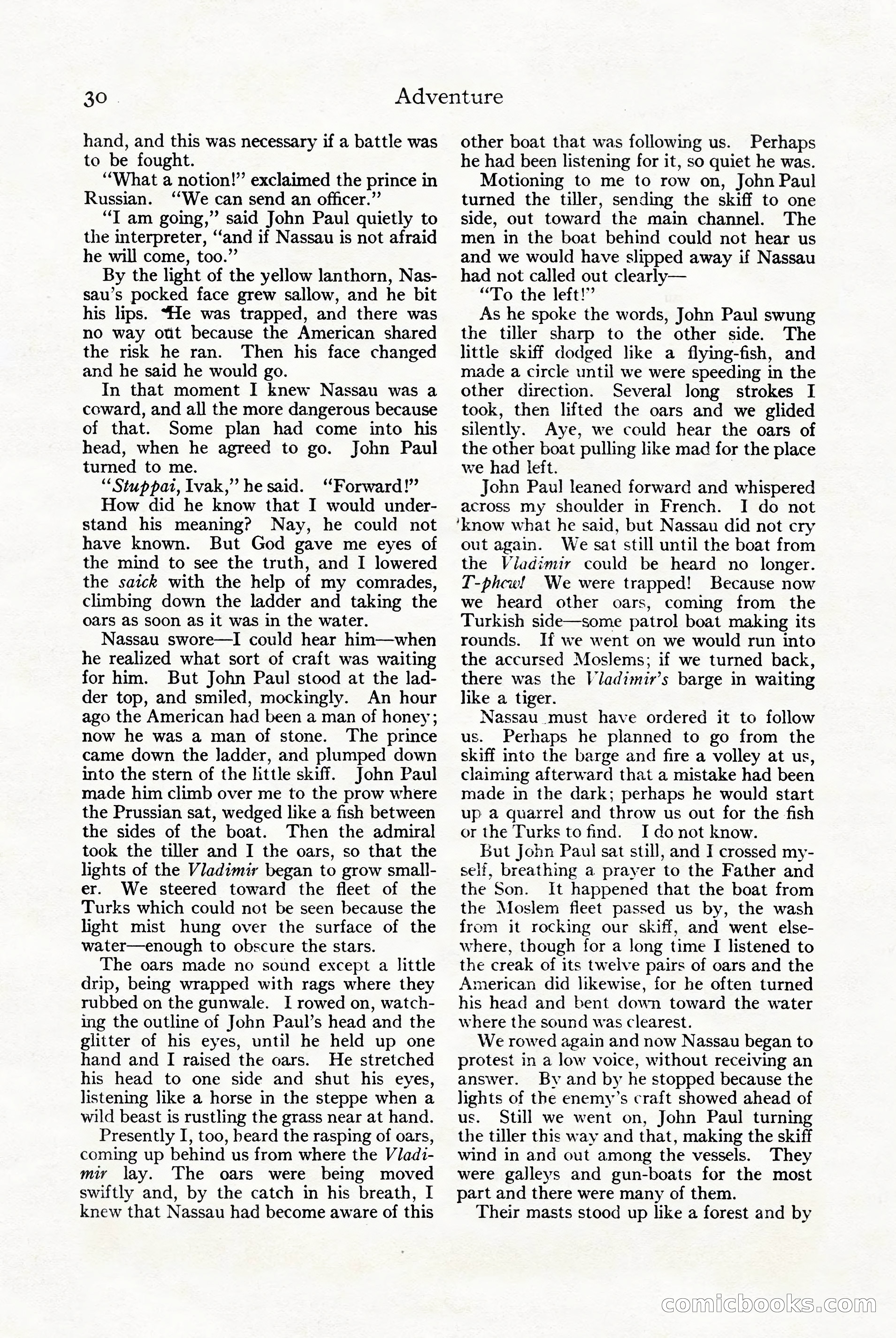
A restored page from Pulp Fiction, 1924. Page through the whole issue in the reader above.
📄 Transcribed text from this page (OCR, searchable)
Machine-transcribed from the original scan — historical spelling and the odd misread are preserved.
30 hand, and this was necessary if a battle was to be fought. ‘What a notion!” exclaimed the prince in Russian. ‘We can send an officer.” “TI am going,” said John Paul quietly to the interpreter, ‘“‘and if Nassau is not afraid he will come, too.” By the light of the yellow lanthorn, Nas- sau’s pocked face grew sallow, and he bit his lips. “He was trapped, and there was no way ott because the American shared the risk he ran. Then his face changed and he said he would go. In that moment I knew Nassau was a coward, and all the more dangerous because of that. Some plan had come into his head, when he agreed to go. John Paul turned to me. “Stuppai, Ivak,” he said. ‘Forward!’ How did he know that I would under- stand his meaning? Nay, he could not have known. But God gave me eyes of the mind to see the truth, and I lowered the satck with the help of my comrades, climbing down the ladder and taking the oars as soon as it was in the water. Nassau swore—I could hear him—when he realized what sort of craft was waiting for him. But John Paul stood at the lad- der top, and smiled, mockingly. An hour ago the American had been a man of honey; now he was a man of stone. The prince came down the ladder, and plumped down into the stern of the little skiff. John Paul made him climb over me to the prow where the Prussian sat, wedged like a fish between the sides of the boat. Then the admiral took the tiller and I the oars, so that the lights of the Vladimir began to grow small- er. We steered toward the fleet of the Turks which could not be seen because the light mist hung over the surface of the water—enough to obscure the stars. The oars made no sound except a little drip, being wrapped with rags where they rubbed on the gunwale. I rowed on, watch- ing the outline of John Paul’s head and the glitter of his eyes, until he held up one hand and I raised the oars. He stretched his head to one side and shut his eyes, listening like a horse in the steppe when a wild beast is rustling the grass near at hand. Presently I, too, beard the rasping of oars, coming up behind us from where the Vladi- mw lay. The oars were being moved swiftly and, by the catch in his breath, I knew that Nassau had become aware of this Adventure other boat that was following us. Perhaps he had been listening for it, so quiet he was. Motioning to me to row on, John Paul turned the tiller, sending the skiff to one side, out toward the main channel. The men in the boat behind could not hear us and we would have slipped away if Nassau had not called out clearly— “To the left!’ As he spoke the words, John Paul swung the tiller sharp to the other side. The little skiff dodged like a flying-fish, and made a circle until we were speeding in the other direction. Several long strokes I took, then lifted the oars and we glided silently. Aye, we could hear the oars of the other boat pulling like mad for the place we had left. 7 John Paul] leaned forward and whispered across my shoulder in French. I do not ‘know what he said, but Nassau did not cry out again. We sat still until the boat from the Vladimir could be heard no longer. I-phcw! We were trapped! Because now we heard other oars, coming from the Turkish side—some patrol boat making its rounds. If we went on we would run into the accursed Moslems; if we turned back, there was the Vladimir’s barge in waiting like a tiger. Nassau must have ordered it to follow us. Perhaps he planned to go from the skiff into the barge and fire a volley at us, claiming afterward that a mistake had been made in the dark; perhaps he would start up a quarrel and throw us out for the fish or the Turks to find. I donot know. But John Paul sat still, and I crossed my- self, breathing a prayer to the Father and the Son. It happened that the boat from the Moslem fleet passed us by, the wash from it rocking our skiff, and went else- where, though for a long time I listened to the creak of its twelve pairs of oars and the American did likewise, for he often turned his head and bent down toward the water where the sound was clearest. We rowed again and now Nassau began to protest in a low voice, without receiving an answer. Bvy and by he stopped because the lights of the enemy’s craft showed ahead of us. Still we went on, John Paul turning the tiller this way and that, making the skiff wind in and out among the vessels. They were galleys and gun-boats for the most part and there were many of them. Their masts stood up like a forest and by MICLOOOK C@ inn