
Pulp Fiction, 1924 · page 20 of 196
Adventure Magazine Cover — page 20: what you’re looking at
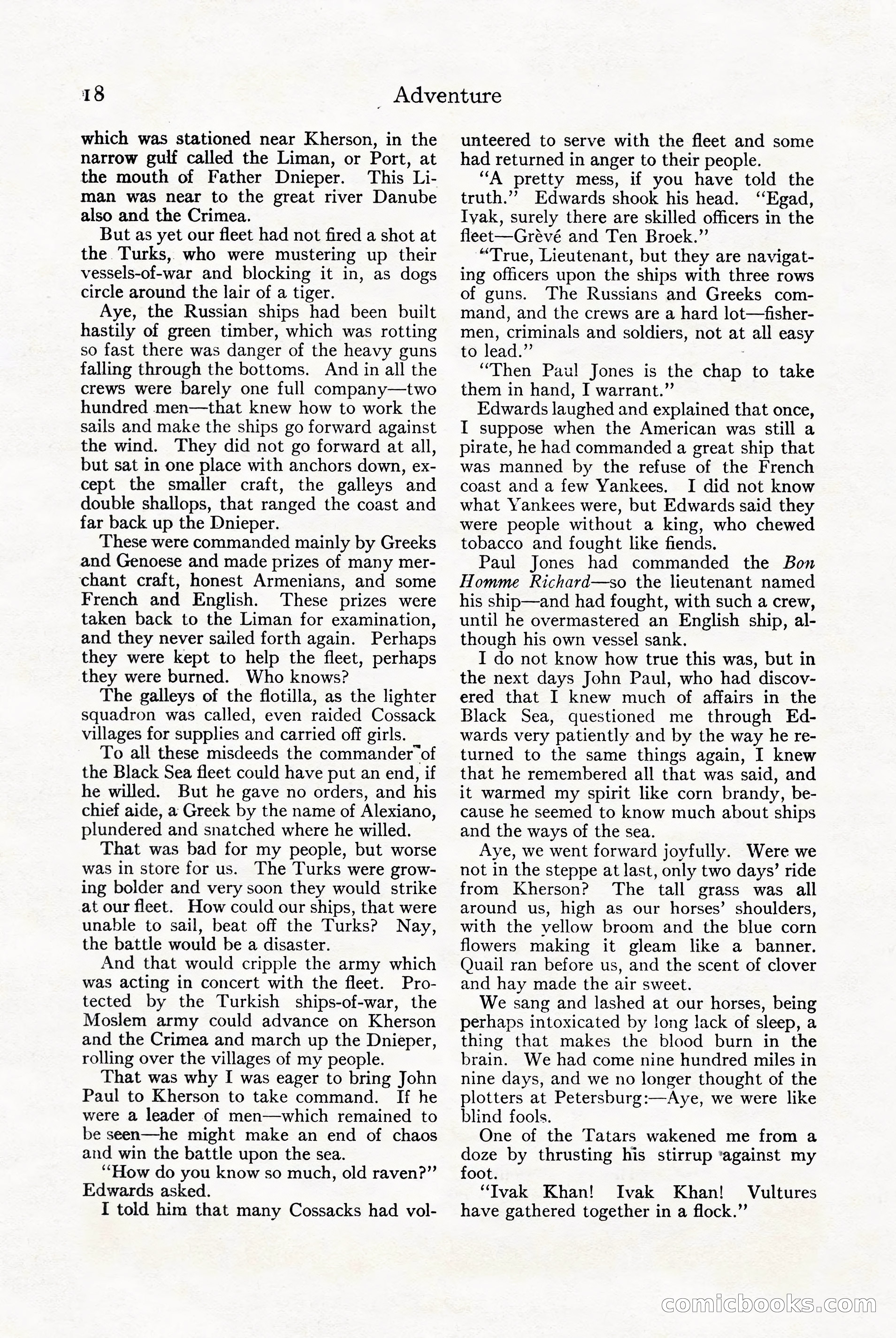
A restored page from Pulp Fiction, 1924. Page through the whole issue in the reader above.
📄 Transcribed text from this page (OCR, searchable)
Machine-transcribed from the original scan — historical spelling and the odd misread are preserved.
18 which was stationed near Kherson, in the narrow gulf called the Liman, or Port, at the mouth of Father Dnieper. This Li- man was near to the great river Danube also and the Crimea. But as yet our fleet had not fired a shot at the. Turks, who were mustering up their vessels-of-war and blocking it in, as dogs circle around the lair of a tiger. Aye, the Russian ships had been built hastily of green timber, which was rotting so fast there was danger of the heavy guns falling through the bottoms. And in all the crews were barely one full company—two hundred men—that knew how to work the sails and make the ships go forward against the wind. They did not go forward at all, but sat in one place with anchors down, ex- cept the smaller craft, the galleys and double shallops, that ranged the coast and far back up the Dnieper. These were commanded mainly by Greeks and Genoese and made prizes of many mer- chant craft, honest Armenians, and some French and English. These prizes were taken back to the Liman for examination, and they never sailed forth again. Perhaps they were kept to help the fleet, perhaps they were burned. Who knows? The galleys of the flotilla, as the lighter squadron was called, even raided Cossack villages for supplies and carried off girls. To all these misdeeds the commander of the Black Sea fleet could have put an end, if he willed. But he gave no orders, and his chief aide, a Greek by the name of Alexiano, plundered and snatched where he willed. That was bad for my people, but worse was in store for us. The Turks were grow- ing bolder and very soon they would strike at our fleet. How could our ships, that were unable to sail, beat off the Turks? Nay, the battle would be a disaster. And that would cripple the army which was acting in concert with the fleet. Pro- tected by the Turkish ships-of-war, the Moslem army could advance on Kherson and the Crimea and march up the Dnieper, rolling over the villages of my people. That was why I was eager to bring John Paul to Kherson to take command. If he were a leader of men—which remained to be seen—he might make an end of chaos and win the battle upon the sea. ‘How do you know so much, old raven?” Edwards asked. I told him that many Cossacks had vol- _ Adventure unteered to serve with the fleet and some had returned in anger to their people. “A pretty mess, if you have told the truth.”” Edwards shook his head. ‘Egad, Ivak, surely there are skilled officers in the fleet—Greévé and Ten Broek.” “True, Lieutenant, but they are navigat- ing officers upon the ships with three rows of guns. The Russians and Greeks com- mand, and the crews are a hard lot—fisher- men, criminals and soldiers, not at all easy to lead.” “Then Paul Jones is the chap to take them in hand, I warrant.” Edwards laughed and explained that once, I suppose when the American was still a pirate, he had commanded a great ship that was manned by the refuse of the French coast and a few Yankees. I did not know what Yankees were, but Edwards said they were people without a king, who chewed tobacco and fought like fiends. Paul Jones had commanded the Bon Homme Richard—so the lieutenant named his ship—and had fought, with such a crew, until he overmastered an English ship, al- though his own vessel sank, I do not know how true this was, but in the next days John Paul, who had discov- ered that I knew much of affairs in the Black Sea, questioned me through Ed- wards very patiently and by the way he re- turned to the same things again, I knew that he remembered all that was said, and it warmed my spirit like corn brandy, be- cause he seemed to know much about ships and the ways of the sea. Aye, we went forward joyfully. Were we not in the steppe at last, only two days’ ride from Kherson? The tall grass was all around us, high as our horses’ shoulders, with the vellow broom and the blue corn flowers making it gleam like a banner. Quail ran before us, and the scent of clover and hay made the air sweet. We sang and lashed at our horses, being perhaps intoxicated by long lack of sleep, a thing that makes the blood burn in the brain. We had come nine hundred miles in nine days, and we no longer thought of the plotters at Petersburg:—Aye, we were like blind fools. One of the Tatars wakened me from a doze by thrusting his stirrup ‘against my foot. “Ivak Khan! Ivak Khan! Vultures have gathered together in a flock.” Conniiclooolkxs.conm