
Pulp Fiction, 1924 · page 189 of 196
Adventure Magazine Cover — page 189: what you’re looking at
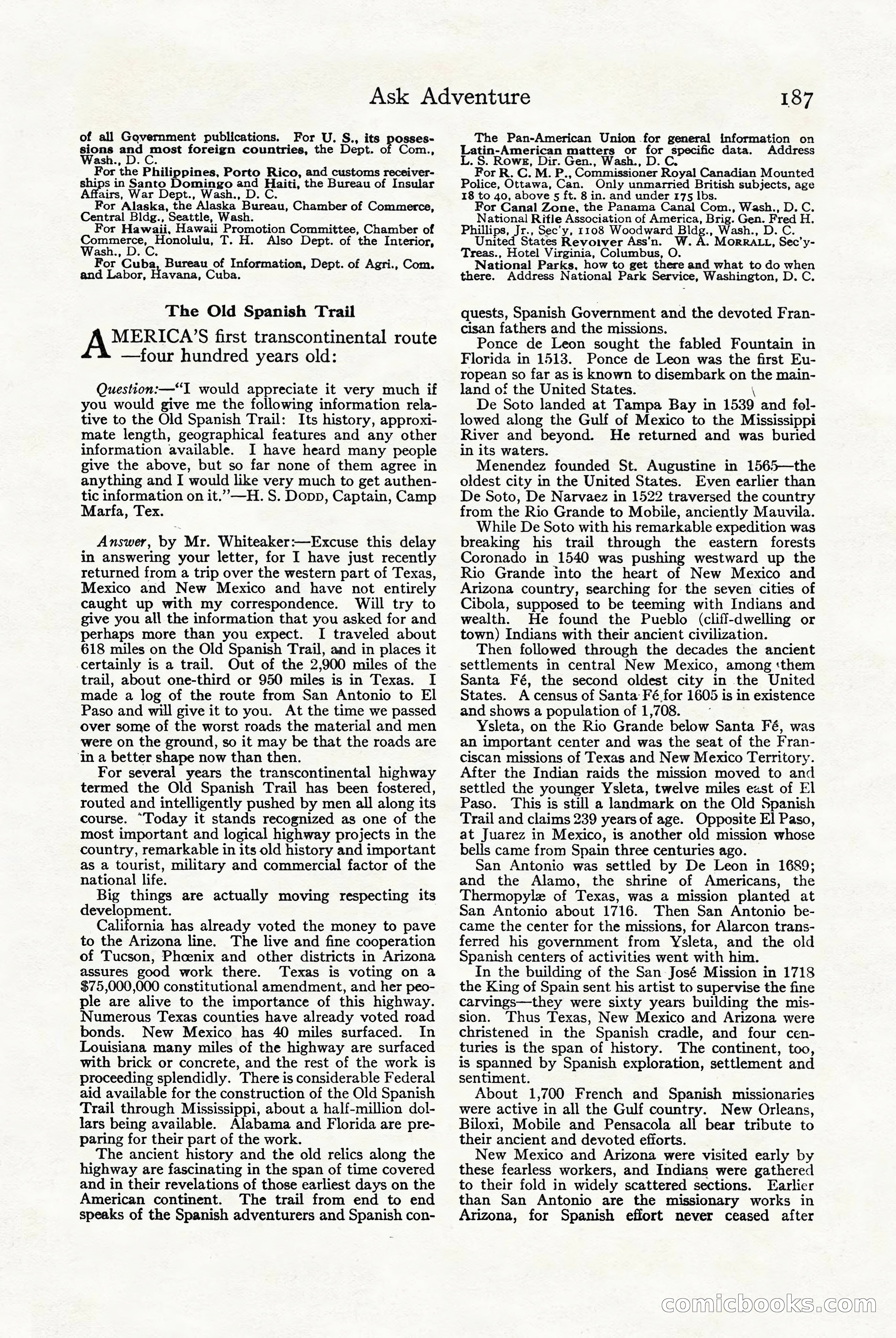
A restored page from Pulp Fiction, 1924. Page through the whole issue in the reader above.
📄 Transcribed text from this page (OCR, searchable)
Machine-transcribed from the original scan — historical spelling and the odd misread are preserved.
Ask Adventure of all Government publications. For U. S., its Fone | and most foreign countries, the Dept. o as HG Ns the Philippines, Porto Rico, and customs receiver- sin Santo Domingo and Haiti, the Bureau of Insular Wales War Dept., Wash., D. C. For Alaska, the Alaska Bureau, Chamber of Commerce, Central Bldg., Seattle, Was For Hawaii. Hawaii Promotion Committee, Chamber of aad Honolulu, T. H. Also Dept. of ‘the Interior, For Cuba, Bureau of Information, Dept. of Agri., Com. and Labor, Havana, Cuba. osses- Com., The Old Spanish Trail MERICA’S first transcontinental route —four hundred years old: Question: —“I would appreciate it very much if you would give me the following information rela- tive to the Old Spanish Trail: Its history, approxi- mate length, geographical features and any other information available. I have heard many people give the above, but so far none of them agree in anything and I would like very much to get authen- tic information on it.” —H. S. Dopp, Captain, Camp Marfa, Tex. Answer, by. Mr. Whiteaker:—Excuse this delay in answering your letter, for I have just recently returned from a trip over ‘the western part of Texas, Mexico and New Mexico and have not entirely caught up with my correspondence. Will try to give you all the information that you asked for and perhaps more than you expect. I traveled about 618 miles on the Old Spanish Trail, and in places it certainly is a trail. Out of the 2,900 miles of the trail, about one-third or 950 miles is in Texas. I made a log of the route from San Antonio to El Paso and will give it to you. At the time we passed over some of the worst roads the material and men were on the ground, so it may be that the roads are ‘In a better shape now than then. For several years the transcontinental highway termed the Old Spanish Trail has been fostered, routed and intelligently pushed by men all along its course. “Today it stands recognized as one of the most important and logical highway projects in the country, remarkable in its old history and important as a tourist, military and commercial factor of the national life. Big things are actually moving respecting its development. California has already voted the money to pave to the Arizona line. The live and fine cooperation of Tucson, Phoenix and other districts in Arizona assures good work there. Texas is voting on a $75,000,000 constitutional amendment, and her peo- ple are alive to the importance of this highway. Numerous Texas counties have already voted road bonds. New Mexico has 40 miles surfaced. In Louisiana many miles of the highway are surfaced with brick or concrete, and the rest of the work is proceeding splendidly. There is considerable Federal aid available for the construction of the Old Spanish Trail through Mississippi, about a half-million dol- lars being available. Alabama and Florida are pre- paring for their part of the work. The ancient history and the old relics along the highway are fascinating in the span of time covered and in their revelations of those earliest days on the American continent. The trail from end to end speaks of the Spanish adventurers and Spanish con- 187 The Pan-American Union for general information on Latin-American matters or for specific data. Address L. S. Rowe, Dir. Gen., Wash., D. C. For R. C. M. P., Comehissioner Royal Canadian Mounted Police, Ottawa, Can. Only unmarried British subjects, age 18 to 4o, above s ft. 8in. and under 175 lbs. For Canal Zone, the Panama Canal Com., Wash., D. C. National Rifle Association of America, Brig. Gen. Fred H. ips, Jr., Sec’y, 1108 Woodward Bldg., Wash., D. C. United States Revoiver Ass'n. . A. MoRRALL, Sec’ y- Treas., Hotel Virginia, Columbus, O. National Parks, how to get there and what to do when ere. Address National Park Service, Washington, D. C quests, Spanish Government and the devoted Fran- cisan fathers and the missions. Ponce de Leon sought the fabled Fountain in Florida in 1513. Ponce de Leon was the first Eu- ropean so far as is known to disembark on main- land of the United States. De Soto landed at Tampa Bay in 1539 and fol- lowed along the Gulf of Mexico to the Mississippi River and beyond. He returned and was buried in its waters. Menendez founded St. Augustine in 1565—the oldest city in the United States. Even earlier than De Soto, De Narvaez in 1522 traversed the country from the Rio Grande to Mobile, anciently Mauvila. While De Soto with his remarkable expedition was breaking his trail through the eastern forests Coronado in 1540 was pushing westward up the Rio Grande into the heart of New Mexico and Arizona country, searching for the seven cities of Cibola, supposed to be teeming with Indians and wealth. He found the Pueblo (cliff-dwelling or town) Indians with their ancient civilization. Then followed through the decades the ancient settlements in central New Mexico, among ‘them Santa Fé, the second oldest city in the United States. A census of Santa Fé for 1605 is in existence and shows a population of 1,708. Ysleta, on the Rio Grande below Santa Fé, was an important center and was the seat of the Fran- ciscan missions of Texas and New Mexico Territory. After the Indian raids the mission moved to and settled the younger Ysleta, twelve miles east of El Paso. This is still a landmark on the Old Spanish Trail and claims 239 years of age. Opposite El Paso, at Juarez in Mexico, is another old mission whose bells came from Spain three centuries ago. San Antonio was settled by De Leon in 1689; and the Alamo, the shrine of Americans, the Thermopylze of Texas, was a mission planted at San Antonio about 1716. Then San Antonio be- came the center for the missions, for Alarcon trans- ferred his government from Ysleta, and the old Spanish centers of activities went with him. In the building of the San José Mission in 1718 the King of Spain sent his artist to supervise the fine carvings—they were sixty years building the mis- sion. Thus Texas, New Mexico and Arizona were christened in the Spanish cradle, and four cen- turies is the span of history. The continent, too, is spanned by Spanish exploration, settlement and sentiment. About 1,700 French and Spanish missionaries were active in all the Gulf country. New Orleans, Biloxi, Mobile and Pensacola all bear tribute to their ancient and devoted efforts. New Mexico and Arizona were visited early by these fearless workers, and Indians were gathered to their fold in widely scattered sections. Earlier than San Antonio are the missionary works in Arizona, for Spanish effort never ceased after DOO C©