
Pulp Fiction, 1924 · page 139 of 196
Adventure Magazine Cover — page 139: what you’re looking at
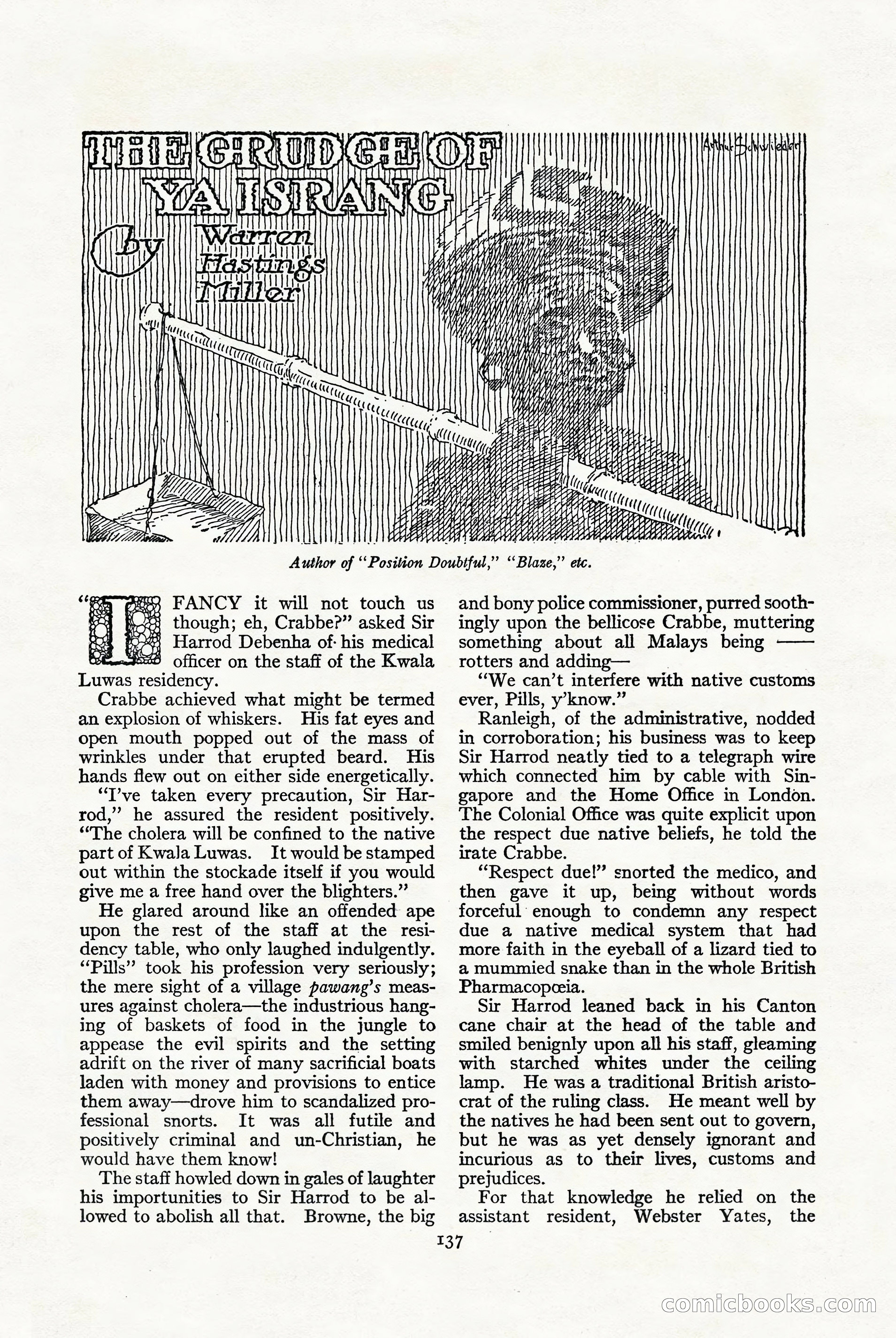
A restored page from Pulp Fiction, 1924. Page through the whole issue in the reader above.
📄 Transcribed text from this page (OCR, searchable)
Machine-transcribed from the original scan — historical spelling and the odd misread are preserved.
on sul Pao ‘all De FU ? TF | Ht : | fAsthek dite Tint GARD GA @ tH nUvanady A TL LTT siatntes by | | Kop | iy; bs rN P Se | CO Vad) | wle hh ra Ip oa WAR Yi, LLM, HAY 2652654 YANN LH Gs | pL: TOW Wa eee WU LAIULUDI BMLer SEABED Wy e228 | My My YY HU Hy IND 56422" 4 , CANN VL | ae Me LV MAA is Wh, | (C¢ | AA | li OY 7 MU eee Ai Seecs eaKotecaers a 4 4253972,445 ts Wt AA ry EAE af SE VL); CNOA En Cen ah BiG 00259 VEL COU Bee ly), Wii hm “GUA LCA GOAL Author of ‘Position Doubtful,” “Blaze,’’ etc. %3 FANCY it will not touch us 33} though; eh, Crabbe?” asked Sir 34% Harrod Debenha of: his medical 43% officer on the staff of the Kwala dency. Crabbe achieved what might be termed an explosion of whiskers. His fat eyes and open mouth popped out of the mass of wrinkles under that erupted beard. His hands flew out on either side energetically. “I’ve taken every precaution, Sir Har- rod,” he assured the resident positively. “The cholera will be confined to the native part of KwaJa Luwas. It would be stamped out within the stockade itself if you would give me a free hand over the blighters.”’ He glared around like an offended ape upon the rest of the staff at the resi- dency table, who only laughed indulgently. ‘Pills” took his profession very seriously; the mere sight of a village pawang’s meas- ures against cholera—the industrious hang- ing of baskets of food in the jungle to appease the evil spirits and the setting adrift on the river of many sacrificial boats laden with money and provisions to entice them away—drove him to scandalized pro- fessional snorts. It was all futile and positively criminal and un-Christian, he would have them know! The staff howled down in gales of laughter his importunities to Sir Harrod to be al- lowed to abolish all that. Browne, the big and bony police commissioner, purred sooth- ingly upon the bellicose Crabbe, muttering something about all Malays bemg —— rotters and adding— | ‘“‘We can’t interfere with native customs ever, Pills, y’ know.” Ranleigh, of the administrative, nodded in corroboration; his business was to keep Sir Harrod neatly tied to a telegraph wire which connected him by cable with Sin- gapore and the Home Office in London. The Colonial Office was quite explicit upon the respect due native beliefs, he told the irate Crabbe. “Respect due!” snorted the medico, and then gave it up, being without words forceful’: enough to condemn any respect due a native medical system that had more faith in the eyeball of a lizard tied to a mummied snake than in the whole British Pharmacopceia. Sir Harrod leaned back in his Canton cane chair at the head of the table and smiled benignly upon all his staff, gleaming with starched whites under the ceiling lamp. He was a traditional British aristo- crat of the ruling class. He meant well by the natives he had been sent out to govern, but he was as yet densely ignorant and incurious as to their lives, customs and prejudices. For that knowledge he relied on the assistant resident, Webster Yates, the 137 NOOK (C© in