
Pulp Fiction, 1924 · page 130 of 196
Adventure Magazine Cover — page 130: what you’re looking at
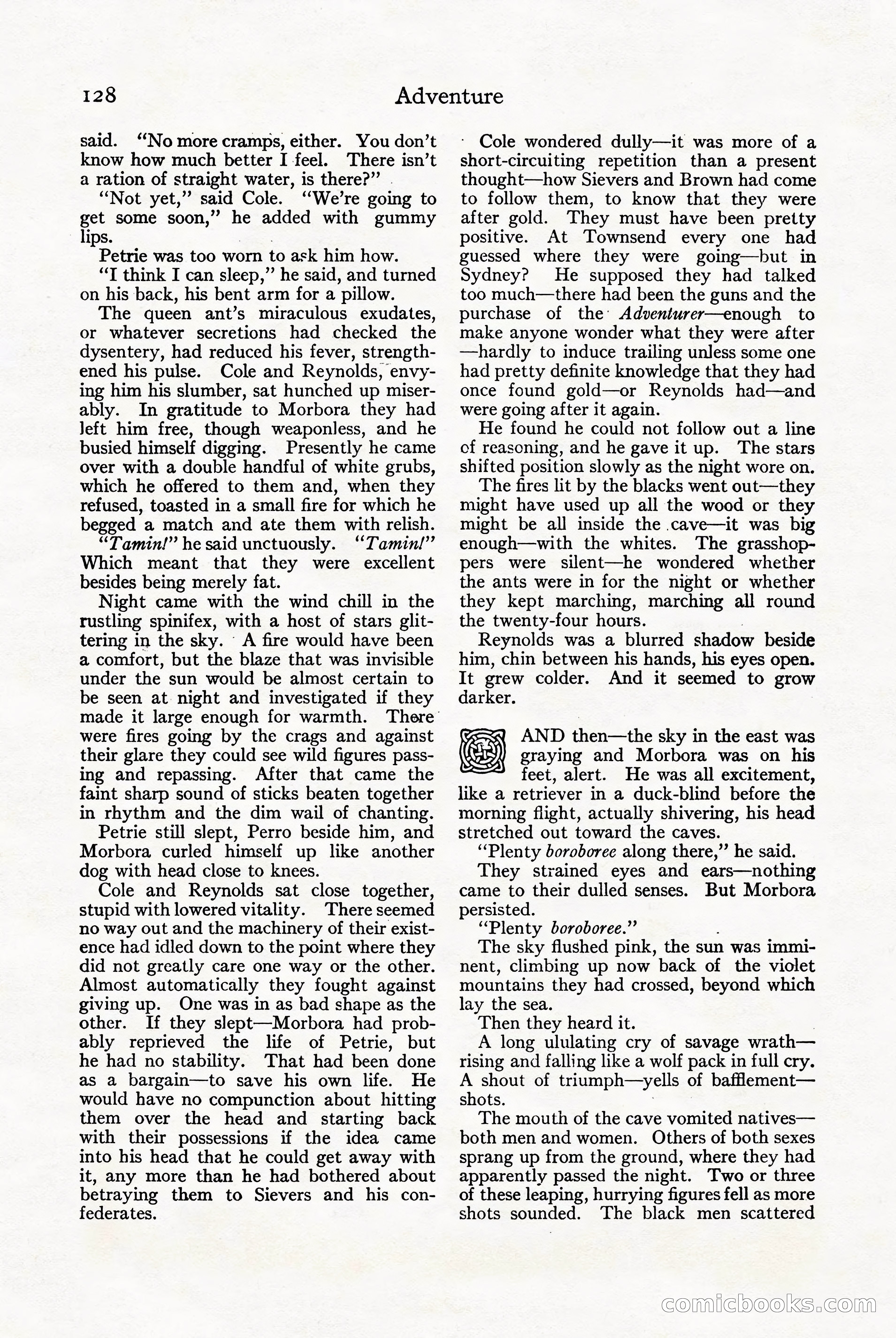
A restored page from Pulp Fiction, 1924. Page through the whole issue in the reader above.
📄 Transcribed text from this page (OCR, searchable)
Machine-transcribed from the original scan — historical spelling and the odd misread are preserved.
128 said. ‘No more cramps, either. You don’t know how much better I feel. There isn’t a ration of straight water, is there?” . “Not yet,” said Cole. ‘We're going to get some soon,” he added with gummy lips. Petrie was too worn to ask him how. “T think I can sleep,” he said, and turned on his back, his bent arm for a ‘pillow. The queen ant’s miraculous exudates, or whatever secretions had checked the dysentery, had reduced his fever, strength- ened his pulse. Cole and Reynolds, envy- ing him his slumber, sat hunched up miser- ably. In gratitude to Morbora they had Jeft him free, though weaponless, and he busied himself digging. Presently he came over with a double handful of white grubs, which he offered to them and, when they refused, toasted in a small fire for which he begged a match and ate them with relish. “Tamin!” he said unctuously. ‘‘Tamin!’’ Which meant that they were excellent besides being merely fat. Night came with the wind chill in the rustling spinifex, with a host of stars glit- tering in the sky. A fire would have been a comfort, but the blaze that was invisible under the sun would be almost certain to be seen at. night and investigated if they made it large enough for warmth. There were fires going by the crags and against their glare they could see wild figures pass- ing and repassing. After that came the faint sharp sound of sticks beaten together in rhythm and the dim wail of chanting. Petrie still slept, Perro beside him, and Morbora curled himself up like another dog with head close to knees. Cole and Reynolds sat close together, stupid with lowered vitality. There seemed no way out and the machinery of their exist- ence had idled down to the point where they did not greatly care one way or the other. Almost automatically they fought against giving up. One was in as bad shape as the other. If they slept—Morbora had prob- ably reprieved the life of Petrie, but he had no stability. That had been done as a bargain—to save his own life. He would have no compunction about hitting them over the head and starting back with their possessions if the idea came into his head that he could get away with it, any more than he had bothered about betraying them to Sievers and his con- federates. Adventure * Cole wondered dully—it was more of a short-circuiting repetition than a present thought—how Sievers and Brown had come to follow them, to know that they were after gold. They must have been pretty positive. At Townsend every one had guessed where they were going—but in Sydney? He supposed they had talked too much—there had been the guns and the purchase of the’ Adventurer—enough to make anyone wonder what they were after —hardly to induce trailing unless some one had pretty definite knowledge that they had once found gold—or Reynolds had—and were going after it again. He found he could not follow out a line of reasoning, and he gave it up. The stars shifted position slowly as the night wore on. The fires lit by the blacks went out—they might have used up all the wood or they might be all inside the cave—it was big enough—with the whites. The grasshop- pers were silent—he wondered whether the ants were in for the night or whether they kept marching, marching all round the twenty-four hours. Reynolds was a blurred shadow beside him, chin between his hands, his eyes open. It grew colder. And it seemed to grow darker. aN AND then—the sky in the east was @) (a) graying and Morbora was on his feet, alert. He was all excitement, like a retriever in a duck-blind before the morning flight, actually shivering, his head stretched out toward the caves. “Plenty boroboree along there,” he said. They strained eyes and ears—nothing came to their dulled senses. But Morbora persisted. ‘Plenty boroboree.”’ The sky flushed pink, the sun was immi- nent, climbing up now back of the violet mountains they had crossed, beyond which lay the sea. Then they heard it. A long ululating cry of savage wrath— rising and falling like a wolf pack in full cry. A shout of triumph—yells of bafflement— shots. The mouth of the cave vomited natives— both men and women. Others of both sexes sprang up from the ground, where they had apparently passed the night. Two or three of these leaping, hurrying figures fell as more shots sounded. The black men scattered MICLOOOK C© in