
Pulp Fiction, 1924 · page 126 of 196
Adventure Magazine Cover — page 126: what you’re looking at
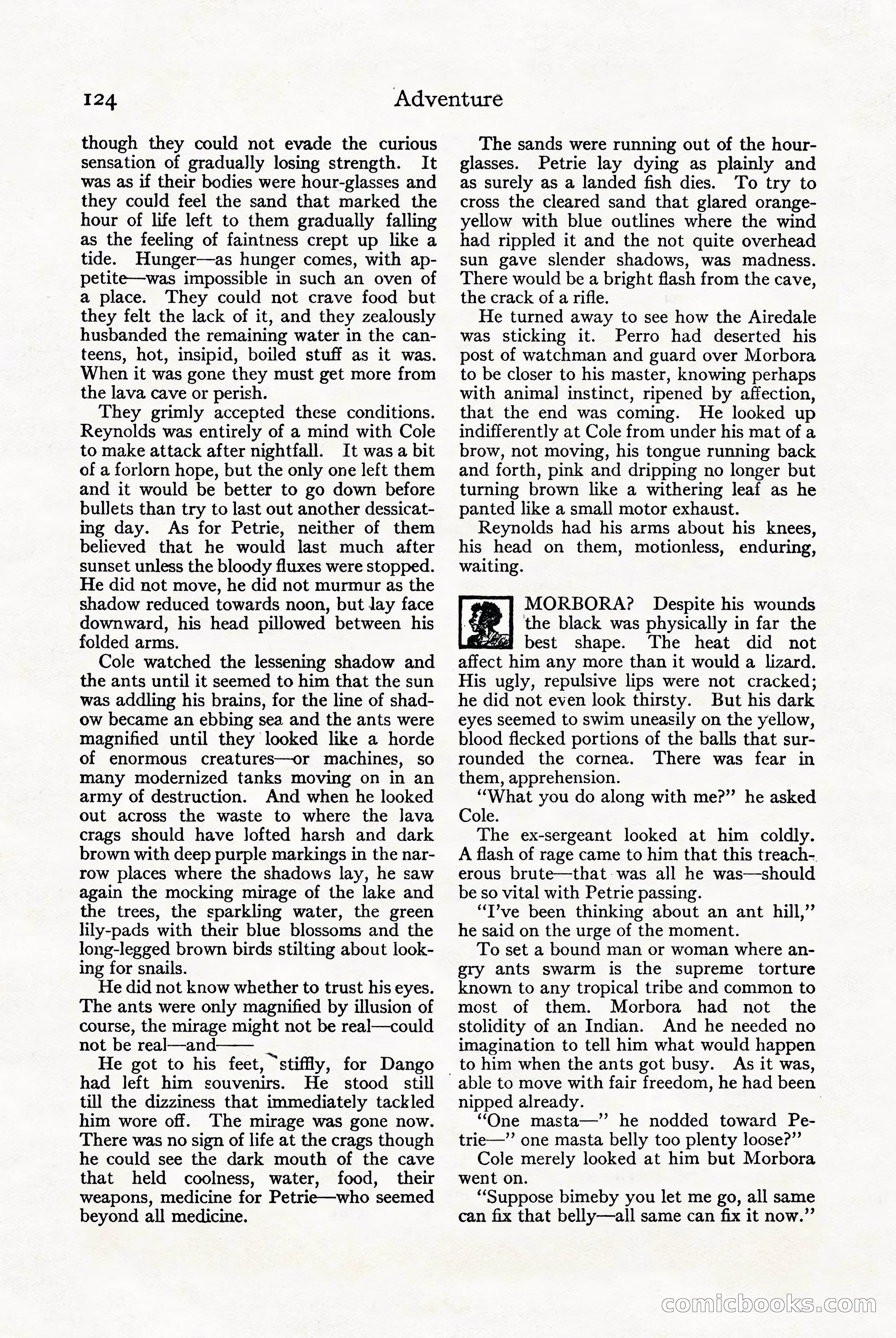
A restored page from Pulp Fiction, 1924. Page through the whole issue in the reader above.
📄 Transcribed text from this page (OCR, searchable)
Machine-transcribed from the original scan — historical spelling and the odd misread are preserved.
124 though they could not evade the curious sensation of gradually losing strength. It was as if their bodies were hour-glasses and they could feel the sand that marked the hour of life left to them gradually falling as the feeling of faintness crept up like a tide. Hunger—as hunger comes, with ap- petite—was impossible in such an oven of a place. They could not crave food but they felt the lack of it, and they zealously husbanded the remaining water in the can- teens, hot, insipid, boiled stuff as it was. When it was gone they must get more from the lava cave or perish. They grimly accepted these conditions. Reynolds was entirely of a mind with Cole to make attack after nightfall. It was a bit of a forlorn hope, but the only one left them and it would be better to go down before bullets than try to last out another dessicat- ing day. As for Petrie, neither of them believed that he would last much after sunset unless the bloody fluxes were stopped. He did not move, he did not murmur as the shadow reduced towards noon, but lay face downward, his head pillowed between his folded arms. Cole watched the lessening shadow and the ants until it seemed to him that the sun was addling his brains, for the line of shad- ow became an ebbing sea and the ants were magnified until they looked like a horde of enormous creatures—or machines, so many modernized tanks moving on in an army of destruction. And when he looked out across the waste to where the lava crags should have lofted harsh and dark brown with deep purple markings in the nar- row places where the shadows lay, he saw again the mocking mirage of the lake and the trees, the sparkling water, the green lily-pads with their blue blossoms and the long-legged brown birds stilting about look- ing for snails. He did not know whether to trust his eyes. The ants were only magnified by illusion of course, the mirage might not be real—could not be real—and He got to his feet, ‘stiffly, for Dango had left him souvenirs. He stood still till the dizziness that immediately tackled him wore off. The mirage was gone now. There was no sign of life at the crags though he could see the dark mouth of the cave that held coolness, water, food, their weapons, medicine for Petrie—who seemed beyond all medicine. Adventure The sands were running out of the hour- glasses. Petrie lay dying as plainly and as surely as a landed fish dies. To try to cross the cleared sand that glared orange- yellow with blue outlines where the wind had rippled it and the not quite overhead sun gave slender shadows, was madness. There would be a bright flash from the cave, the crack of a rifle. He turned away to see how the Airedale was sticking it. Perro had deserted his post of watchman and guard over Morbora to be closer to his master, knowing perhaps with animal instinct, ripened by affection, that the end was coming. He looked up indifferently at Cole from under his mat of a brow, not moving, his tongue running back and forth, pink and dripping no longer but turning brown like a withering leaf as he panted like a small motor exhaust. Reynolds had his arms about his knees, his head on them, motionless, enduring, waiting. MORBORA? Despite his wounds me 1 the black was physically in far the Met“d best shape. The heat did not affect him any more than it would a lizard. His ugly, repulsive lips were not cracked; he did not even look thirsty. But his dark eyes seemed to swim uneasily on the yellow, blood flecked portions of the balls that sur- rounded the cornea. There was fear in them, apprehension. “What you do along with me?”’ he asked Cole. The ex-sergeant looked at him coldly. A flash of rage came to him that this treach-. erous brute—that was all he was—should be so vital with Petrie passing. “T’ve been thinking about an ant hill,” he said on the urge of the moment. To set a bound man or woman where an- gry ants swarm is the supreme torture known to any tropical tribe and common to most of them. Morbora had not the stolidity of an Indian. And he needed no imagination to tell him what would happen to him when the ants got busy. As it was, able to move with fair freedom, he had been nipped already. “One masta—” he nodded toward Pe- trie—’’ one masta belly too plenty loose?”’ Cole merely looked at him but Morbora went on. ‘Suppose bimeby you let me go, all same can fix that belly—all same can fix it now.” MICLOOOK ©