
Pulp Fiction, 1924 · page 111 of 196
Adventure Magazine Cover — page 111: what you’re looking at
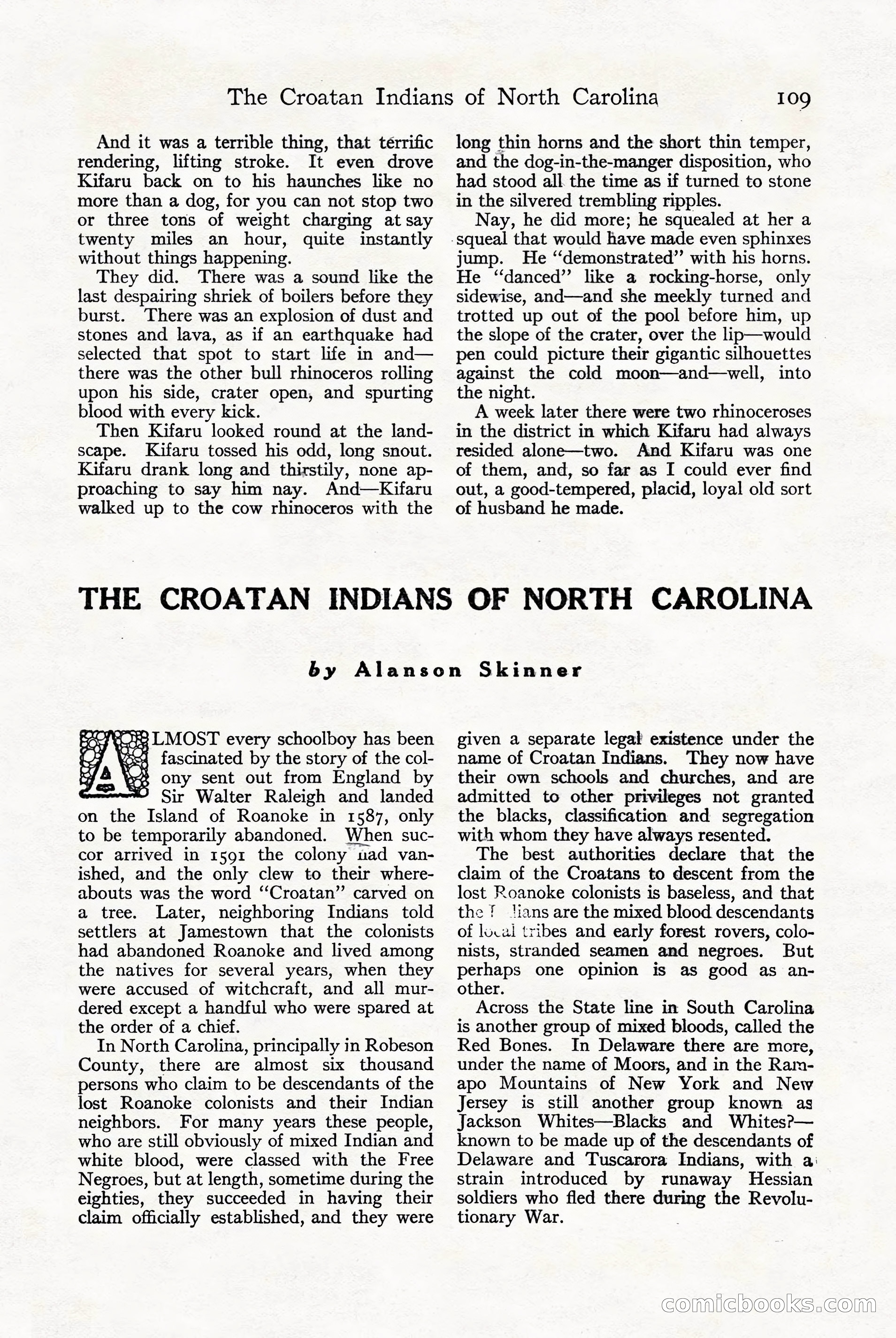
A restored page from Pulp Fiction, 1924. Page through the whole issue in the reader above.
📄 Transcribed text from this page (OCR, searchable)
Machine-transcribed from the original scan — historical spelling and the odd misread are preserved.
The Croatan Indians of North Carolina And it was a terrible thing, that térrific rendering, lifting stroke. It even drove Kifaru back on to his haunches like no more than a dog, for you can not stop two or three tons of weight charging at say twenty miles an hour, quite instantly without things happening. They did. There was a sound like the last despairing shriek of boilers before they burst. There was an explosion of dust and stones and lava, as if an earthquake had selected that spot to start life in and— there was the other bull rhinoceros rolling upon his side, crater open, and spurting blood with every kick. Then Kifaru looked round at the land- scape. Kifaru tossed his odd, long snout. Kifaru drank long and thirstily, none ap- proaching to say him nay. And—Kifaru walked up to the cow rhinoceros with the 109 long thin horns and the short thin temper, and the dog-in-the- -manger disposition, who had stood all the time as if turned to stone in the silvered trembling ripples. Nay, he did more; he squealed at her a -squeal that would have made even sphinxes jump. He “demonstrated”’ with his horns. He “danced” like a rocking-horse, only sidewise, and—and she meekly turned and trotted up out of the pool before him, up the slope of the crater, over the lip—would pen could picture their gigantic silhouettes against the cold moon—and—well, into the night. A week later there were two rhinoceroses in the district in which Kifaru had always resided alone—two. And Kifaru was one of them, and, so far as I could ever find out, a good-tempered, placid, loyal old sort of husband he made. THE CROATAN INDIANS OF NORTH CAROLINA by Alanson Skinner Fe LMOST every schoolboy has been si fascinated by the story of the col- ¥ ony sent out from England by %O Sir Walter Raleigh and_ landed on the Island of Roanoke in 1587, only to be temporarily abandoned. When suc- cor arrived in 1591 the colony nad van- ished, and the only clew to their where- abouts was the word “Croatan” carved on a tree. Later, neighboring Indians told settlers at Jamestown that the colonists had abandoned Roanoke and lived among the natives for several years, when they were accused of witchcraft, and all mur- dered except a handful who were spared at the order of a chief. In North Carolina, principally in Robeson County, there are almost six thousand persons who claim to be descendants of the lost Roanoke colonists and their Indian neighbors. For many years these people, who are still obviously of mixed Indian and white blood, were classed with the Free Negroes, but at length, sometime during the eighties, they succeeded in having their claim officially established, and they were given a separate legal existence under the name of Croatan Indians. They now have their own schools and churches, and are admitted to other privileges not granted the blacks, classification and segregation with whom they have always resented. The best authorities declare that the claim of the Croatans to descent from the lost Roanoke colonists is baseless, and that the { ‘ians are the mixed blood descendants of local tribes and early forest rovers, colo- nists, stranded seamen and negroes. But perhaps one opinion is as good as an- other. Across the State line in South Carolina is another group of mixed bloods, called the Red Bones. In Delaware there are more, under the name of Moors, and in the Ram- apo Mountains of New York and New Jersey is still another group known as Jackson Whites—Blacks and WhitesP— known to be made up of the descendants of Delaware and Tuscarora Indians, with a strain introduced by runaway Hessian soldiers who fled there Se the Revolu- tionary War. DOOK (C© in