
Pulp Fiction, 1924 · page 102 of 196
Adventure Magazine Cover — page 102: what you’re looking at
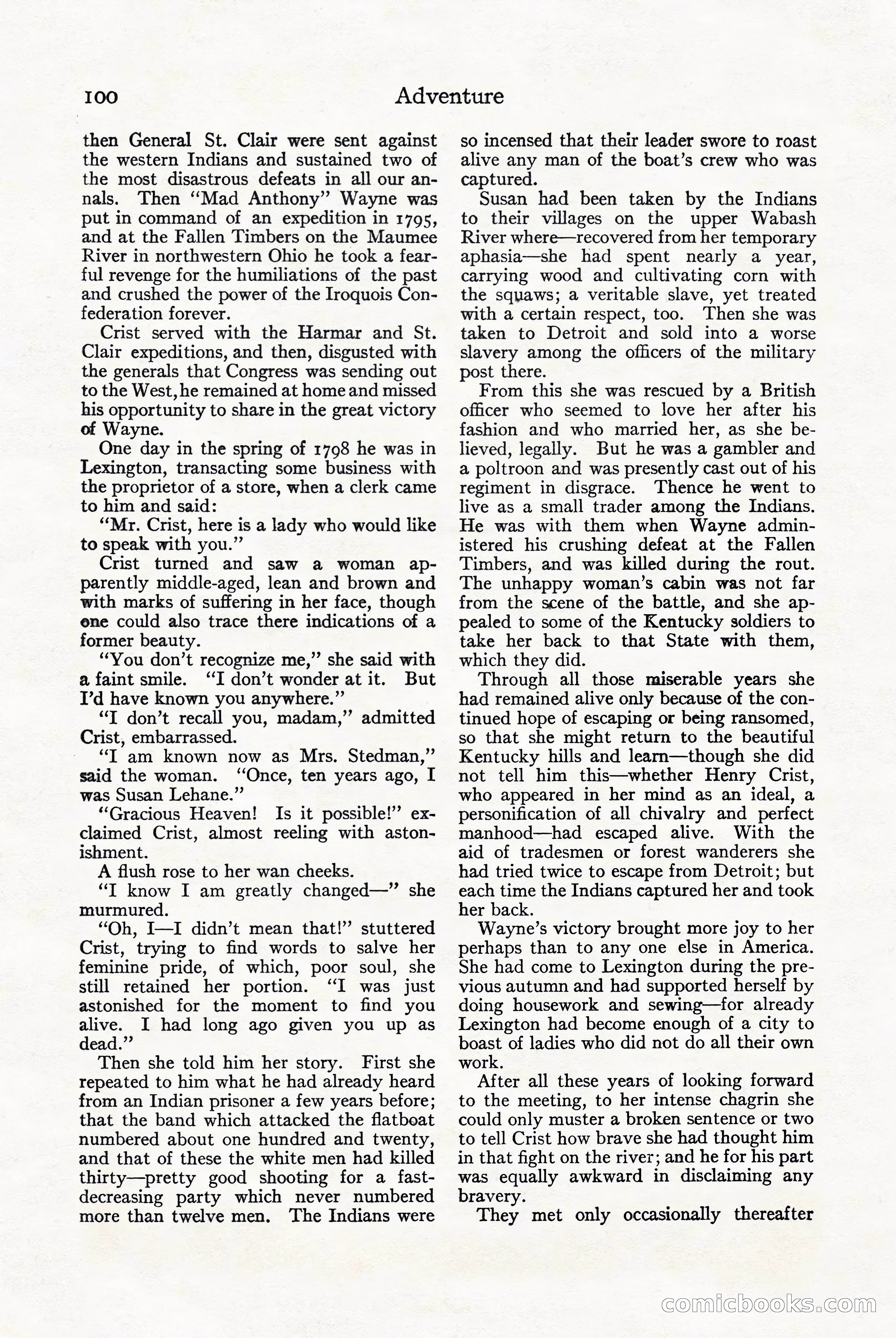
A restored page from Pulp Fiction, 1924. Page through the whole issue in the reader above.
📄 Transcribed text from this page (OCR, searchable)
Machine-transcribed from the original scan — historical spelling and the odd misread are preserved.
TOO then General St. Clair were sent against the western Indians and sustained two of the most disastrous defeats in all our an- nals, Then ‘Mad Anthony” Wayne was put in command of an expedition in 1795, and at the Fallen Timbers on the Maumee River in northwestern Ohio he took a fear- ful revenge for the humiliations of the past and crushed the power of the Iroquois Con- federation forever. Crist served with the Harmar and St. Clair expeditions, and then, disgusted with the generals that Congress was sending out to the West, he remained at home and missed his opportunity to share in the great victory of Wayne. One day in the spring of 1798 he was in Lexington, transacting some business with the proprietor of a store, when a clerk came to him and said: “Mr. Crist, here is a lady who would like to speak with you.” Crist turned and saw a woman ap- parently middle-aged, lean and brown and with marks of suffering in her face, though ene could also trace there indications of a former beauty. “You don’t recognize me,’”’ she said with a faint smile. ‘I don’t wonder at it. But I’d have known you anywhere.” “T don’t recall you, madam,” admitted Crist, embarrassed. “T am known now as Mrs. Stedman,” said the woman. “Once, ten years ago, I was Susan Lehane.” ‘“‘Gracious Heaven! Is it possible!’ ex- claimed Crist, almost reeling with aston- ishment. A flush rose to her wan cheeks. “IT know I am greatly changed—” she murmured. “Oh, I—I didn’t mean that!” stuttered Crist, trying to find words to salve her feminine pride, of which, poor soul, she still retained her portion. “I was just astonished for the moment to find you alive. I had long ago given you up as dead.”’ Then she told him her story. First she repeated to him what he had already heard from an Indian prisoner a few years before; that the band which attacked the flatboat numbered about one hundred and twenty, and that of these the white men had killed thirty—pretty good shooting for a fast- decreasing party which never numbered more than twelve men. The Indians were 1? Adventure so incensed that their leader swore to roast alive any man of the boat’s crew who was captured. Susan had been taken by the Indians to their villages on the upper Wabash River where—recovered from her temporary aphasia—she had spent nearly a year, carrying wood and cultivating corn with the squaws; a veritable slave, yet treated with a certain respect, too. Then she was taken to Detroit and sold into a worse slavery among the officers of the military post there. From this she was rescued by a British officer who seemed to love her after his fashion and who married her, as she be- lieved, legally. But he was a gambler and a poltroon and was presently cast out of his regiment in disgrace. Thence he went to live as a small trader among the Indians. He was with them when Wayne admin- istered his crushing defeat at the Fallen Timbers, and was killed during the rout. The unhappy woman’s cabin was not far from the scene of the battle, and she ap- pealed to some of the Kentucky soldiers to take her back to that State with them, which they did. Through all those miserable years she had remained alive only because of the con- tinued hope of escaping or being ransomed, so that she might return to the beautiful Kentucky hills and learn—though she did not tell him this—whether Henry Crist, who appeared in her mind as an ideal, a personification of all chivalry and perfect manhood—had escaped alive. With the aid of tradesmen or forest wanderers she had tried twice to escape from Detroit; but each time the Indians captured her and took her back. Wayne’s victory brought more joy to her perhaps than to any one else in America. She had come to Lexington during the pre- vious autumn and had supported herself by doing housework and sewing—for already Lexington had become enough of a city to boast of ladies who did not do all their own work. After all these years of looking forward to the meeting, to her intense chagrin she could only muster a broken sentence or two to tell Crist how brave she had thought him in that fight on the river; and he for his part was equally awkward in disclaiming any bravery. They met only occasionally thereafter CO DOOLK C©