
Pulp Fiction, 1924 · page 63 of 204
Adventure Magazine Cover — page 63: what you’re looking at
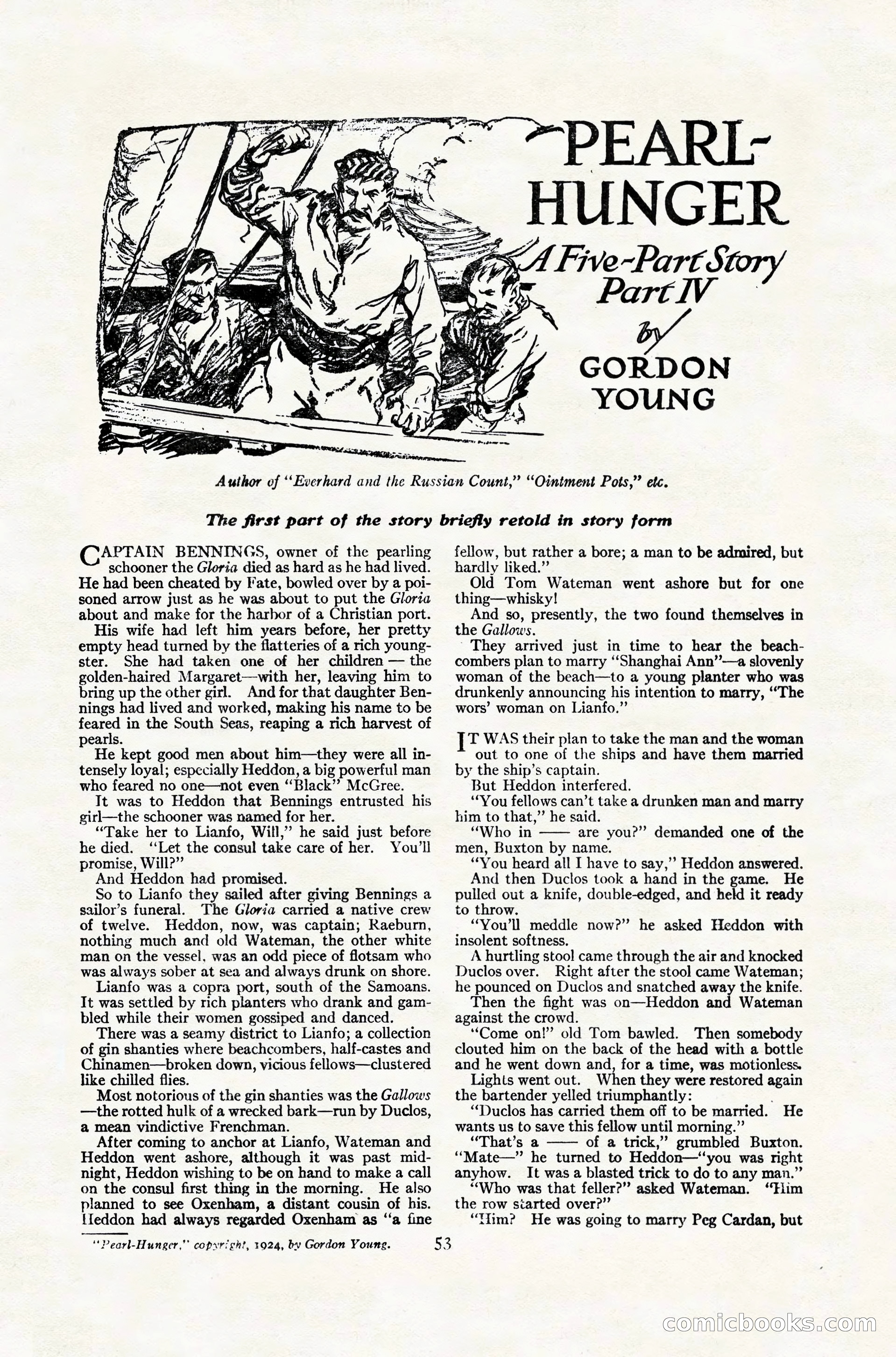
A restored page from Pulp Fiction, 1924. Page through the whole issue in the reader above.
📄 Transcribed text from this page (OCR, searchable)
Machine-transcribed from the original scan — historical spelling and the odd misread are preserved.
t v nsf ey Lay ~E mn Z aap ogee €. HUNGER y*— fil Five-Part Story Toa ian cm, del PartlV GORDON YOUNG Author of ‘Everhard and the Russian Count,” “Ointment Pots,’ etc. The first part of the story briefly retold in story form APTAIN BENNINGS, owner of the pearling schooner the Gloria died as hard as he had lived. He had been cheated by Fate, bowled over by a poi- soned arrow just as he was about to put the Glorza about and make for the harbor of a Christian port. His wife had left him years before, her pretty empty head turned by the flatteries of a rich young- ster. She had taken one of her children — the golden-haired Margaret—with her, leaving him to bring up the other girl. And for that daughter Ben- nings had lived and worked, making his name to be feared in the South Seas, reaping a rich harvest of pearls. He kept good men about him—they were all in- tensely loyal; especially Heddon, a big powerful man who feared no one—not even ‘“‘Black”’ McGree. It was to Heddon that Bennings entrusted his girl—the schooner was named for her. “Take her to Lianfo, Will,’ he said just before he died. ‘‘Let the consul take care of her. You'll promise, Will?” And Heddon had promised. So to Lianfo they sailed after giving Bennings a sailor’s funeral. The Gloria carried a native crew of twelve. Heddon, now, was captain; Raeburn, nothing much and old Wateman, the other white man on the vessel, was an odd piece of flotsam who was always sober at sea and always drunk on shore. Lianfo was a copra port, south of the Samoans. It was settled by rich planters who drank and gam- bled while their women gossiped and danced. There was a seamy district to Lianfo; a collection of gin shanties where beachcombers, half-castes and Chinamen—broken down, vicious fellows—clustered like chilled flies. Most notorious of the gin shanties was the Gallows —the rotted hulk of a wrecked bark—run by Duclos, a mean vindictive Frenchman. After coming to anchor at Lianfo, Wateman and Heddon went ashore, although it was past mid- night, Heddon wishing to be on hand to make a call on the consul first thing in the morning. He also planned to see Oxenham, a distant cousin of his. tfeddon had always regarded Oxenham as “‘a fine “Pearl-Hunger,” copxrigh!, 1924, bv Gordon Young. 53 fellow, but rather a bore; a man to be admired, but hardly liked.” Old Tom Wateman went ashore but for one thing—whisky! And so, presently, the two found themselves in the Gallows. They arrived just in time to hear the beach- combers plan to marry ‘“‘Shanghai Ann’’—a slovenly woman of the beach—to a young planter who was drunkenly announcing his intention to marry, ‘The wors’ woman on Lianfo.”’ {Tt WAS their plan to take the man and the woman out to one of the ships and have them married by the ship’s captain. But Heddon interfered. “You fellows can’t take a drunken man and marry him to that,’’ he said. “Who in are you?” demanded one of the men, Buxton by name. “You heard all I have to say,” Heddon answered. And then Duclos took a hand in the game. He pulled out a knife, double-edged, and held it ready to throw. “‘You’ll meddle now?” he asked Heddon with insolent softness. A hurtling stool came through the air and knocked Duclos over. Right after the stool came Wateman; he pounced on Duclos and snatched away the knife. Then the fight was on—Heddon and Wateman against the crowd. ‘‘Come on!’ old Tom bawled. Then somebody clouted him on the back of the head with a bottle and he went down and, for a time, was motionless. Lights went out. When they were restored again the bartender yelled triumphantly: “Duclos has carried them off to be married. He wants us to save this fellow until morning.”’ “That’s a of a trick,” grumbled Buxton. ““Mate—”’ he turned to Heddon—“‘you was right anyhow. It was a blasted trick to do to any man.” “‘Who was that feller?” asked Wateman. ‘“Tiim the row started over?” “Tiim? He was going to marry Peg Cardan, but 1OOOLK C©